


Brass Desktop Globe
A brass desktop globe brings the geography of earlier centuries directly onto a desk or table, combining cartographic detail with tactile metalwork.
Brass Desktop Globe
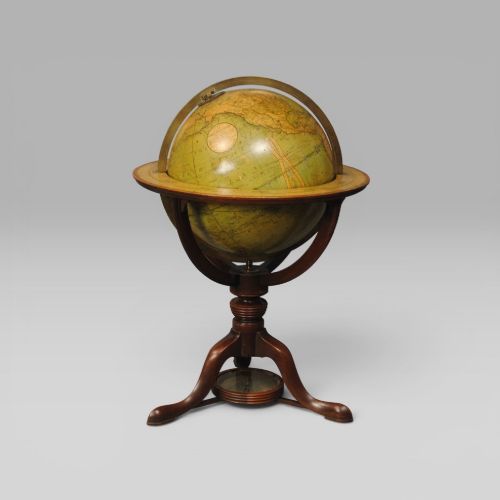
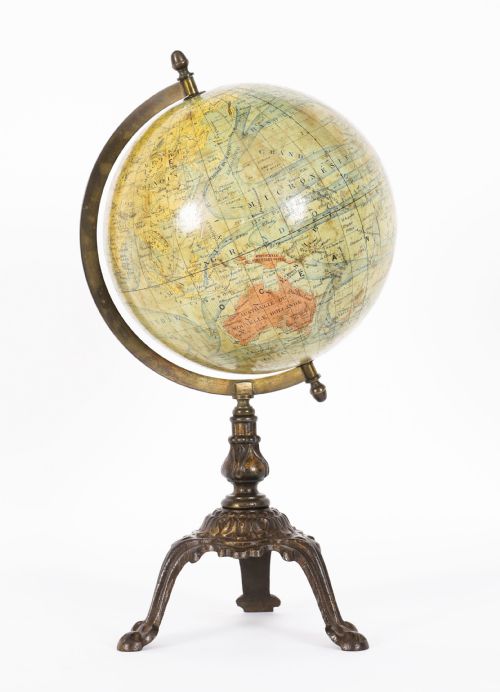
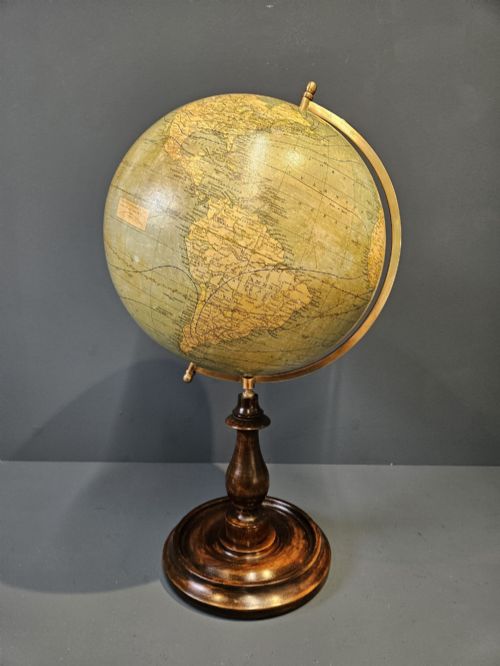
A brass desktop globe represents a compact cartographic instrument designed for study or display, often mounted upon a stand of mahogany, walnut, or ebonised wood. These pieces incorporate terrestrial spheres covered in printed gores of paper, supported by metal meridians and bases.
The versions most commonly met on this page span the nineteenth century and the early twentieth century, originating from British, French, and German makers. They range in scale from diminutive miniature models to twelve-inch table globes featuring detailed cartography of the period.
Materials and construction
The construction of these items relies on spheres formed from plaster or paper mache, which receive applied paper gores printed with geographical maps. These globes are then mounted within brass half-meridians and set upon turned wooden stands made from mahogany, walnut, or ebonised timber.
Metal components such as cast iron and brass provide structural support and rotation mechanisms, whilst the printed paper surfaces are occasionally hand-coloured to delineate national boundaries and shipping routes.
Listings feature items from the nineteenth century and the 1930s, constructed from brass, paper, mahogany, and cast iron.
Distinctions in quality
The refinement of the cartography and the legibility of the printed gores separate simpler examples from superior productions. Finely engraved maps by recognised geographic firms offer greater historical detail and precise territorial boundaries.
The materials of the base and mounting hardware also indicate standard versus higher-grade pieces, with heavy cast brass meridians and carefully turned hardwood stands demonstrating superior craftsmanship compared to simpler metal and wood combinations.
Cary London·Lebegue and Cie·Parkes and Hadley·Bacon·Geographia·J Forest·Malby·M Vivien
The Brass Desktop Globe Glossary
- Gores
- The printed paper segments shaped like gores that are applied to the spherical core of a globe to form the map. Accurate alignment of these sections is essential for correct geographical representation.
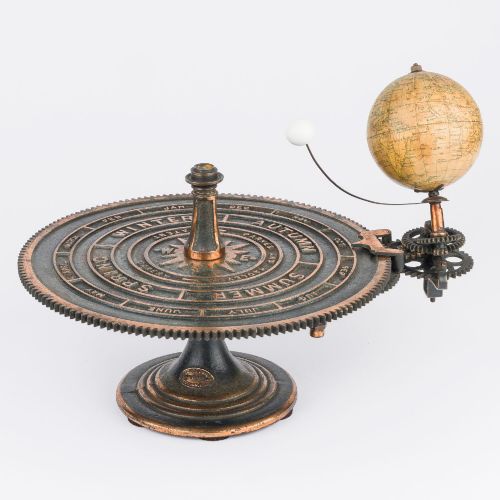
- Orrery
- A mechanical model of the solar system showing the relative positions and motions of planets and moons. These scientific instruments sometimes incorporate brass work and gear mechanisms.
- Terrestrial globe
- A spherical map representing the earth rather than the celestial sphere. These objects display continents, oceans, and historical political borders.
Brass Desktop Globe: Frequently Asked Questions
How are desktop globes dated?
Dating relies heavily on the political boundaries, country names, and shipping routes printed on the map gores. Cartographers frequently updated these details as territories changed.
Additional clues come from the style of the wooden stand, the typography used for place names, and any manufacturer signatures printed directly onto the paper sphere.
Where were these globes placed?
These instruments were designed for libraries, studies, and offices of the nineteenth and early twentieth centuries. They provided accessible geographical reference for scholars, merchants, and households.
Their compact sizes allowed them to sit conveniently upon writing desks, library tables, and mantelpieces for regular consultation.
How do I clean a paper globe?
Maintenance requires extreme care because the surface consists of fragile printed paper applied over plaster or papier-mache. Dust should be removed very gently using a soft, dry brush.
Water and liquid cleaners must be avoided entirely, as moisture will stain the paper, soften the underlying core, and dissolve the historic adhesives.
What is the difference between a table globe and a pocket globe?
Table globes are built with dedicated stands made of wood or metal, allowing them to remain stationary on a flat surface for frequent viewing. They generally measure several inches or more across.
Pocket globes are much smaller miniature versions, often housed inside protective hollow cases lined with celestial maps, intended to be carried easily.