




Brass Desk Barometer
These brass desk barometers are sturdy meteorological instruments housed in polished metal and rich timbers, offering a practical touch of historical science for the study or library.
Brass Desk Barometer
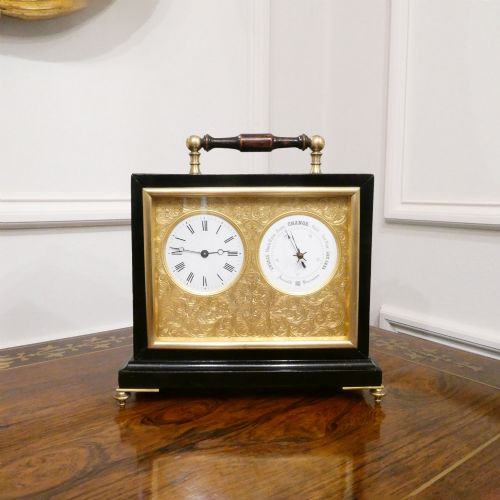
A brass desk barometer sits upon a table or shelf to measure atmospheric pressure, often appearing alongside thermometers and clocks in desk compendiums. When you search for a brass desk barometer, you encounter pieces spanning from the Victorian era through the Edwardian period.
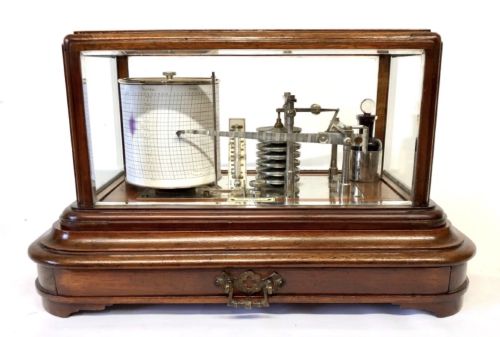
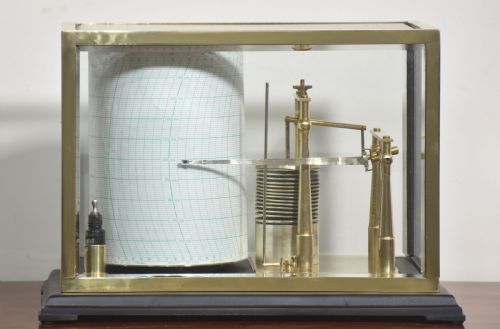
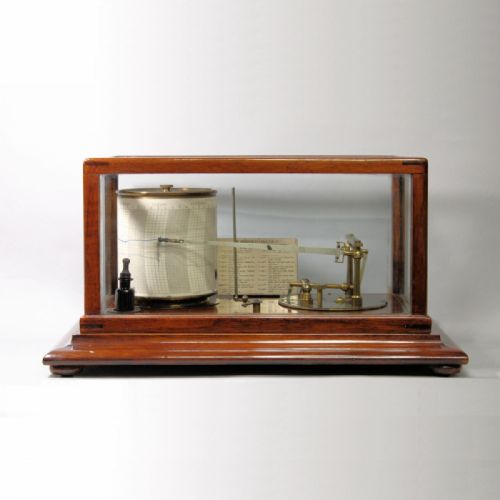
The selections on this page include heavy marine-style instruments, architectural oak and mahogany cases, and mechanical barographs that record weather patterns onto paper charts over time. Most examples date from the late nineteenth century up to the nineteen-twenties.
Form follows function closely in these weather instruments, with brass dials, silvered scales, and bevelled glass bezels protecting the delicate internal linkages. Makers housed these mechanisms in everything from simple ebonised stands to elaborate Chinoiserie and Art Nouveau wooden cases.
How they were made
Instrument makers utilised heavy brass for bezels, cases, and internal aneroid movements, pairing the metal with seasoned hardwoods like mahogany and oak. Enamel and silvered bronze provided durable, legible surfaces for the engraved weather scales and dials.
Cabinetmakers constructed five-glass cases and architectural frames to house the recording drums and levers of barographs, utilising glass windows to display the mechanical precision within. Selected pieces incorporated inlaid woods and ebonised details to suit contemporary interior tastes.
Miniature barographs allowed Victorian travellers to track atmospheric pressure fluctuations whilst riding the rails across Europe.
What varies in quality
The standard of a desk barometer rests on the crispness of the engraved scale and the weight of the cast brass housing. Superior instruments maintain responsive internal mechanisms and clear, bevelled glass without distortion.
Cabinet work distinguishes finer examples, where polished mahogany, walnut, or carved oak frames join seamlessly to protect the delicate scientific apparatus inside. Signed dials from established opticians and instrument makers indicate a higher tier of production.
GAUPP & CO HONGKONG & SINGAPORE·Short & Mason·R Fuess·Robson of Newcastle·Negretti & Zambra·Pillischer London·Richard Freres·Imhof
The Brass Desk Barometer Glossary
- Aneroid barometer
- An instrument that measures air pressure using an expanding and contracting metal capsule rather than liquid mercury. It forms the mechanical heart of most desk weather instruments.
- Barograph
- A self-recording barometer that traces atmospheric pressure onto a rotating drum fitted with a paper chart. These often sit within wooden cases glazed on multiple sides.
- Bevelled glass
- Thick glass pane with angled edges fitted into the brass bezel of a barometer face. This technique added strength and a decorative edge to the instrument aperture.
- Silvered dial
- A brass dial treated with a silver compound to create a matte, reflective surface for black engraved numerals. It provides high legibility for reading shifting weather indicators.
- Desk compendium
- A multi-instrument desk set containing a barometer alongside a clock, thermometer, or compass. These heavy pieces consolidated desk accessories for the Victorian study.
Brass Desk Barometer: Frequently Asked Questions
How do I read a desk barometer?
Observe the position of the pointer relative to the engraved weather words like 'Fair', 'Change', and 'Rain'. Tapping the glass gently helps settle the needle to show the actual current pressure.
Rising pressure generally indicates improving weather, while falling pressure suggests approaching storms. Compare readings over several hours to track local meteorological trends.
What is the difference between a barometer and a barograph?
A standard barometer shows only the air pressure at the exact moment you look at it. It uses a single pointer moving across a marked dial.
By contrast, a barograph records continuous pressure changes onto a rotating paper chart driven by a clockwork mechanism. This creates a permanent visual graph of the weather over a week.
How do I care for an antique brass desk barometer?
Place the instrument away from direct sunlight, radiators, and damp areas to protect the wooden case and internal brass components. Sudden temperature shifts can affect the delicate metal aneroid capsule.
Dust the glass and wooden surfaces with a dry, soft cloth. Avoid using harsh chemical polishes on the brass case to preserve the original patina.
Can antique barometers still be calibrated?
Many surviving desk barometers can be adjusted to match current local barometric pressure using a small screw located on the back or base of the movement. Turning this screw aligns the indicator needle with a known reference reading.
If the internal linkages have settled or stuck over the decades, a specialist horologist or instrument restorer can service the mechanical parts safely.