
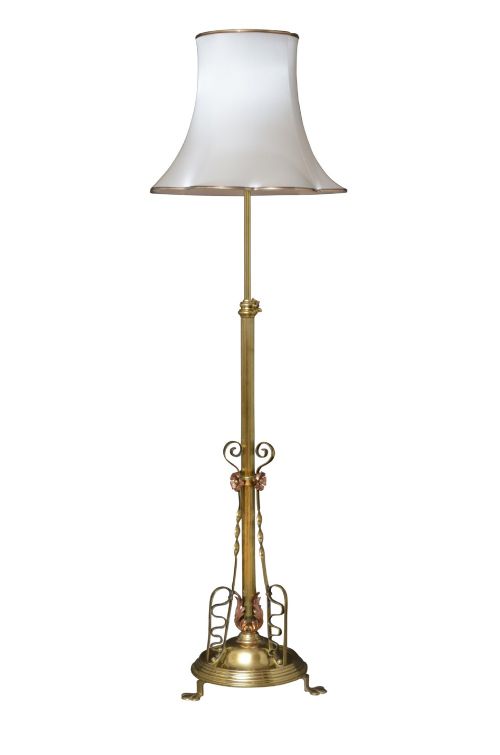


Brass Copper Standard Lamp
These brass copper standard lamp pieces bring warmth and height to a room, offering period character alongside practical floor lighting.
Brass Copper Standard Lamp
A brass copper standard lamp combines two principal metals to create tall floor lighting for living spaces. You will encounter these pieces spanning the Victorian, Edwardian, and Art Nouveau periods, as well as the Arts and Crafts movement.
The inventory on this page ranges from simple nineteenth-century floor columns to elaborate telescopic and height-adjustable designs. Many examples originate from the late nineteenth century and the early decades of the twentieth century.
Standard lamps and floor lamps appear frequently, sometimes retaining their original oil-burning fittings or converted for electrical use. The combination of bright brass and warm copper defines the visual character of these particular items.
How they were made
Maker workshops utilised sheet copper and cast or spun brass to build these tall standards. Metal components were joined through riveting, soldering, and threaded connections to support the weight of the shaft and any attached oil reservoirs.
Adjustable mechanisms relied on sliding telescopic brass tubes secured by thumbscrews or keys. Arts and Crafts examples often display hand-beaten copper textures, showing the direct hammer marks of the metalworker.
Materials recorded in the archive include brass, copper, fabric, and cranberry glass across standard lamp and floor lamp forms.
What varies in quality
Quality rests in the weight of the metal base and the precision of the adjustable mechanism. Heavier cast bases provide stability for tall standards, while lighter constructions can feel top-heavy.
The finesse of the metalwork distinguishes standard production from finer workshop pieces. Clean joints, well-finished spun brass elements, and crisp hand-beaten copper details separate the superior examples.
W A S Benson
The Brass Copper Standard Lamp Glossary
- Telescopic
- An extendable shaft design allowing the overall height of the lamp to be adjusted. This mechanism often uses inner and outer metal tubes secured with a thumbscrew.
- Arts and Crafts
- A design movement favouring visible hand-craftsmanship and honest materials. Pieces from this tradition often feature beaten copper surfaces and straightforward structural forms.
- Art Nouveau
- A style characterised by flowing, organic lines and plant-like motifs. Lamps from this period incorporate sinuous metalwork and decorative botanical flourishes.
- Standard lamp
- A traditional British term for a tall floor-standing lamp. These pieces are designed to stand beside furniture and cast light downward from a raised position.
- Cranberry glass
- A rich pinkish-red glass created by adding gold chloride to the molten mixture. It frequently appears in the oil fonts associated with nineteenth-century lighting.
Brass Copper Standard Lamp: Frequently Asked Questions
What is a standard lamp?
A standard lamp is a tall floor-standing lighting fixture designed to illuminate a room from a vertical post. These pieces typically stand beside armchairs or sofas.
They emerged in various period styles, using weighted bases to maintain stability while holding a lamp fitting or oil reservoir at height.
How do adjustable lamps work?
Adjustable standard lamps use telescopic metal tubes that slide vertically to alter the height of the fixture. A thumbscrew or collar tightens the inner tube at the desired position.
This mechanism allowed nineteenth-century users to raise or lower the light source depending on where they sat in the room.
Were these lamps used for oil?
Many nineteenth-century and early twentieth-century examples began life as oil lamps before later conversion to electricity. They frequently incorporate brass burners and glass reservoirs alongside the metal standard.
Today, surviving oil lamp fittings remain visible on many pieces even when wired for modern bulbs.
How do I identify an Arts and Crafts lamp?
Arts and Crafts lamps display honest construction, simple structural lines, and visible hand-working in the metal. You will often see beaten copper surfaces and functional joints rather than cast ornamentation.
These pieces reflect a philosophy that valued the labour of the artisan over machine production.