







Brass Church Lamps
These brass church lamps bring a solemn, historic weight and warm metallic gleam into a room.
Brass Church Lamps
Brass church lamps encompass a range of ecclesiastical lighting and altar fittings, spanning table lamps, chandeliers, oil lamps, and candlestands. When you search for brass church lamps, you find pieces adapted from liturgical use or created in ecclesiastical styles for domestic and chapel settings.
The pieces listed on this page lean heavily towards the nineteenth century and Victorian eras, alongside early twentieth-century examples. You will frequently encounter Gothic Revival designs, French ecclesiastical styles, and converted altar sticks fitted for modern illumination.
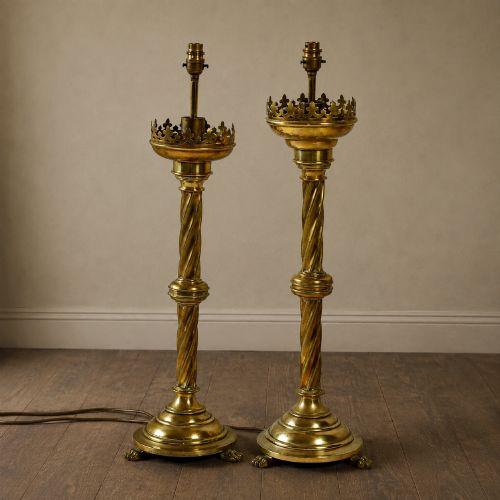
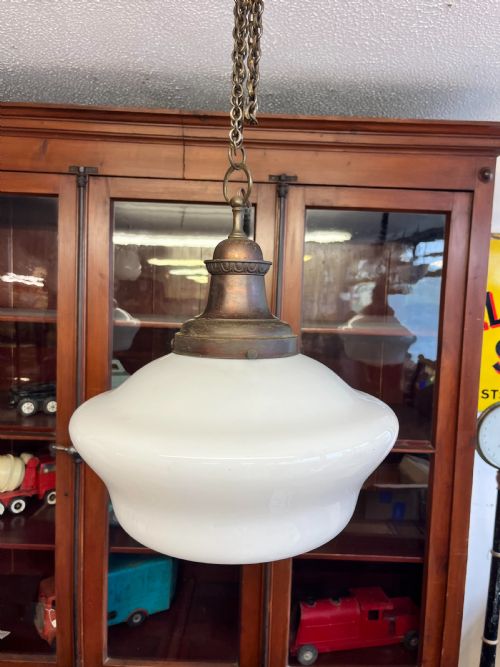
Common forms include paired altar candlesticks converted into table lamps, multi-branched chandeliers, and chapel ceiling lights incorporating opaline glass. These items bridge historical devotion and functional interior lighting, offering robust metalwork and traditional craftsmanship.
How they were made
Makers utilised heavy brass and gilded bronze to cast structural elements, incorporating iron for internal support or durability in larger chandeliers. These metals were shaped into multi-branch candelabras, altar sticks, and hanging fixtures using traditional foundry techniques.
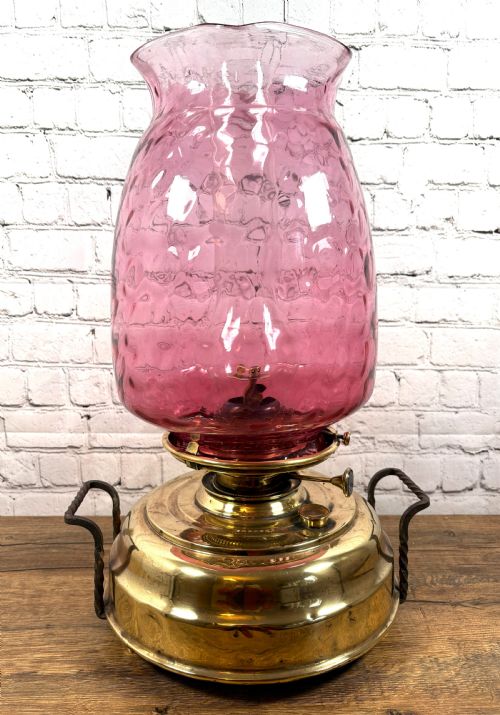
Glass components appear across the inventory in the form of opaline shades and oil lamp reservoirs, occasionally paired with delicate glass beads or damask fabric elements. The combination of polished or gilded brass with textured glass defined the aesthetic of nineteenth-century ecclesiastical metalwork.
Brass Church Lamps Retail Price Guide 2026
Typical asking prices for brass church lamps among the pieces listed under this phrase on Sellingantiques today, from the lower quarter to the upper quarter. They describe what is for sale here now, not the wider market.
Some altar sticks spent decades holding candles in quiet chapels before trading incense for electricity and a spot on a Victorian sideboard.
What varies in quality
The refinement of the casting and chasing separates standard production from finer examples, particularly in the crispness of Gothic Revival ornamentation. Superior pieces exhibit deeply articulated mouldings, well-balanced proportions, and careful hand-finishing on multi-branch chandeliers and altar sticks.
The integrity of the conversion work and the preservation of original gilding or patination dictate the desirability of these lamps. Original components such as matching opaline glass or intact gilded bronze surfaces elevate the character of nineteenth-century French and English pieces.
The Brass Church Lamps Glossary
- Gothic Revival
- A nineteenth-century design movement drawing inspiration from medieval ecclesiastical architecture. It manifests in pointed arches, trefoils, and heavy vertical lines on altar lamps and candlestands.
- Opaline Glass
- A milky, translucent glass frequently utilised for Victorian and early twentieth-century lamp shades. It diffuses light softly and often appears in chapel and oil lamp configurations.
- Altar Stick
- A heavy candlestick designed for placement on a church altar. Many examples are later converted into table lamps for domestic interiors.
- Candelabra
- A branched lighting fixture holding multiple candles or electrical fittings. Nineteenth-century ecclesiastical versions often feature five or seven branches in cast brass or gilded bronze.
- Gilded Bronze
- A metal alloy coated with a thin layer of gold, providing a rich surface finish. It appears on French ecclesiastical pieces to enhance decorative detail.
Brass Church Lamps: Frequently Asked Questions
What periods do these lamps come from?
The pieces listed predominantly originate from the nineteenth century, including Victorian interpretations and Gothic Revival designs. You will also find early twentieth-century items dating around nineteen-twenty.
These dates reflect the eras when ecclesiastical metalwork flourished, producing heavy brass altar pieces and chapel lighting that later found a place in homes.
Were all of these originally electrical lamps?
Most items started life as oil lamps, altar candlesticks, or gas fixtures used within churches and chapels. They were subsequently adapted for electrical use to serve as table lamps or chandeliers.
This conversion process allows historical ecclesiastical metalwork to function safely in modern domestic spaces while retaining its original aesthetic.
How do I identify a Gothic Revival piece?
Gothic Revival items display architectural motifs borrowed from medieval churches, such as pointed arches, trefoils, and heavy structural bases. They often feature robust brass casting with ecclesiastical detailing.
These design cues separate period church fittings from later, simpler domestic reproductions.
What materials are commonly used?
Brass forms the primary material for the bodies, stands, and branch structures of these lamps. Gilded bronze, iron, opaline glass, and occasional fabric elements also appear across the inventory.
These durable materials ensured the original church fittings withstood heavy daily use and centuries of handling.
Can I find matched pairs?
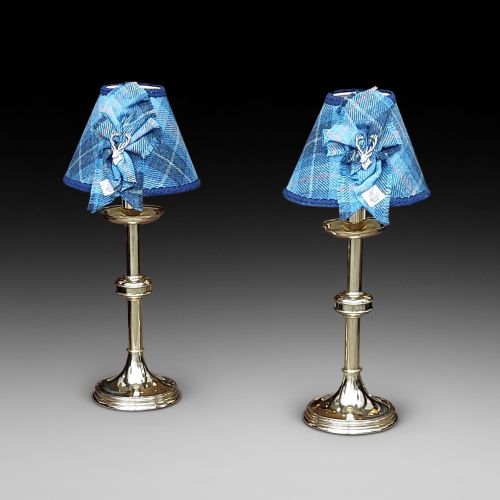
Several listings comprise matched pairs of altar candlesticks and table lamps. These are typically nineteenth-century Gothic Revival pieces designed for balanced placement on either side of an altar.
Matched pairs offer symmetry when used on sideboards or mantelpieces in a domestic setting.