





Brass Church Altar Sticks
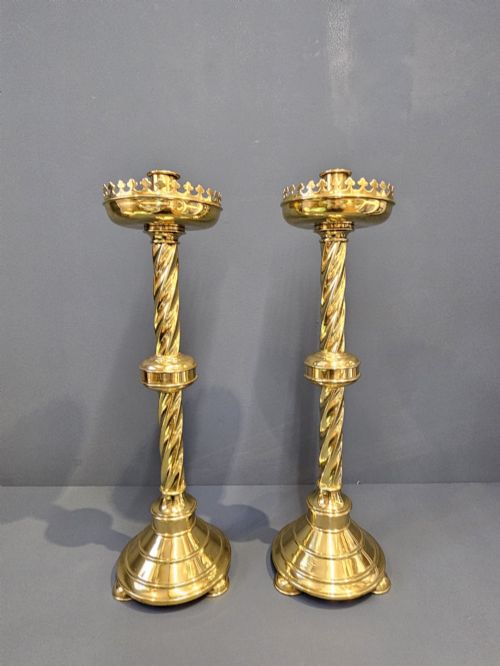
Brass church altar sticks are striking metal liturgical candleholders that bring height and architectural presence to a room.
Brass Church Altar Sticks
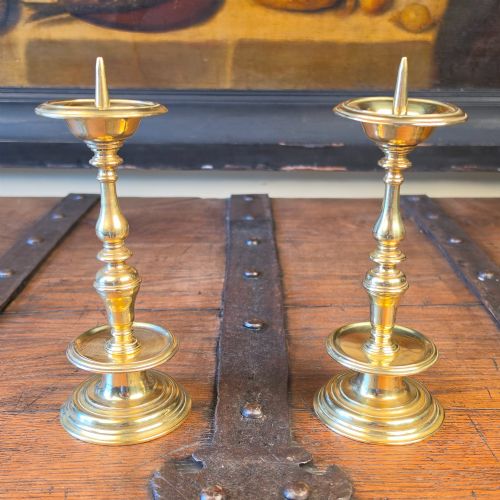
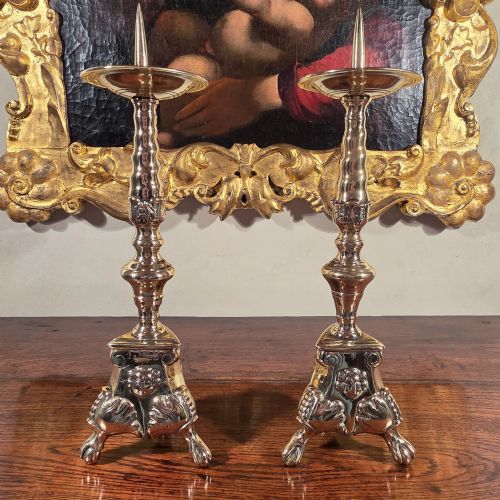
Brass church altar sticks are tall ecclesiastical candlesticks designed to stand on altars or tables, appearing here in pairs spanning from the seventeenth century to the twentieth century. These pieces encompass sturdy brass and bronze forms, often taking the shape of pricket candlesticks with spikes or standard socket holders. Buyers will most frequently encounter nineteenth-century Gothic Revival and Victorian interpretations across these listings.
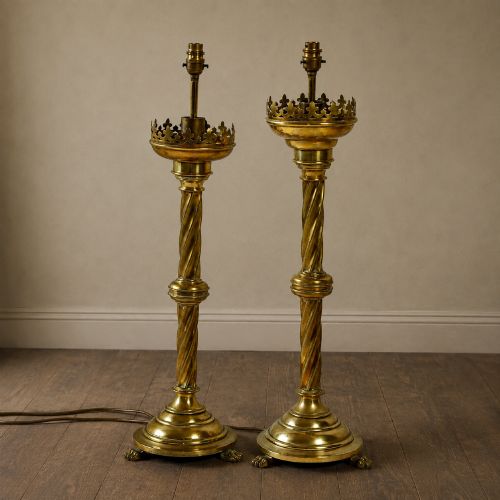
The assortment includes tall antique candlesticks, table lamps converted from altar sticks, and heavy seventeenth-century style designs. Originating from diverse eras including the eighteenth century and the 1830s to 1930s spectrum, they provide vertical drama and historical depth. Most items survive as matched pairs, making them practical for flanking a fireplace or sideboard.
How they were made
These items rely heavily on cast brass and bronze construction, employing traditional foundry methods to achieve substantial weight and complex profiles. Metal components are cast in sections before being turned on lathes or joined together to form soaring stems and wide drip pans. Some examples incorporate decorative elements such as glass beads and damask fabric components.
Surface finishes vary from polished metal to aged patinas developed over centuries of handling and use in ecclesiastical settings. Details like Gothic style tracery and Baroque moulding are worked directly into the metal during casting or added through subsequent chasing and engraving.
Brass Church Altar Sticks Retail Price Guide 2026
Typical asking prices for brass church altar sticks among the pieces listed under this phrase on Sellingantiques today, from the lower quarter to the upper quarter. They describe what is for sale here now, not the wider market.
Some tall ecclesiastical sticks have lived past their church days by swapping holy candles for modern bulbs as converted table lamps.
What varies in quality
Quality in these pieces rests upon the crispness of the cast details and the overall architectural proportion of the stem and base. Superior examples exhibit heavy gauge metal with deeply defined Gothic or Baroque ornamentation rather than shallow, mass-produced stamping.
The integrity of the construction, including straight vertical alignment and original components without excessive later alterations, separates fine examples from ordinary ones. A well-balanced pair with an undisturbed, natural metal surface commands greater interest among collectors.
T Thomason And Co
The Brass Church Altar Sticks Glossary
- Pricket candlestick
- A candlestick featuring an upward-pointing metal spike designed to impale the base of a wax candle rather than a socket to hold it.
- Gothic Revival
- An architectural and decorative style popular during the nineteenth century that revives medieval forms, pointed arches, and ecclesiastical motifs.
- Baroque
- A flamboyant and ornate European style spanning the seventeenth and eighteenth centuries, characterised by exuberant curves, heavy moulding, and dramatic volume.
- Flemish Baroque
- A regional decorative style originating in Flanders during the seventeenth century, known for robust proportions and elaborate surface detailing.
Brass Church Altar Sticks: Frequently Asked Questions
Are brass church altar sticks safe for modern candles?
Most antique socket candlesticks accommodate standard modern taper candles safely, though pricket versions require candles with a suitable base hole to sit firmly upon the spike. Buyers should measure the diameter of the socket or check the pricket length before selecting candles.
For electrified table lamp conversions, wiring should be inspected by a qualified professional to ensure compliance with current safety standards before regular domestic use.
How do I clean antique brass altar sticks?
These pieces are best maintained with a soft, dry cloth to remove surface dust without disturbing the aged patina that accumulates over generations. Aggressive metal polishes strip away historical depth and can damage softer cast details.
If cleaning is necessary, use a mild, non-abrasive soap solution and dry thoroughly immediately afterwards to prevent spotting or corrosion on the metal surface.
How can I tell a seventeenth-century pair from a nineteenth-century copy?
Seventeenth-century originals, such as Flemish pricket sticks, display distinct casting irregularities, hand-finished surfaces, and heavier construction methods characteristic of early metalworking shops. Nineteenth-century Gothic Revival pieces often feature more uniform machine tooling and precise historical revival ornament.
Examining the underside, base construction, and wear patterns helps establish the true age of the metalwork.
Where should I place tall altar sticks in a home?
Their significant height makes these candlesticks ideal for floor placement beside a hearth, on large dining sideboards, or anchoring the ends of a long console table. Paired arrangements create symmetry and draw the eye upward in rooms with high ceilings.
Care should be taken to place them on stable, level surfaces away from heavy foot traffic due to their substantial weight and height.