
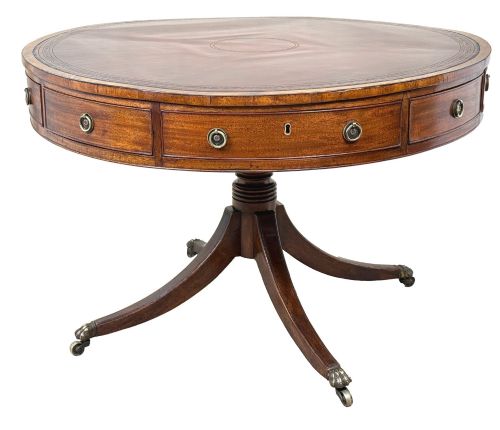
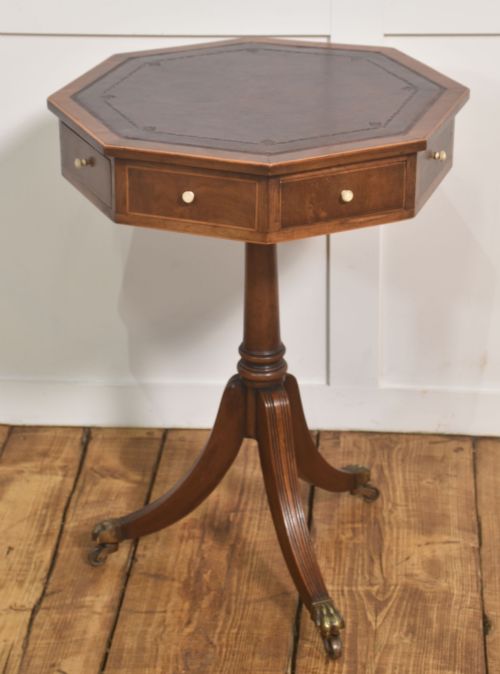


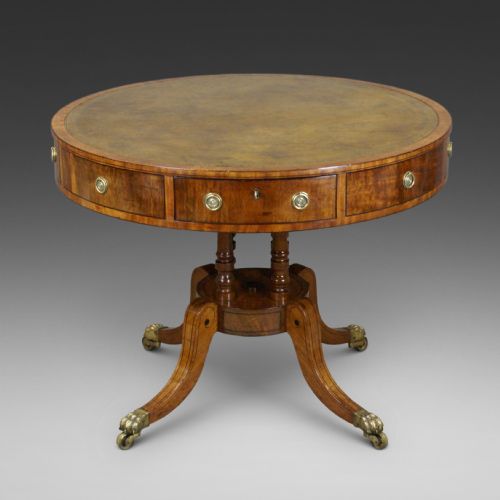


Brass Castor Drum Table
A brass castor drum table is a round centre table with drawers, built to turn and move easily on small brass wheels.
Brass Castor Drum Table
When you search for a brass castor drum table, you encounter circular library and occasional tables designed with revolving tops and multiple frieze drawers. The examples met on this page span the Georgian, Regency, and Edwardian eras, alongside later revival pieces.
Mahogany is the dominant timber across these items, often paired with rosewood or satinwood elements and fitted with leather writing surfaces. Most versions rest upon a central column supported by tripod legs finished with brass castors.
How they were made
Cabinet makers constructed the circular tops from solid mahogany or mahogany veneers, frequently incorporating crossbanding and boxwood inlay. Drawers were integrated into the deep frieze to provide storage while maintaining the smooth, round profile.
The turned central column descends to tripod legs, which terminate in brass capped castors that allowed the heavy table to rotate and roll across a room.
Listings span Georgian, Regency, and Edwardian periods, utilising mahogany, rosewood, satinwood, and leather.
What varies in quality
The standard of timber selection and inlay work marks the difference between standard production and superior craftsmanship, with figured mahogany and intricate crossbanding lifting a piece. Finer examples display precise turning on the central column and well-proportioned sabre legs.
The integration of the revolving mechanism and the quality of the original brass castors further distinguish better examples from simpler utilitarian tables.
The Brass Castor Drum Table Glossary
- Drum table
- A circular library table with a deep frieze containing alternating drawers and dummy drawers, resting on a central pillar.
- Crossbanding
- A strip of veneer laid around the border of a tabletop with the grain running perpendicular to the centre.
- Sabre leg
- A curved, outwardly splaying furniture leg that tapers towards the foot, common on Regency pieces.
- Frieze
- The broad horizontal band situated beneath the top of the table, used here to house drawers.
Brass Castor Drum Table: Frequently Asked Questions
What is a drum table used for?
These pieces served primarily as library tables or centre tables in formal rooms, providing a stable surface for writing and reading.
The built-in drawers allowed owners to store papers, stationery, and small volumes close at hand.
How do I date a drum table?
Dating relies on observing the timber choice, leg style, and construction methods characteristic of periods like the Georgian or Regency eras.
Revival pieces from the Edwardian period or nineteen-hundreds often mimic earlier Georgian and Regency designs with machine-cut precision.
Why do they have brass castors?
The small brass wheels were fitted to the feet to make the heavy timber tables easy to reposition on carpets and wooden floors.
This mobility was essential for shifting the furniture when tending to fires or altering room layouts.
Do drum tables revolve?
Many traditional examples feature a revolving top designed to let a seated person access any drawer without walking around.
This pivoting function defined the form during the Georgian and Regency periods.