

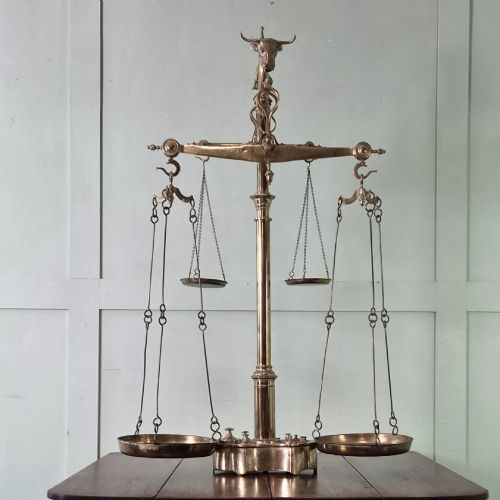
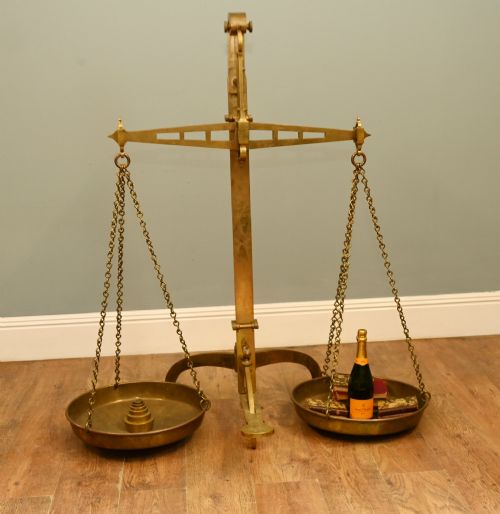
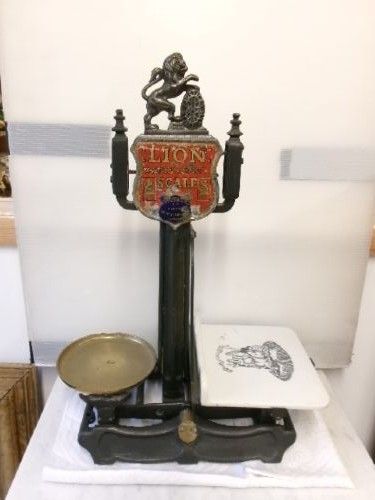
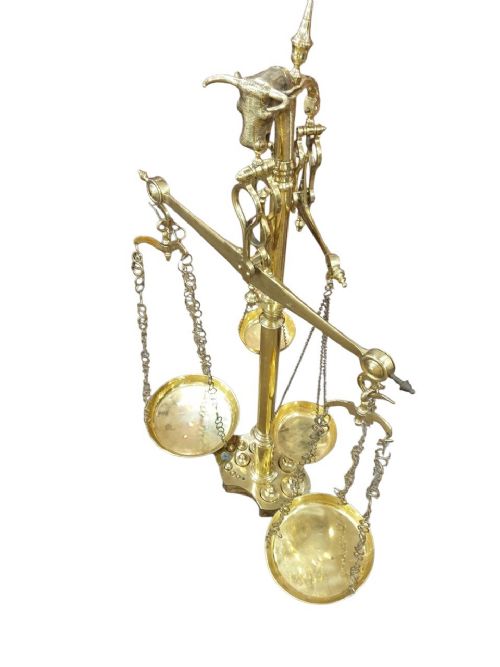
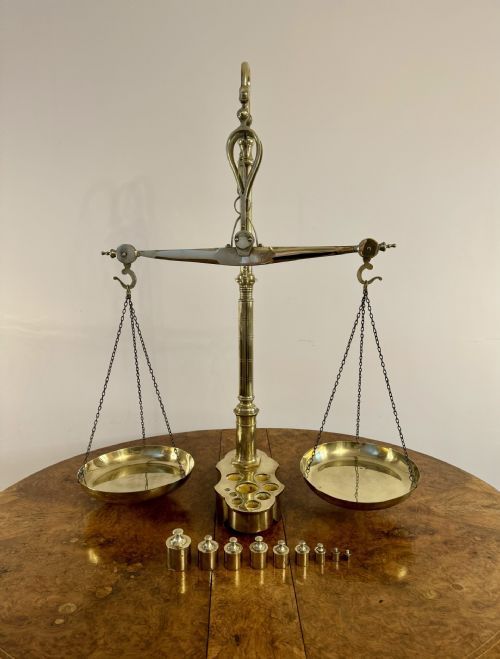


Brass Balance Shop Scales
These brass balance shop scales bring sturdy Victorian and Edwardian mercantile heritage straight onto a modern kitchen counter or into a grand hallway.
Brass Balance Shop Scales
Brass balance shop scales are utilitarian weighing devices designed for trade, featuring dual pans suspended from a central beam that pivots to determine exact weights. A buyer searching this phrase encounters robust instruments spanning the late nineteenth century through to the early twentieth century.
Most examples found here take the form of grocers scales, butchers scales, or heavy balance scales housed on timber or cast iron bases. These items served commercial hubs, cooperative stores, and local butchers before retiring from active trade into domestic decoration.
Victorian and Edwardian pieces dominate the selection, often bearing the marks of prominent makers from London, Birmingham, and Bristol. They combine functional cast iron or mahogany structures with gleaming brass pans and counterweights.
How they were made
Makers utilised cast iron for foundational stability and heavy bases, often moulding ornate details like lions or decorative scrollwork into the metal. Iron and mahogany provided durable framing capable of withstanding daily commercial use.
Brass formed the beams, pans, and delicate indicator components, polished to a bright finish that resisted the wear of daily handling. Glass and ceramic elements occasionally appeared on dials or platters, adding clean surfaces for food handling.
Makers inscribed or stamped their enterprise details directly into the metal beams or timber beds, ensuring lasting attribution. Heavy brass beams required precise balancing to guarantee accuracy across generations of trade.
Brass Balance Shop Scales Retail Price Guide 2026
Typical asking prices for brass balance shop scales among the pieces listed under this phrase on Sellingantiques today, from the lower quarter to the upper quarter. They describe what is for sale here now, not the wider market.
Listings feature brass, cast iron, iron, mahogany, ceramic, glass, and marble across Victorian and Edwardian periods.
What varies in quality
Quality rests in the proportional harmony of the brass beam and the crispness of the maker's stamp cast into the metal or struck into the wood. Finer examples retain their original matching weights and possess fluid, balanced movement across the pivot.
The choice of base materials marks a clear division, with heavy mahogany stands or detailed cast iron animal figures lifting a piece above standard utilitarian models. Untouched patination on the brass and honest wear on the timber indicate a well-preserved survivor.
WT Avery Birmingham·Herbert & Sons London·Parnall & Sons of Bristol·Palethorpes
The Brass Balance Shop Scales Glossary
- Beam
- The horizontal metal bar that pivots at its centre to support the weighing pans at either end. This component dictates the mechanical accuracy of the scale.
- Counterbalance
- A heavy mass used to offset the weight of the pan or to calibrate the scale before goods are added. It ensures precise measurement in commercial transactions.
- Cast iron
- A sturdy, heavy alloy poured into moulds to create rigid bases and decorative stands. It provides the necessary counterweight for large floor and counter scales.
- Patina
- The surface sheen and darkening acquired by brass and mahogany through decades of handling and polishing. Collectors prize an honest, undisturbed surface.
- Grocers scales
- Countertop weighing apparatus fitted with flat brass pans or scoops suited for loose produce. They represent a common domestic adaptation from nineteenth century shops.
Brass Balance Shop Scales: Frequently Asked Questions
How do brass balance shop scales work?
These scales operate on the principle of equilibrium, where an item placed on one pan is measured against standardised weights placed on the other. The central brass beam shifts until the pointer rests at the exact centre.
Historically, shopkeepers adjusted the sliding weights on the beam or added small fractional masses to achieve precise measurements for customers purchasing goods by weight.
Can I still use antique scales for cooking?
While many balance scales remain mechanically sound, most antique examples are collected today for display rather than certified kitchen use. Over the decades, pivots can wear and legal standards for commercial accuracy have shifted.
For home baking or decorative weighing, they function adequately, but they serve primarily as striking interior objects with a strong historical presence.
How do I clean brass scale pans?
Antique brass benefits from gentle dusting and occasional light cleaning with a non abrasive cloth to preserve the underlying metal. Avoid aggressive chemical polishes that strip away the historical darkening and character.
Leaving a mellow, aged tone on the brass pans maintains the authentic appearance of a nineteenth century mercantile instrument.
How do I identify a Victorian scale?
Victorian scales often feature robust cast iron bases, sometimes decorated with moulded motifs like lions, alongside hand-stamped maker marks from cities like London and Birmingham. The use of solid mahogany and heavy brass beams also points toward this era.
Examining the typography of the maker's name and the style of the cast iron base helps separate nineteenth century trade pieces from later twentieth century reproductions.