

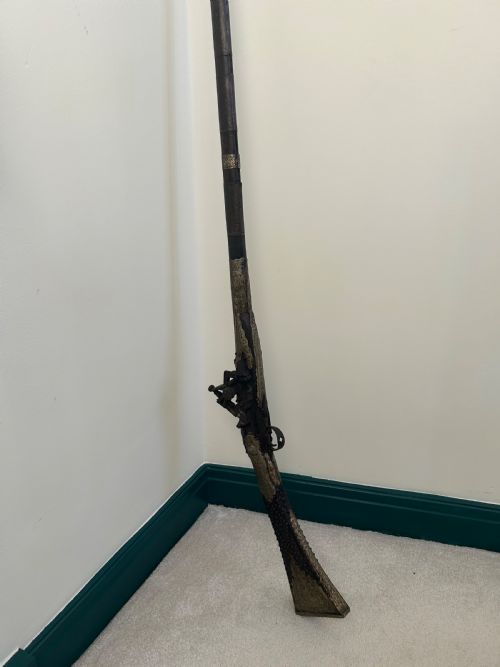


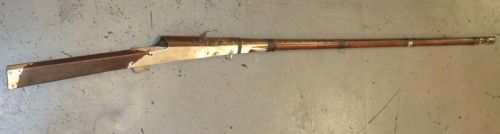

Brass and Wood Gun
A brass and wood gun brings tactile history to your collection, combining functional engineering with decorative craftsmanship from past centuries.
Brass and Wood Gun
A brass and wood gun encompasses antique firearms and militaria spanning from the seventeenth century through to the Victorian era. You will encounter various global forms here, including flintlock muskets, matchlock guns, and holster pistols originating from European, Ottoman, and Indo-Persian regions.
The pieces listed on this page range from military service arms like the English Brown Bess to tribal and decorative models featuring traditional regional construction. Collectors frequently find pieces defined by distinct geographic styles such as North Indian Toradar matchlocks, Afghan Jezail rifles, and Balkan flintlocks.
Dating these firearms involves examining the lock mechanism, timber stock profile, and any brass furniture or decorative mountings. Eighteenth-century and nineteenth-century examples dominate the selection, offering tangible connections to historic military conflicts and civilian defence.
Materials and construction
Gunmakers constructed stocks primarily from dense timbers such as walnut and selected hardwoods, shaped to house the barrel and firing mechanism securely. Brass formed a crucial material for sideplates, trigger guards, buttplates, and decorative wire inlay.
Lock mechanisms utilised forged steel and iron components engineered for reliable ignition of gunpowder via flintlock or matchlock systems. Artisans frequently embellished surfaces with intricate bone and mother-of-pearl inlay alongside engraved brass bands.
Brass and Wood Gun Retail Price Guide 2026
Typical asking prices for brass and wood gun among the pieces listed under this phrase on Sellingantiques today, from the lower quarter to the upper quarter. They describe what is for sale here now, not the wider market.
Periods represented span from seventeenth-century military arms to mid-nineteenth-century Enfield rifles.
Evaluating craftsmanship and condition
Quality in a brass and wood gun rests on the integrity of the original timber stock and the crispness of the lock mechanism. Superior examples retain their original brass mounts and decorative inlays intact without substantial replacement timber.
The finesse of metal engraving and the precision of bone or mother-of-pearl ornamentation distinguish higher grade artisanal production from standard military issue arms. Patina accumulated through age on both the brass and wood surfaces indicates genuine historical preservation.
Sargant and Son
The Brass and Wood Gun Glossary
- Flintlock
- A firearm ignition mechanism that uses a flint struck against a steel frizzen to create sparks, igniting the priming powder. This system dominated military and civilian arms for centuries.
- Matchlock
- An early type of firearm ignition where a burning slow match is lowered into a flash pan to fire the weapon. It represents some of the earliest portable gun technology.
- Jezail
- A type of long gun used across the Middle East and Central Asia, recognised by its distinct curved stock and often extensive inlay. These arms were hand-built for rugged terrain.
- Toradar
- A traditional South Asian matchlock gun featuring a straight wooden stock and characteristic barrel bands. They display distinctive regional aesthetic traditions.
- Miquelet
- A form of snaplock firearm mechanism originating in Spain and widely used across the Mediterranean and Ottoman lands. It utilises external mainsprings and dog heads.
- Blunderbuss
- A muzzle-loading firearm with a flared barrel designed to scatter shot at close range. They served in defensive roles on coaches and board ships.
Brass and Wood Gun: Frequently Asked Questions
How do I care for a brass and wood gun?
Keep the antique in a stable environment away from direct sunlight and excessive humidity to protect the timber stock.
Apply microcrystalline wax sparingly to metal and wood surfaces to preserve the finish without damaging historical patina.
Are these firearms in working order?
Most antique firearms listed are sold as historical collectors' items or decorative models rather than operational weapons.
Internal lock mechanisms may be fragile or deactivated due to age, and professional inspection is required before any attempt at use.
How can I tell the period of a matchlock gun?
Examine the shaping of the wooden stock, the complexity of the brass barrel bands, and the style of the match-holding serpentine.
Comparative analysis with documented examples from regions like North India helps narrow down the manufacturing decade.
What is the significance of brass inlay?
Brass wire and plate inlay served both a decorative purpose and a structural function by reinforcing the wooden stock against splitting.
Intricate patterns often indicate the cultural origin and social status associated with the original owner.