
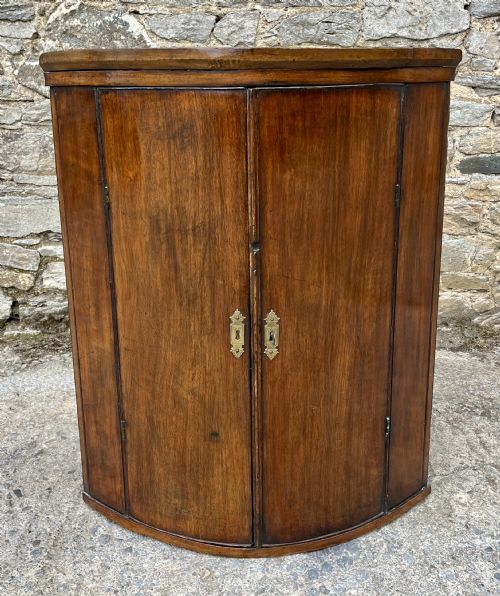


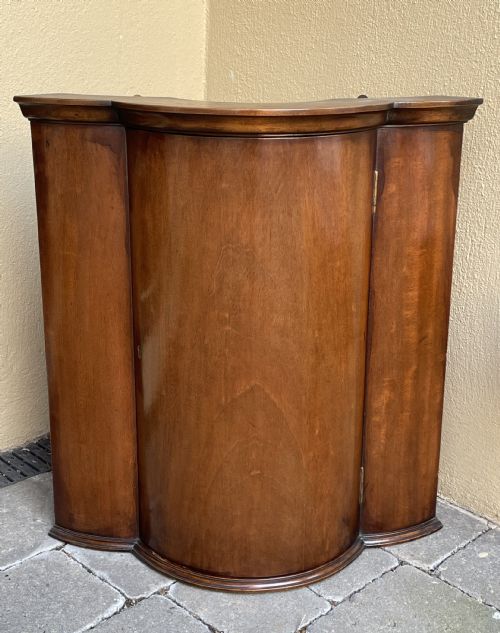


Bowfront Corner Unit
A bowfront corner unit is a clever space-saving cabinet with a curved front that fits snugly into a room angle.
Bowfront Corner Unit
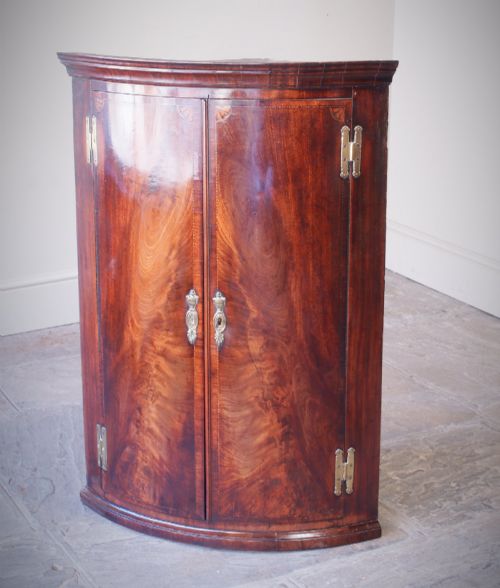
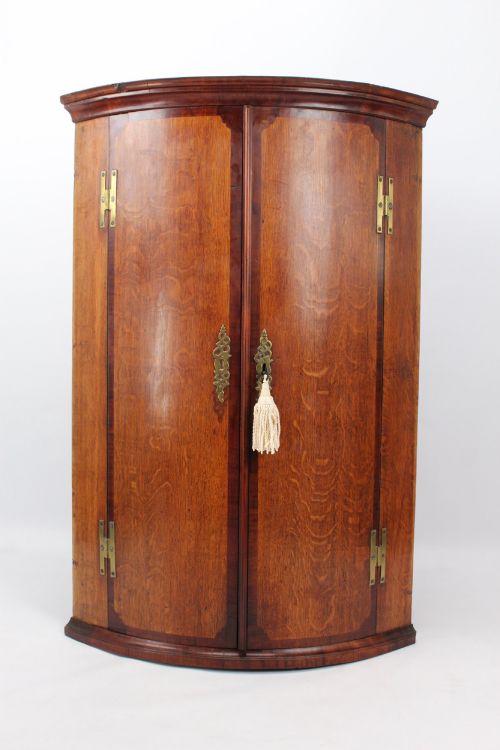
When you search for a bowfront corner unit, you find functional timber cabinetry designed to occupy unused wall junctions. The pieces on this page span the Georgian, Victorian, and Edwardian eras, stretching from the eighteenth century into the twentieth.
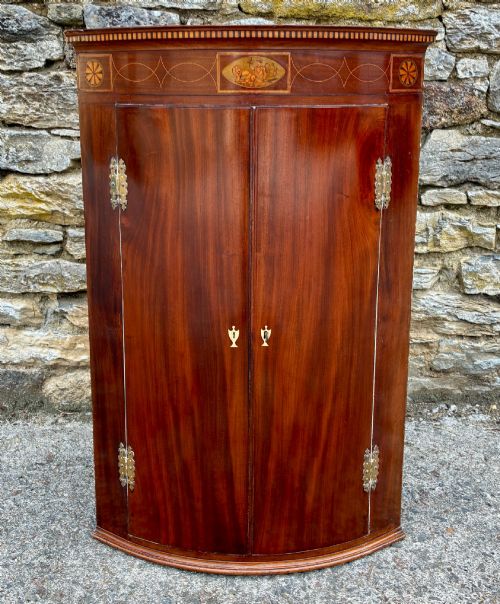
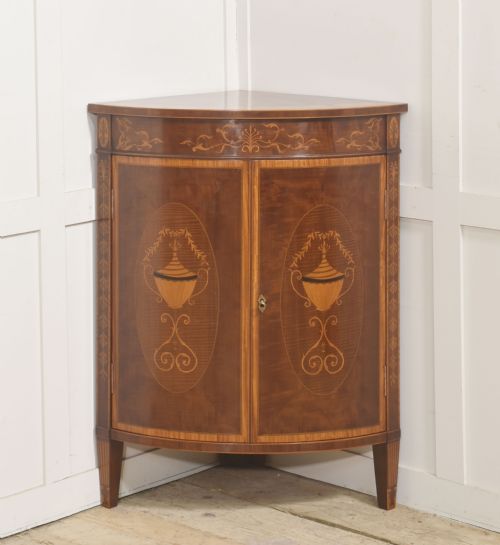
Mahogany and oak dominate the selection, appearing either as hanging wall cupboards or standing floor units. Many examples feature refined boxwood and satinwood inlay work alongside simpler vernacular pine and painted finishes.
The most common form is the hanging corner cupboard, which fastens directly to the wall to keep floor space clear. Standing cupboards and occasional washstands also appear, offering larger storage capacity or distinctive fold-down tops.
How they were made
Cabinetmakers constructed these frames primarily from solid mahogany and native oak, frequently utilising secondary pine for internal shelving and backs. Timber selection prioritized stability, particularly for the curved doors that had to hold their shape over centuries.
Decorations rely heavily on contrasting boxwood and satinwood stringing and inlay, creating geometric borders and central shell motifs. Brass hardware such as H-hinges and escutcheons secures the doors and provides functional contrast to the dark wood.
What varies in quality
The refinement of the timber and the precision of the curved front set the standard for these cabinets. Superior examples exhibit tightly figured mahogany grain and meticulous crossbanding that follows the sweeping radius of the doors.
Subtleties in the inlay work and the execution of interior shelving reveal the skill of the original workshop. Finer pieces maintain crisp mouldings and original brass fixtures that integrate seamlessly with the carcase structure.
The Bowfront Corner Unit Glossary
- Bowfront
- A convex, curved cabinet front that projects outward in a smooth arc. This shape softens the hard angles of a standard corner piece.
- Crossbanding
- A narrow strip of veneer laid across the grain of the primary timber to form a decorative border. It frames the panel edges on better cabinet doors.
- Hanging cupboard
- A wall-mounted storage unit supported by internal brackets rather than floor legs. These pieces were designed to be secured high in room corners.
- Stringing
- Fine inlay lines of contrasting wood used to outline panels and drawers. It adds linear detail to mahogany and oak surfaces.
Bowfront Corner Unit: Frequently Asked Questions
How do I hang a corner cupboard safely?
These wall-mounted units require secure fixing to solid masonry or properly located timber studs behind the plaster. Professional installation is essential due to the combined weight of solid hardwood and stored contents.
Ensure the internal hanging brackets or screw points are thoroughly checked before loading the shelves with heavy ceramics or glassware.
Where should I place a corner unit?
A corner unit makes efficient use of dead space in dining rooms, hallways, or reception rooms where standard rectangular furniture will not fit. Hanging versions free up the floor entirely, while standing cupboards anchor an empty corner.
Positioning them away from direct sunlight and heat sources protects the antique timber and delicate veneer work from drying out.
How do I tell Georgian pieces apart from later copies?
Eighteenth-century examples typically show hand-cut dovetails, secondary woods like Scots pine or oak, and authentic timber shrinkage in the back panels. Later reproductions often employ uniform machine-cut joints and modern adhesives.
Examine the interior shelves and hinges to understand the construction methods used during the period of manufacture.
What is the difference between standing and hanging cupboards?
Hanging cupboards attach directly to wall surfaces and sit at eye level or above, leaving the floor completely unobstructed. Standing cabinets rest on plinths or bracket feet directly on the floor, providing a larger capacity.
Standing versions sometimes include a base cupboard or drawer section beneath the main display area.