


Bow Fronted Wardrobe
A bow fronted wardrobe brings a distinct curved presence to a bedroom, offering generous interior volume without sacrificing floor space.
Bow Fronted Wardrobe
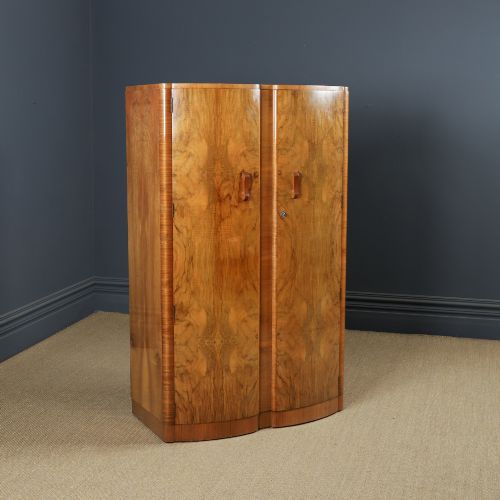
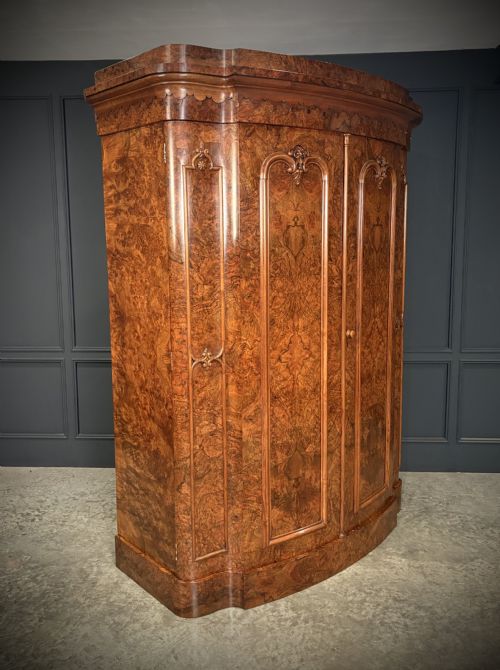
A bow fronted wardrobe provides a rounded exterior profile that softens the vertical lines of heavy bedroom furniture while concealing ample hanging space and shelving. These pieces range from grand Georgian and Victorian constructions in solid timber to streamlined Art Deco designs finished in decorative veneers.
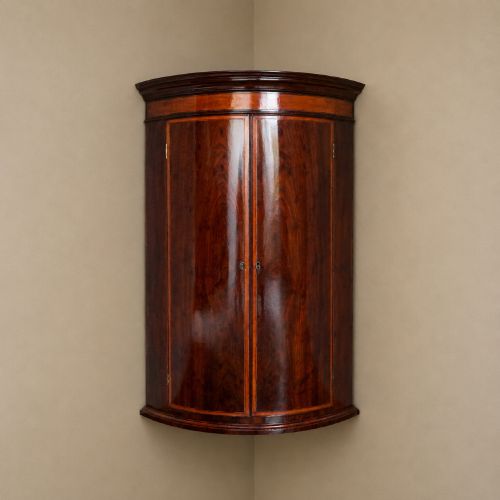
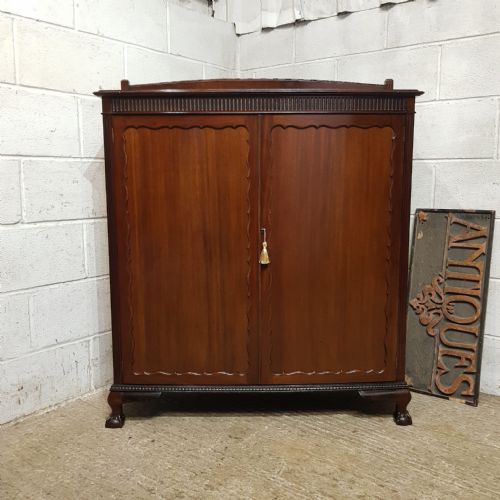
The version most commonly encountered in these listings is the Edwardian double or triple wardrobe in mahogany, often incorporating inlaid details. Alongside full-scale closets, the category occasionally encompasses related storage forms such as linen presses and corner cabinets sharing the same curved facade.
Origins stretch from the late eighteenth century through the Edwardian era and into the 1930s. Buyers select these pieces for their combination of architectural interest and practical compartmentalisation.
Materials and construction
Cabinet makers relied primarily on mahogany, walnut and burr walnut, applying figured veneers over stable secondary timbers to create striking grain patterns across the curved doors. Flame mahogany and plum pudding mahogany provide intense visual movement, whilst boxwood stringing adds delicate linear contrast.
Curving the front of a wardrobe required sophisticated carpentry, utilising bent laminations or solid timbers shaped to maintain structural integrity under the tension of heavy doors. Brass fittings, including hinges, locks and hanging hooks, complete the interior and exterior hardware.
Listings feature bow fronted wardrobes spanning the Georgian, Victorian, Edwardian, and Art Deco periods, constructed in mahogany, walnut, and satinwood.
Distinguishing quality
Quality rests upon the selection and matching of wood veneers, particularly on the prominent curved doors where grain symmetry defines the visual success of the piece. Superior examples exhibit continuous grain flow across panels and meticulous hand-cut joinery that ensures doors hang true without sagging over time.
The sophistication of the internal fittings separates standard utilitarian closets from finer commissions. Fitted interior trays, sliding linen slides, specialist compartments and original brass hardware indicate a higher grade of manufacture from workshops.
Maple and Co
The Bow Fronted Wardrobe Glossary
- Bow front
- A convex, outwardly curved front facade characteristic of certain case furniture. This profile softens the rectangular silhouette of the piece.
- Linen press
- A tall piece of furniture featuring upper doors enclosing sliding trays or shelves, often above a base of lower drawers. They were traditionally utilised for storing folded linens and garments.
- Compactum
- A multi-functional wardrobe combining hanging space, drawers, and shelving within a single unified carcass. This configuration maximises storage efficiency in smaller rooms.
- Flame mahogany
- A veneer cut from the fork of a mahogany tree, yielding a distinctive ripple pattern resembling flickering flames. Cabinet makers prized this figure for principal display surfaces.
- Burr walnut
- Timber harvested from the wart-like growth on a walnut tree, producing an intricate, swirling cluster of knots. It creates a highly decorative surface on wardrobes from the Edwardian and Art Deco periods.
Bow Fronted Wardrobe: Frequently Asked Questions
How do I know if a wardrobe will fit my room?
Check the maximum width, depth, and height dimensions provided in the listing, remembering that the curved bow front projects further than the side panels. Ensure adequate clearance for opening the full doors within your bedroom space.
Measure doorways and stairwells prior to purchase, as many period wardrobes are large, solid constructions that cannot be easily disassembled.
What is the difference between an Edwardian and a Georgian wardrobe?
Georgian examples, dating from the eighteenth century, typically feature heavy solid timbers such as flame or plum pudding mahogany with architectural cornices and hand-cut dovetails. They reflect a simpler, more monumental approach to storage.
Edwardian pieces from around 1900 frequently incorporate satinwood inlay, brighter polished surfaces, and wider use of figured mahogany or mirrored doors. They often arrive as modular triple sections designed for grand Victorian and Edwardian bedroom suites.
Can these wardrobes be dismantled for transport?
Many period wardrobes, particularly larger triple versions and compactums, were built with sectional cornices, bases, and demountable sides held together by internal bolts or pegs. This modular design allowed historical cabinet makers to deliver bulky furniture up narrow stairs.
Simpler double doors and older Georgian carcasses may be constructed as single solid units requiring professional furniture movers with specialist equipment.
How do I maintain walnut veneer?
Keep walnut veneer furniture out of direct sunlight and away from direct heat sources to prevent the thin timber layers from drying out, lifting, or fading. Maintain a stable room temperature and humidity level.
Dust regularly with a soft, dry cloth and apply a quality microcrystalline wax occasionally to nourish the polished surface without building up excessive residue.