
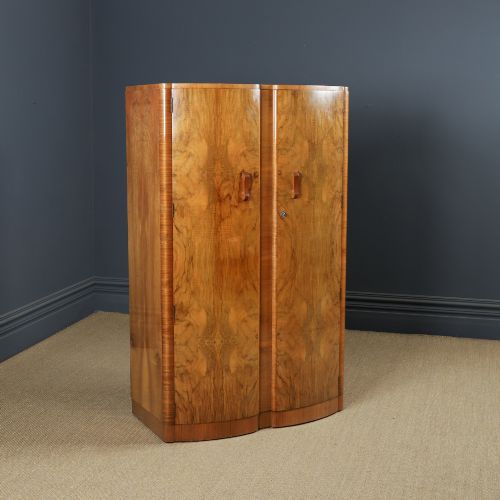
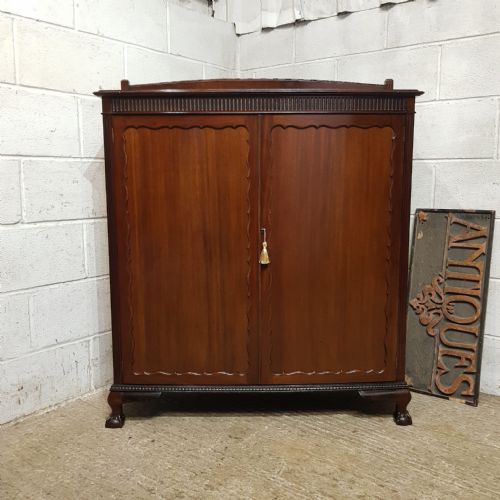
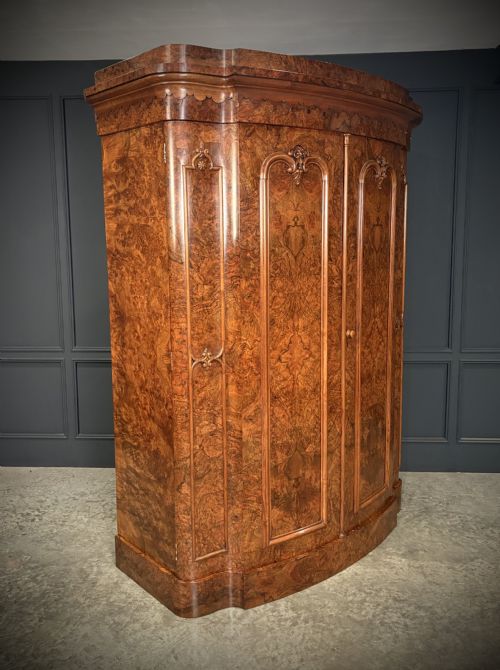


Bow Front Armoire
A bow front armoire provides substantial hanging and shelving space within a graceful curved silhouette that softens room corners.
Bow Front Armoire
When you search for a bow front armoire, you are looking at large storage furniture characterised by a convex, rounded front facade. These pieces operate primarily as wardrobes, cupboards, cabinets, and linen presses designed to house clothing and household textiles.
The versions you are most likely to meet on this page span several distinct periods, including the Georgian, Victorian, and Edwardian eras, alongside Art Deco and Regency Revival interpretations. They originate predominantly from English workshops, with occasional French examples appearing in the record.
Formats range from tall two-door wardrobes with fitted interiors to compact corner cupboards and large triple mirror door compactums. Each variation utilises the curved frontal projection to create internal depth while maintaining a refined exterior profile.
How they were made
Cabinet makers constructed these pieces using solid timbers like mahogany and walnut for structural integrity, often applying figured walnut, burr walnut, or flame mahogany veneers across the curved doors and panels to create striking grain patterns. The bending of wood for the convex facade required specialist joinery techniques to ensure the curved rails and doors held their shape over time.
Hardware details such as brass handles, escutcheons, and hinges were integrated into the design to complement the rich tones of the wood. Interior configurations frequently included pull-out linen slides, drawers, and hanging spaces tailored to the domestic requirements of their respective periods.
Some Edwardian cupboards proudly hide their linen slides behind curved doors that must have required immense patience from the joiner.
What varies in quality
The distinction between standard examples and finer pieces lies in the selection and matching of wood veneers across the curved surfaces, where book-matched flame mahogany or burr walnut creates a continuous, balanced visual rhythm. Superior construction is evident in the precision of the joinery along the radius of the bow front, ensuring doors close flush without binding.
The complexity of the interior fittings and the sophistication of period details, such as inlaid stringing or panel moulding, further elevate a piece. Maker expertise dictates how well the convex doors retain their alignment through decades of environmental changes.
The Bow Front Armoire Glossary
- Bow front
- A convex, outwardly curved front facade characteristic of certain cabinets and wardrobes. This design softens the visual impact of large case furniture by replacing flat planes with a gentle sweep.
- Linen press
- A tall piece of furniture featuring upper doors enclosing sliding trays or shelves, positioned above a base of lower drawers. They were traditionally utilised for storing folded linens and garments.
- Veneer
- A thin layer of finely figured wood applied to a sturdier secondary timber base. Techniques involving burr and flame walnut or mahogany veneers create decorative patterned surfaces.
- Compactum
- A multi-compartment wardrobe designed to maximise internal storage efficiency through a combination of hanging space, drawers, and shelving units. These often incorporate mirrored doors.
- Escutcheon
- A protective metal plate surrounding a keyhole, frequently cast in brass on period cabinetry. It serves both a functional purpose and a decorative role on the door facade.
Bow Front Armoire: Frequently Asked Questions
How do I date a bow front armoire?
Dating relies on identifying stylistic markers, construction methods, and materials specific to eras such as Georgian, Victorian, Edwardian, or Art Deco. Georgian and Regency pieces often display flame mahogany and subtle inlay, while Victorian examples tend to be heavier with extensive proportions.
Twentieth-century Art Deco interpretations introduce figured walnut veneers and streamlined silhouettes. Comparing hardware styles and interior fittings provides further chronological context.
Where should I place a bow front armoire?
These large storage pieces suit bedrooms, dressing rooms, or spacious hallways where their depth and height can be accommodated safely. Placing them against a flat wall allows the curved facade to project into the room as a focal point.
Corner variations fit directly into room angles, making efficient use of otherwise underutilised space while displaying characteristic curved doors.
What is the difference between an armoire and a linen press?
An armoire functions primarily as a wardrobe with dedicated vertical space for hanging garments behind full-length doors. A linen press traditionally houses horizontal sliding trays or shelves in the upper section, accompanied by drawers in the base.
Both utilise the curved bow front design to add decorative presence and internal depth to the piece.