




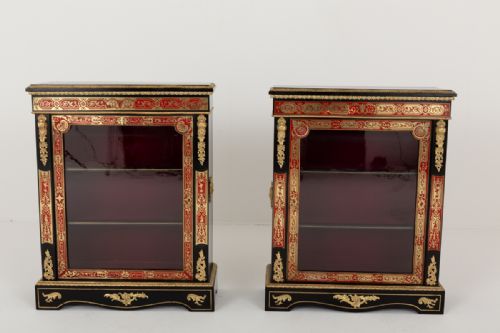


Boulle Cabinet
A boulle cabinet brings together tortoiseshell and brass marquetry upon ebonised wood to anchor a room with nineteenth-century French and English splendour.
Boulle Cabinet
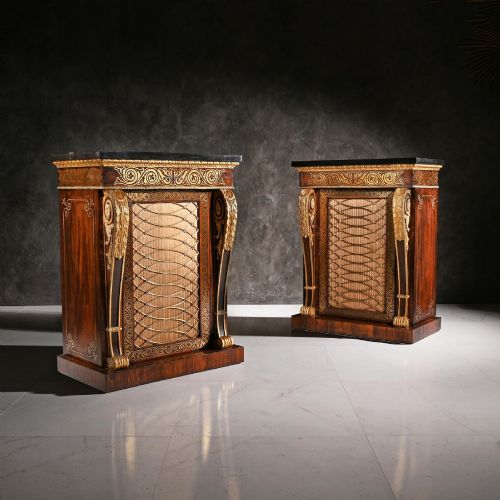
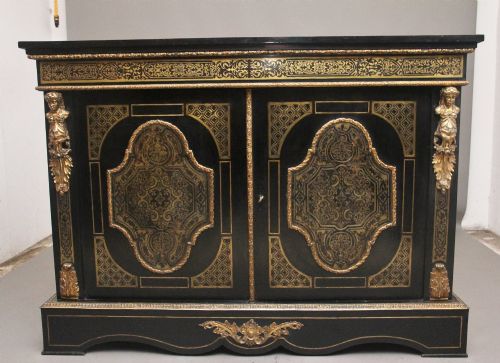
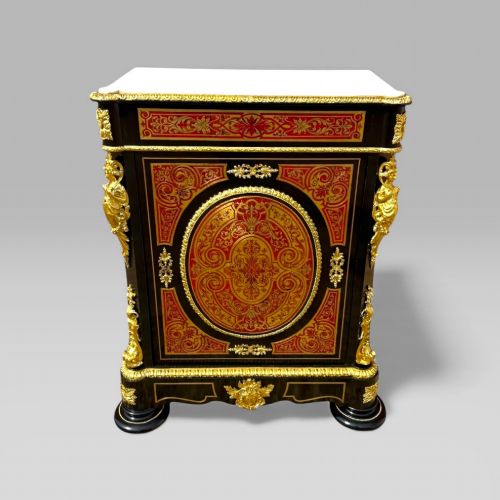
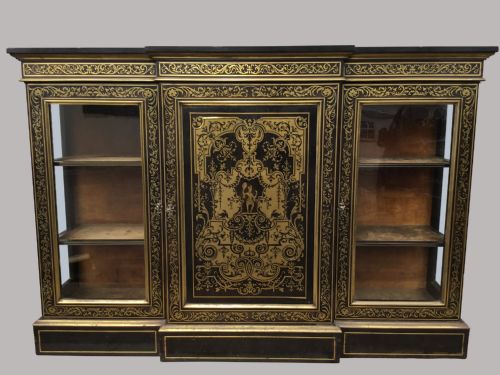
A boulle cabinet is a storage or display piece defined by elaborate tortoiseshell and brass inlay, appearing in forms from pier cabinets and credenzas to writing desks and breakfront sideboards.
The pieces on this page span the nineteenth century, including the Victorian era and the French Napoleon III period, alongside Louis XVI style revivals and Grand Regency examples.
Buyers will most frequently meet pier cabinets and side cabinets framed in ebonised wood or rosewood, often topped with marble and mounted with ormolu or gilt bronze.
How they were made
Craftsmen built these cabinets using ebonised wood, ebony, or rosewood as a dark ground to contrast with luminous metallic and organic veneers.
Brass and tortoiseshell were cut together in intricate marquetry patterns, producing contre-partie variations where the metal ground reverses with the shell.
Ormolu and gilt bronze mounts, alongside marble tops and glass panels, finished the structural edges and display doors of these nineteenth-century forms.
Boulle Cabinet Retail Price Guide 2026
Typical asking prices for boulle cabinet among the pieces listed under this phrase on Sellingantiques today, from the lower quarter to the upper quarter. They describe what is for sale here now, not the wider market.
What varies in quality
Quality rests in the crispness of the brass cutting and the depth of the tortoiseshell beneath it, showing how cleanly the artisan managed the marquetry saw.
The precision of the ormolu mounts and the weight of the marble tops distinguish workshop output, alongside the integrity of the ebonised timber frame.
Louis Constantin Le Gaigneur
The Boulle Cabinet Glossary
- Boulle work
- Marquetry technique utilising tortoiseshell and brass developed by André-Charles Boulle during the reign of Louis XIV. It creates a shimmering metallic pattern set against a dark organic background.
- Pier cabinet
- A low cabinet designed specifically to stand against the wall space between windows. These nineteenth-century examples often incorporate glass doors for display.
- Ormolu
- Gilded bronze mounts applied to furniture corners, feet, and friezes. This technique adds structural highlight and rich metallic texture.
- Credenza
- A long, low cabinet style popular in the nineteenth century, frequently fitted with doors and central display spaces. They often feature serpentine marble tops.
- Marquetry
- The art of applying pieces of veneer to a structure to form decorative patterns. In these listings, brass and tortoiseshell form the primary veneer elements.
Boulle Cabinet: Frequently Asked Questions
What is a boulle cabinet?
A boulle cabinet is a nineteenth-century storage or display furniture piece decorated with intricate brass and tortoiseshell marquetry.
These pieces typically utilise ebonised wood or rosewood and often feature ormolu mounts and marble tops.
How do I date these cabinets?
Dating relies on stylistic markers associated with the Victorian era, the Napoleon III period, and Louis XVI revivals.
Nineteenth-century construction methods, timber choices like ebony and rosewood, and specific brass inlay patterns help establish the timeline.
Where should I place one?
These cabinets suit reception rooms and hallways where their reflective brass inlay and marble tops catch natural light.
Pier cabinets work well in narrow wall spaces, while credenzas anchor larger expanses of a room.
How are different styles distinguished?
French Napoleon III and Victorian Boulle Revival pieces often showcase dense brass and tortoiseshell marquetry on ebonised wood.
Grand Regency and Louis XVI style examples lean toward restrained lines, specific ormolu mounts, and architectural symmetry.