

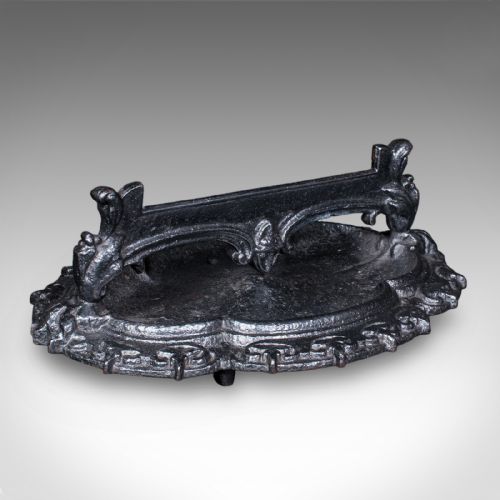


Boot Cleaner Tray
These boot cleaner tray examples are cast iron household essentials designed for doorways, offering a sturdy way to remove mud.
Boot Cleaner Tray
A boot cleaner tray serves as a practical entryway fixture, frequently designated in listings as a boot scraper or shoe cleaner. When searching for a boot cleaner tray, buyers encounter heavy metal pieces placed outside doorways to clear footwear before entering.
The items found here span the Victorian, Georgian, and Regency eras alongside general nineteenth-century examples. Most available pieces take the form of cast iron scrapers, often accompanied by a pull for removing boots.
Originating largely from English townhouses and country houses, these utilitarian objects range from small oval designs to large pairs. They reflect the domestic requirements of nineteenth-century households where muddy footwear demanded attention before crossing the threshold.
Materials and construction
Every piece recorded in the evidence is made from cast iron, utilising the foundry methods standard for nineteenth-century metalwork. Molten iron was poured into sand moulds to create rigid frames capable of withstanding heavy daily use outside doorways.
Makers integrated structural elements such as scrapers and pulls directly into the cast iron body during production. This single-material construction ensured durability against weathering and the physical force applied by boots.
Boot Cleaner Tray Retail Price Guide 2026
Typical asking prices for boot cleaner tray among the pieces listed under this phrase on Sellingantiques today, from the lower quarter to the upper quarter. They describe what is for sale here now, not the wider market.
A Victorian country house scraper ensures your modern muddy boots meet the exact same iron that greeted top hats and crinolines.
Assessing quality and character
Quality in these cast iron pieces rests upon the crispness of the casting and the presence of integrated architectural details like shoe pulls. Simpler small oval designs contrast with larger country house pairs and named foundry output.
The distinction between standard domestic items and superior examples lies in the robustness of the execution and the inclusion of design flourishes specific to townhouse entrances. Foundry attribution, such as Coalbrookdale, elevates a piece beyond anonymous utility.
Coalbrookdale
The Boot Cleaner Tray Glossary
- Boot scraper
- A metal blade or trough fixed near a doorway to scrape mud from the soles of shoes. It forms the primary functional component of these objects.
- Shoe pull
- An auxiliary loop or handle cast into the ironwork to assist in steadying the foot while removing boots. This feature appears on many townhouse examples.
- Cast iron
- An iron-carbon alloy poured into moulds while molten, chosen for its strength and weight in outdoor architectural hardware. It constitutes the sole material recorded in the listings.
- Foundry
- A factory where metal is melted and cast into shapes. Pieces from specific foundries carry distinct markers of industrial heritage.
Boot Cleaner Tray: Frequently Asked Questions
What is a boot cleaner tray?
A boot cleaner tray is a heavy cast iron fixture placed at an entrance to scrape mud and dirt from footwear. These items combine a scraping blade with a sturdy frame designed to stay firmly in place.
Historical examples date from the Georgian, Regency, and Victorian periods, reflecting the heavy footwear demands of past centuries. They were standard additions to English townhouses and country houses.
Where were they positioned?
These items were positioned directly outside exterior doorways, often bolted to stone steps or placed within dedicated porch recesses. Their location ensured that residents and visitors cleaned their shoes before stepping onto interior floors.
Because they lived outdoors, they relied entirely on durable cast iron construction to withstand rain and mud.
How do I date a cast iron scraper?
Dating relies on stylistic clues and design characteristics associated with periods such as the Regency or Victorian eras. Simpler utilitarian shapes often share workspace aesthetics with nineteenth-century foundry production.
Makers' marks or specific architectural associations, such as Great Exhibition links, help narrow the timeframe of manufacture.
Are pairs common?
Pairs of scrapers appear in nineteenth-century country house and large townhouse contexts where grander entryways required symmetrical hardware. These larger matched items served high-status domestic settings.
Single scrapers represent the more common urban configuration found at standard doorways.