
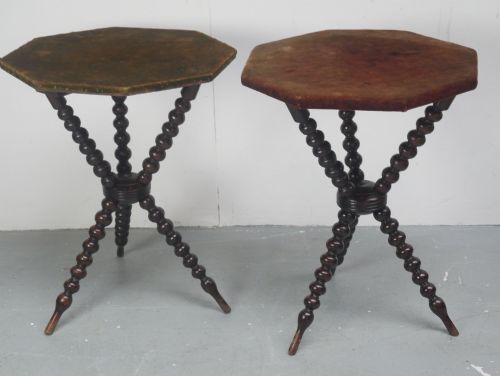
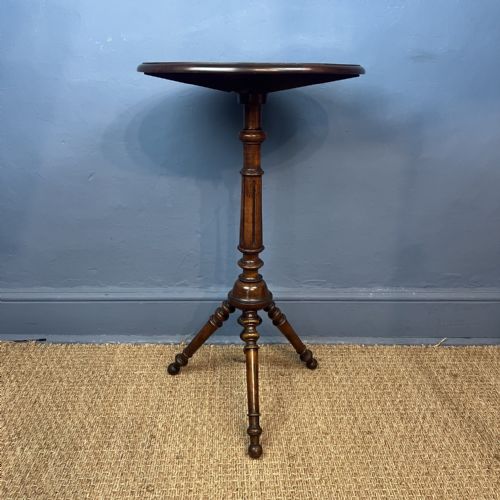
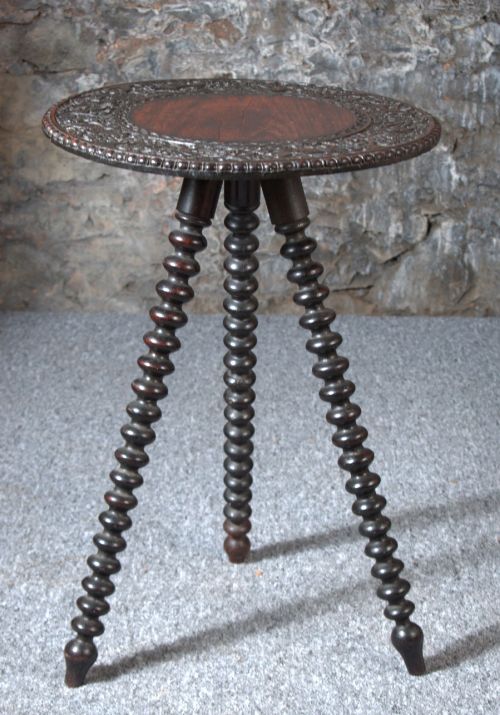


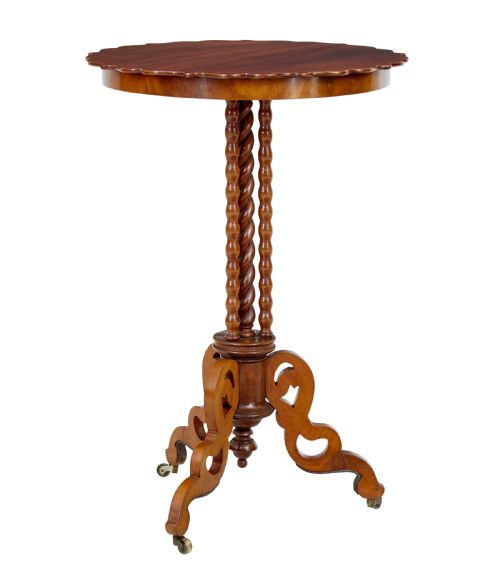


Bobbin Leg Tripod Table
A bobbin leg tripod table brings distinctive turned woodwork and a compact circular top into any corner that needs character.
Bobbin Leg Tripod Table
A bobbin leg tripod table combines a small circular top supported by three legs with distinctive spool or bobbin turnings along the vertical supports. Buyers seek these pieces for their compact footprints and charmingly turned structural timbers that fit easily beside chairs or in narrow hallways.
The versions met most frequently on this page span the Victorian era, the Aesthetic Movement, and the early twentieth century, alongside specific regional forms. They appear primarily as occasional tables, side tables, and gipsy tables featuring tripod bases.
How these tables were constructed
Cabinet makers utilised a variety of hardwoods including mahogany, walnut, burr walnut, padouk, oak, and pine to shape these supports and tops. Turning the bobbin legs required a lathe to cut repetitive spherical and cylindrical spool shapes down the length of the timber.
Surface decoration ranges from natural polished grain to ebonised finishes, hand-painted details, marquetry inlay, and velvet upholstery. Some examples integrate carved ornament into the legs or incorporate brass fittings.
The current selection spans from the 1880s through to the 1920s, incorporating woods such as mahogany, walnut, padouk, and oak alongside velvet and brass elements.
What separates the fine examples
The distinction between standard production and superior craftsmanship lies in the crispness of the wood turning and the selection of timber figures for the top. Finely articulated bobbins show precise, uniform spacing without splintering or coarse grain distortion.
Stability in the three-legged base and the integrity of the joints dictate longevity, where tight fitting dowels or tenons prevent the wobble common in lighter occasional furniture. The presence of secondary decorative elements such as marquetry or hand-painting further elevates an individual piece.
The Bobbin Leg Tripod Table Glossary
- Bobbin turning
- A form of woodturning characterised by a series of rounded, spool-like shapes resembling bobbins threaded on a string. This decorative profile defines the legs of these tripod tables.
- Tripod base
- A support structure consisting of three distinct legs radiating from a central pillar or directly from the underside of the top. It ensures stability on uneven floors.
- Gipsy table
- A lightweight occasional table featuring three turned legs, popular during the Victorian and Aesthetic Movement eras. They often served as display surfaces for decorative objects.
- Marquetry inlay
- The art of applying small pieces of veneered wood to a structure to form decorative patterns or pictures. It adds visual complexity to table tops.
- Ebonisation
- A chemical or pigment treatment applied to cheaper timbers to imitate the dark, dense appearance of ebony. Victorian makers used this technique extensively on turned furniture.
Bobbin Leg Tripod Table: Frequently Asked Questions
What is a bobbin leg tripod table used for?
These tables function primarily as convenient surfaces for small lamps, books, or decorative objects placed beside seating. Their modest proportions make them adaptable for placement in corners or tight spaces.
Historically, many served as gipsy tables holding cloths, ornaments, or tea services in nineteenth-century reception rooms.
How do you date a bobbin leg tripod table?
Dating relies on identifying timber species, construction methods, and stylistic cues linked to periods like the Victorian era or the Aesthetic Movement. Mahogany and walnut dominate mid-to-late nineteenth-century examples, while ebonised finishes and hand-painted tops point toward specific decades.
Examining the underside of the top and the wear patterns on the feet provides additional context regarding age and origin.
Are bobbin turned legs strong?
The structural integrity depends heavily on the quality of the hardwood used and the tightness of the joints connecting the legs to the top or central column. Dense timbers like mahogany and walnut offer robust support despite the slender appearance of the turnings.
Careful handling prevents strain on the three-legged junction during relocation.
What is an Aesthetic Movement table?
Aesthetic Movement tables reflect the late nineteenth-century push for art in daily life, emphasising form, craftsmanship, and often drawing inspiration from Japanese design. These pieces frequently feature ebonised surfaces, delicate proportions, and contrasting materials.
They stand apart from heavier high Victorian furnishings through their pared-down, elegant silhouettes.