


Blue Framed Chinese Artwork
Blue framed chinese artwork brings together delicate silk embroideries, pith paper paintings and maritime oils framed for Western walls.
Blue Framed Chinese Artwork
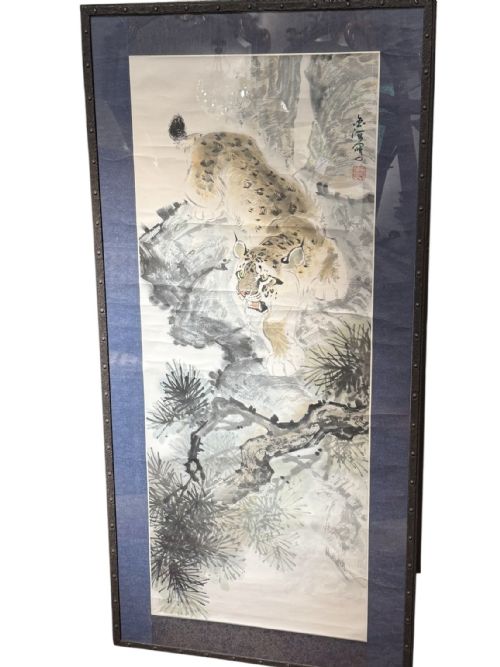
When you search for blue framed chinese artwork, you are looking at paintings and textile pieces originating from China and Anglo-Chinese collaborations, housed in protective frames behind glass. The selection ranges from nineteenth century pith paper paintings and silk embroideries to early twentieth century scroll paintings and marine oils.
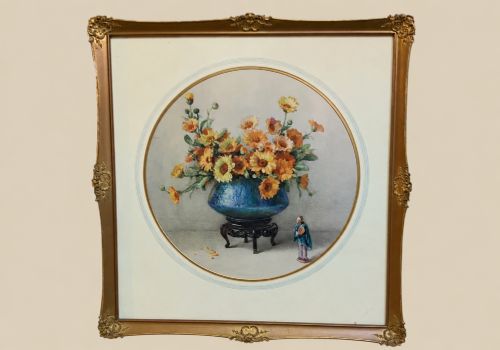
You are most likely to meet pieces dated around nineteen hundred or the nineteenth century, executed in watercolour, gouache, ink, or oil on paper, canvas, and silk. These works often depict figures, flora, ancestral portraits, and ships on the Pearl River.
The styles bridge traditional Chinese execution with export markets, including China Trade and Qing Dynasty aesthetics. Many items are mounted and displayed under glass, preserving fragile materials like pith paper and silk for domestic display.
Materials and methods
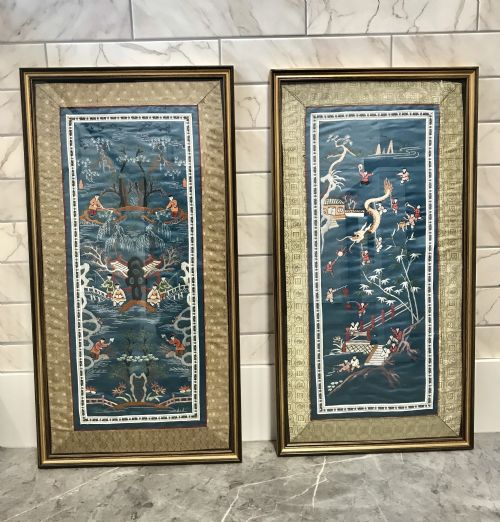
Makers utilised organic supports such as pith paper, silk, and canvas, applying ink, watercolour, gouache, and oil paints by hand. Silk embroidery panels feature hand-sewn figures, dragons, trees, and flowers.
Paintings on pith paper and delicate watercolours required careful handling and mounting to survive, often paired with wooden frames and protective glass panels to shield the artwork from atmospheric damage.
Listings feature works in oil, watercolour, gouache, ink, and silk embroidery across paper, canvas, and pith paper.
Qualities that distinguish the pieces
The standard of execution separates workshop output, seen in the fine detail of ancestor portraits and marine shipping scenes compared to simpler decorative panels. The preservation of fragile materials like pith paper and silk under glass also dictates the integrity of the piece.
Compositional complexity and clarity of pigment play a role, particularly in gouache sets and detailed silk embroidery work where hand-sewing precision defines the visual depth.
Ah Hee Studio
The Blue Framed Chinese Artwork Glossary
- Pith paper
- A delicate material made from the pith of the Tetrapanax papyrifer plant, commonly used in nineteenth century Chinese export paintings.
- China Trade
- Goods produced in China specifically for export to Western markets, often blending Eastern subjects with Western framing or perspective.
- Gouache
- An opaque watercolour paint that dries to a matte finish, frequently observed in mounted sets of Chinese export art.
- Qing Dynasty
- The final imperial dynasty of China, spanning from sixteen forty-four to nineteen twelve, whose stylistic elements influence many of these works.
Blue Framed Chinese Artwork: Frequently Asked Questions
What periods do these artworks come from?
The pieces span the nineteenth and early twentieth centuries, with dates ranging from eighteen fifty up to nineteen fifty.
Most items sit around nineteen hundred, reflecting late Qing Dynasty and export trade periods.
How were pith paper paintings used?
Pith paper paintings were created primarily for the export market as souvenirs or depictions of local customs and scenery.
They were usually compiled into albums or framed for display in Western homes.
What subjects appear in these paintings?
Common subjects include marine shipping scenes on the Pearl River, ancestor group portraits, and botanical studies.
Textile works frequently portray traditional figures, dragons, trees, and flowers.
How should I care for framed silk and paper?
Keep the artworks away from direct sunlight to prevent the fading of delicate watercolours, inks, and dyed silks.
Ensure the protective glass remains intact to shield fragile materials like pith paper from moisture and dust.