




Blue Cabochon Cluster Ring
A blue cabochon cluster ring brings together smooth, polished stones and surrounding sparkle, offering a distinct alternative to faceted gems.
Blue Cabochon Cluster Ring
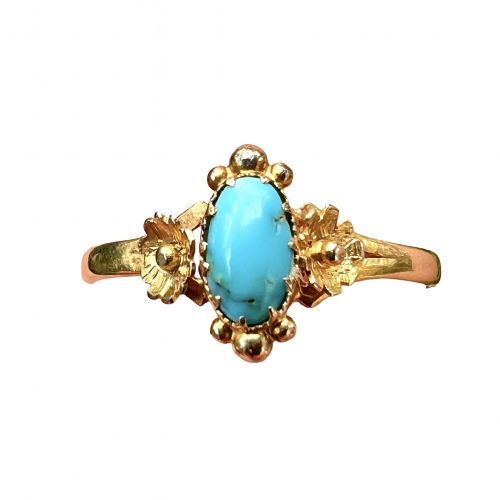
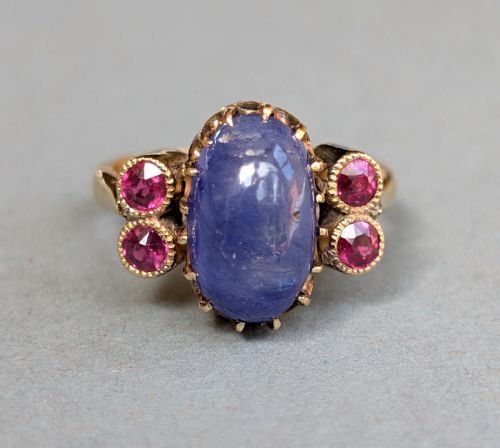
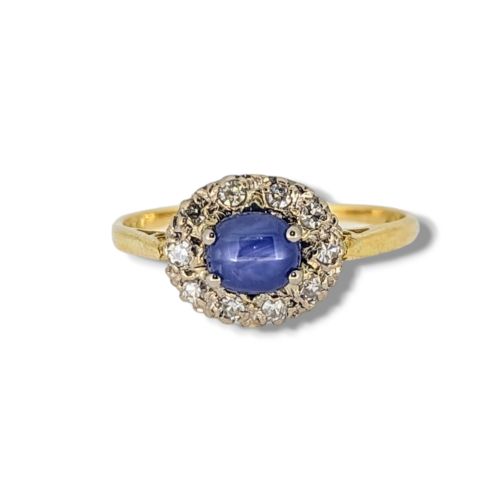
A blue cabochon cluster ring centres on a rounded, unfaceted blue stone, most often sapphire or star sapphire, framed by smaller diamonds or supporting gems.
The form appears across several periods in the evidence, running from Victorian and Edwardian examples through Art Deco and Mid-Century pieces.
Dress rings in this style span multiple gold purities and platinum settings, providing diverse profiles from low Victorian clusters to raised Retro designs.
Materials and Construction
Goldsmiths utilised yellow gold, white gold, and platinum to mount the central cabochon stones and secure the surrounding diamond borders.
Stones are cut with smooth, domed tops rather than facets, relying on the natural depth and lustre of the material for visual effect.
Some sapphires hold tiny needle inclusions that catch the light to form a floating star.
Factors That Distinguish Quality
The polish and symmetry of the central cabochon determine much of the visual impact, alongside the clarity and match of the surrounding diamonds.
Setting work shows in the neatness of the claws or bezels holding the stones, reflecting the skill of the period workshop.
The Blue Cabochon Cluster Ring Glossary
- Cabochon
- A gemstone shaped and polished with a smooth, convex domed surface rather than faceted. This style highlights the internal colour and optical phenomena of stones like star sapphires.
- Cluster ring
- A ring featuring a central stone surrounded by a group of smaller gemstones. The layout maximises overall presence on the hand.
- Rose cut
- An antique diamond cut featuring a flat base and a domed crown composed of triangular facets. It creates a subtle, understated sparkle.
- Star sapphire
- A variety of sapphire that exhibits a star-like phenomenon known as asterism when illuminated. This effect results from needle-like inclusions within the crystal.
- Platinum
- A dense, durable white metal frequently utilised in fine jewellery settings. Its strength allows for delicate claw and bezel work.
Blue Cabochon Cluster Ring: Frequently Asked Questions
What is a cabochon cut?
A cabochon cut lacks the flat facets typical of modern gemstones, presenting instead a smooth, rounded dome. This technique suits stones with distinct colours or optical effects.
Historically, this style predates modern faceting machinery and remains common in antique and vintage rings.
How do I care for a cluster ring?
Regular cleaning with warm soapy water and a soft brush helps maintain the brilliance of the surrounding diamonds. Avoid harsh chemicals that might affect softer surrounding stones.
Checking the setting periodically ensures the claws holding the central cabochon remain secure.
Are these rings suitable for daily wear?
Many examples utilise durable metals like platinum and 18ct gold alongside hard stones like sapphire. Consideration of stone hardness helps determine suitability for everyday use.
Softer centre stones require more careful handling to prevent surface scratches over time.
How do I identify an Art Deco ring?
Art Deco pieces typically feature geometric lines, platinum settings, and strong contrasts between the central stone and surrounding diamonds. These rings often date from the 1920s and 1930s.
The overall design leans toward symmetry and architectural structure.
What is a star sapphire?
A star sapphire displays a luminous six-rayed star pattern across its surface when viewed under a direct light source. This phenomenon is caused by aligned inclusions inside the gem.
Cutting the stone into a high cabochon shape enhances this optical property.