
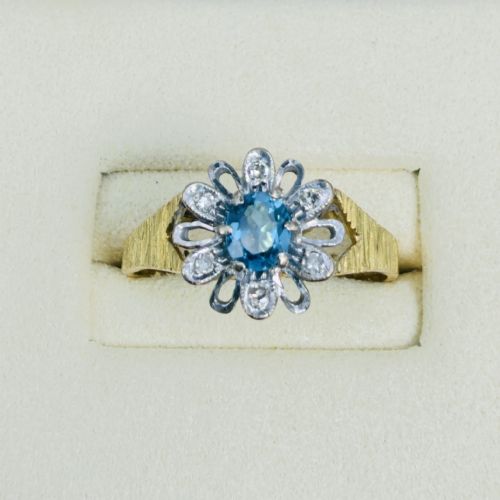
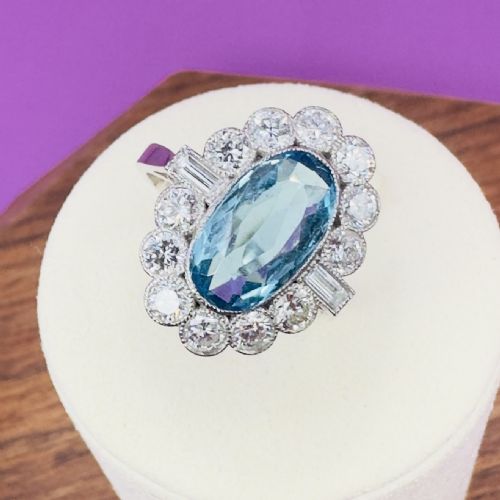


Blue Aquamarine Ring
A blue aquamarine ring brings cool, pale clarity to the hand, drawing the eye through generous stones set in precious metals.
Blue Aquamarine Ring
A blue aquamarine ring is an item of jewellery defined by its central beryl gemstone, appearing frequently across this selection in cluster, cocktail, and dress configurations. These pieces span periods from the nineteenth century through the Art Deco, Retro, and Mid-Century eras.
The most common examples on this page take the form of substantial cocktail and cluster rings from the nineteen-fifties, often pairing large emerald-cut or oval aquamarines with contrasting diamond borders.
Earlier nineteenth-century and nineteen-twenties designs lean towards intricate platinum settings, whilst nineteen-sixties iterations favour bolder gold mounts and heavier stone weights.
Materials and technique
Craftsmen built these pieces using durable precious metals including platinum, eighteen-carat white gold, eighteen-carat yellow gold, and fourteen-carat gold to securely house stones of significant scale.
Gemstones are shaped into emerald, oval, marquise, and old cuts, then integrated with diamonds, onyx, or structural platinum work to define distinct styles such as Art Deco and Retro Tank designs.
The selection includes cluster rings, cocktail rings, and dress rings incorporating diamonds, onyx, and beryl.
Design and construction
Quality rests upon the depth of the aquamarine's crystalline colour and the precision of the stone cutter's facets, which dictate how light moves through the beryl.
Superior examples display balanced proportions between massive feature stones and supporting diamond work, alongside robust claw or bezel metal settings that preserve structural integrity over decades of wear.
The Blue Aquamarine Ring Glossary
- Aquamarine
- A blue-to-green variety of beryl mineral that forms large, transparent crystals suited to substantial ring settings. Its name derives from seawater due to its characteristic pale blue tone.
- Cluster ring
- A design featuring a central gemstone encircled by a group of smaller stones, typically diamonds. This arrangement maximises surface brilliance on the finger.
- Cocktail ring
- An oversized, dramatic ring worn to draw attention, frequently utilising large gemstones and bold twentieth-century metalwork. These pieces emerged during periods of social change.
- Platinum
- A dense, silvery-white precious metal prized for its strength and durability in fine jewellery. It permits delicate claw work while holding heavy stones securely.
- Art Deco
- A design style spanning the nineteen-twenties and nineteen-thirties characterised by geometric lines, symmetry, and strong contrasts. Platinum and diamond accompaniments are typical of this period.
Blue Aquamarine Ring: Frequently Asked Questions
How do I care for a vintage aquamarine ring?
Clean the piece gently using warm soapy water and a soft brush to remove everyday oils from beneath the stone setting. Avoid harsh chemical cleaners and ultrasonic devices that might damage softer surrounding materials.
Store the ring separately in a fabric-lined box to prevent harder gems like diamonds from scratching the softer beryl surface during storage.
What defines an Art Deco aquamarine ring?
Art Deco pieces display strict geometric symmetry, clean lines, and often utilise platinum settings paired with baguette or old-cut diamonds. The aquamarines in these designs are frequently emerald-cut to emphasise linear architectural qualities.
These rings contrast sharply with the softer, organic curves found in earlier nineteenth-century work or the heavier, sculptural forms of nineteen-fifties retro pieces.
Can I wear my aquamarine ring every day?
Aquamarine sits at a relatively hard point on the mineral scale, making it durable enough for regular wear if handled with reasonable care. However, very large cocktail stones require caution against sharp knocks on hard surfaces.
Remove the ring during heavy physical tasks or gardening to protect both the central beryl and the delicate metal claws holding it.
How do I distinguish between white gold and platinum?
Platinum possesses a natural, deep greyish-white lustre and a heavier physical weight that distinguishes it immediately from gold alloys. White gold is created by mixing yellow gold with white metals and is frequently plated with rhodium to enhance brightness.
Examining the hallmark stamps inside the band will confirm the specific metal purity and composition used by the maker.