


Blue and Red Ginger Jar
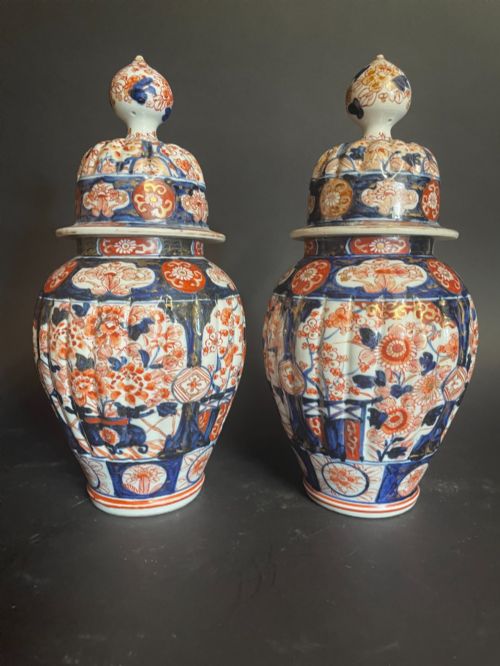
A blue and red ginger jar brings rich colour and pattern into a room, most often seen in nineteenth-century Japanese Imari porcelain decorated with cobalt glaze and iron-red enamel.
Blue and Red Ginger Jar
A blue and red ginger jar typically takes the form of a lidded vessel originally designed to store spices, though antique examples serve entirely decorative purposes today. You will most frequently encounter nineteenth-century Japanese Imari porcelain covered jars alongside eighteenth-century pieces and occasional Chinese transitional or sixteenth-century works.
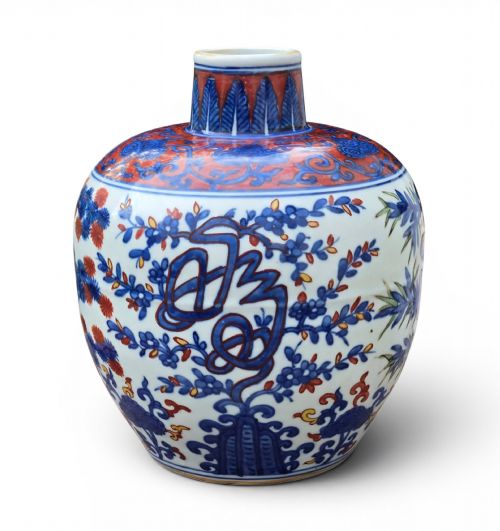
The decorative schemes rely heavily on the Imari palette, combining deep cobalt blue underglaze with striking iron-red enamel, often heightened with gilding or gold leaf. Forms range from simple covered jars to large pairs of lidded vases and urns created in Arita and surrounding kilns.
European makers also adopted these aesthetics, producing pieces in the Imari style during the Victorian and Edwardian eras. Collectors select these jars for their vibrant contrasting pigments and robust ceramic bodies.
Materials and production methods
Potters shaped these pieces from fine ceramic and porcelain, applying cobalt blue pigments beneath a clear glaze before firing at high temperatures. Iron-red enamel and gold leaf or gilding were then added in subsequent low-temperature enamel firings to create the characteristic rich surface contrast.
The resulting bodies vary from heavy nineteenth-century Japanese porcelain to Chinese transitional Wucai bodies painted with yellow Buddhistic lions against red and green enamel over blue and white grounds.
Listings span multiple eras, including sixteenth-century imperial pieces, seventeenth-century Chinese transitional wares, eighteenth-century Arita porcelain, and nineteenth-century Japanese Imari.
Distinctions in quality
Quality rests upon the crispness of the cobalt underglaze painting and the precise application of the iron-red enamel and gilding. Finer examples display balanced compositions and carefully potted ceramic forms with well-fitted original covers.
The clarity of the porcelain body and the depth of the glaze also separate standard production wares from pieces produced by skilled workshops in Arita or imperial kilns.
The Blue and Red Ginger Jar Glossary
- Imari
- A style of Japanese porcelain exported from the port of Arita, traditionally decorated in underglaze blue, iron-red, and gold. This aesthetic heavily influenced European ceramics.
- Cobalt glaze
- A blue ceramic pigment applied beneath the glaze that withstands high kiln temperatures without fading. It forms the dark foundation of many traditional jar designs.
- Iron-red enamel
- A rust-coloured pigment applied over the fired glaze to add bright red detail to ceramic surfaces. It contrasts sharply against the deep cobalt blue.
- Wucai
- A Chinese ceramic decorating technique meaning five colours, combining underglaze blue with contrasting overglaze enamels such as red and green. It appears on transitional period vessels.
- Gilding
- The application of gold leaf or powdered gold onto the ceramic surface to highlight painted motifs. It adds a reflective quality to the finished jar.
Blue and Red Ginger Jar: Frequently Asked Questions
How were ginger jars used historically?
These vessels originally served to transport and store spices, herbs, and ginger along trade routes from Asia to Europe.
Over time, Western households repurposed the lidded jars as purely decorative objects for mantelpieces and display cabinets.
How do I identify Japanese Imari?
Japanese Imari is typically recognised by its distinct palette of deep cobalt blue, iron-red enamel, and gold leaf on a white porcelain body.
Designs often feature intricate floral and geometric panels inspired by traditional textile patterns.
Are lids usually original to the jar?
Many surviving jars retain their matching covers, particularly pairs produced during the nineteenth century.
Because lids are easily separated or broken over centuries, checking the fit and glaze continuity helps confirm authenticity.
Where should I display my jar?
These jars suit prominent placement on sideboards, shelves, or tables where their vibrant pigments can catch natural light.
Keep them away from direct heat sources to protect the delicate overglaze enamels and gilding over time.