


Black Pencil Drawing
A black pencil drawing captures form through graphite and paper, offering a direct view into an artist's hand.
Black Pencil Drawing
A black pencil drawing spans centuries of practice, appearing in formats from small portrait studies to large architectural and landscape compositions. The works on this page include framed artwork, portrait miniatures, and original drawings on paper originating from the Georgian era through to the mid-twentieth century.
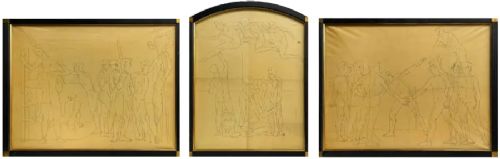
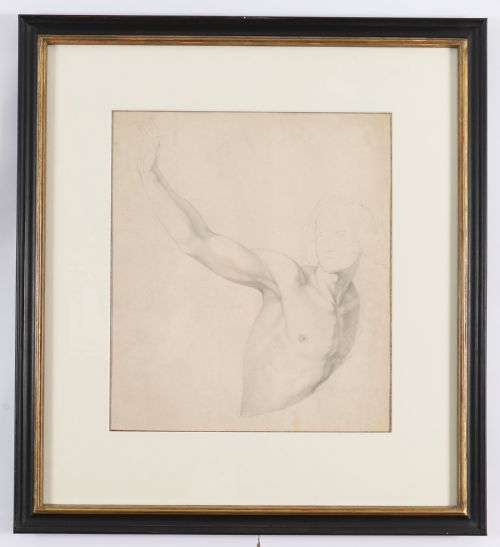
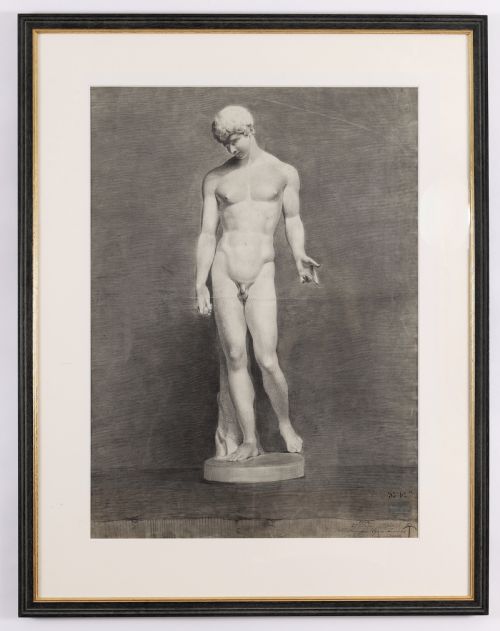
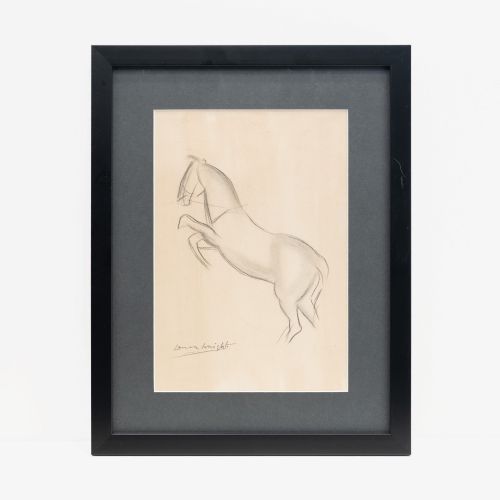
Figural and portrait studies dominate the selection, alongside equestrian subjects, architectural sketches, and landscape views. These pieces range from academic copies after earlier masters to direct observations of sitters and scenes recorded by named artists and regional schools.
Materials and technique
Artists utilise graphite, charcoal, and plumbago on paper sheets, frequently combining pencil with chalk, ink, or watercolour to build tone and depth. These mediums allow for both sharp, linear precision and soft, smudged shading.
Works are typically mounted behind glass within wooden frames, protecting the delicate paper supports and fugitive graphite or charcoal marks from atmospheric damage.
Periods represented span from the 18th century and the Georgian era through to the 1950s and 1960s.
Gradations of quality
Quality rests upon the sureness of the line and the precision of anatomical or architectural observation, separating hurried studio exercises from fully resolved master drawings. The strength of the composition and the expressive handling of tone dictate the visual impact of each sheet.
Condition plays a role, with clean, stable paper surfaces and minimal foxing preserving the original legibility of the artist's marks. Strong provenance or attribution to a documented hand elevates the standing of an individual work.
Dame Laura Knight·John Taylor·Hans Holbein·Demetrios Galanis·Michael Lyne·J D Fergusson·Raoul Millais·James Ferguson·Fred Lawson·Ernest Borough Johnson·Leo Klin·Francis Dodd
The Black Pencil Drawing Glossary
- Plumbago
- An early form of graphite drawing executed with fine precision, often taking the form of detailed monochrome portrait miniatures during the Georgian period.
- Graphite
- A crystalline form of carbon used as a drawing medium, producing metallic grey to deep black marks on paper.
- Charcoal
- A porous form of burnt wood used to create deep black, easily blended lines and broad tonal passages in preparatory studies.
- Triptych
- A work of art divided into three sections or panels, sometimes utilised for narrative or sequential subjects.
- Academic Realism
- A style of painting and drawing produced under the influence of European academies of art, emphasising meticulous anatomical accuracy and finish.
Black Pencil Drawing: Frequently Asked Questions
How are these drawings mounted?
Most works are framed behind glass within wooden surrounds to support and safeguard the paper substrate.
This presentation keeps airborne dust and moisture away from the delicate graphite and charcoal surfaces.
What periods do these works cover?
The selection spans from the eighteenth century through the Georgian and Victorian eras into the mid-twentieth century.
Twentieth-century examples include modernist and cubist approaches alongside traditional academic realism.
Are these works signed by the artists?
Several sheets feature direct signatures or inscriptions identifying the creator or the sitter.
Unsigned studio drawings rely on stylistic attribution and period materials for context.
What subjects appear most frequently?
Portraits and figural studies form a substantial portion of the works, capturing specific sitters or historical figures.
Equestrian scenes, landscapes, and architectural studies also feature across the selection.