
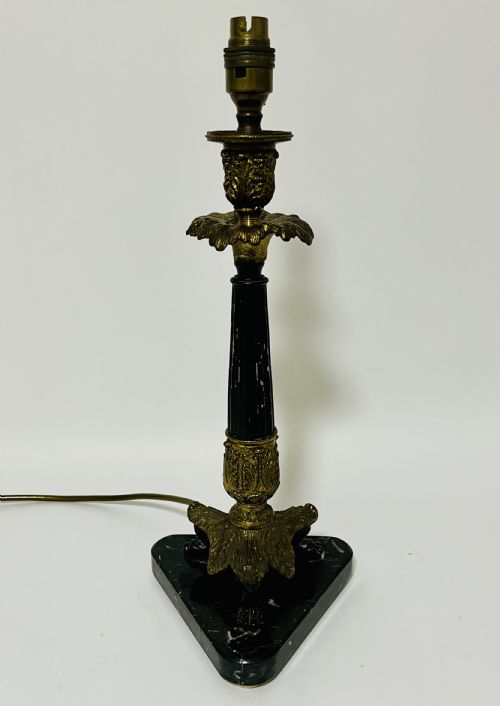


Black Marble Lamp Bases
Black marble lamp bases bring heavy, grounded weight to a room, offering dark stone surfaces paired with gilt metal, brass and bronze.
Black Marble Lamp Bases
When you search for black marble lamp bases, you are looking at heavy stone supports shaped into table lamps and occasional pieces from the nineteenth and early twentieth centuries. These items combine polished dark stone with metals like brass, bronze, and gilt bronze, often taking French Empire, Neoclassical, and Art Deco forms.
The versions you are most likely to meet on this page span the Edwardian era through the nineteen-thirties. They range from sculptural figural designs involving spelter and bronze to clean-lined geometric table lights and architectural columns.
How they were made
These pieces rely on solid stone turned or cut into plinths, columns, and circular bases, paired with cast metal mounts. Makers combined polished marble with bronze, gilt bronze, spelter, and brass, securing the components with threaded rods and nuts through the centre.
Surface work involved hand-finishing the stone to a smooth sheen, alongside patination or gilding on the metal figures, mounts, and toleware shades that completed the assembly.
Materials paired with the stone include brass, glass, spelter, bronze, gilt bronze, burr elm, and dark bronze.
What varies in quality
Quality rests on the crispness of the metal casting and the depth of the stone polish. Fine examples show sharp detail in figural mounts such as cherubs or neoclassical figures, while simpler pieces rely on plain turned marble columns.
The choice of secondary materials marks the division between standard and finer production. Heavy bronze and gilt mounts signal better workshops than lighter spelter or brass substitutes.
The Black Marble Lamp Bases Glossary
- Spelter
- A zinc alloy used as a cheaper substitute for bronze. It takes patination well but is softer and lighter than true bronze.
- Gilt bronze
- Bronze coated with a thin layer of gold. Also known as ormolu, it provides a bright, lasting metallic finish that resists tarnishing.
- Guéridon
- A small French table, often round, supported by one or more central columns. The form frequently adapts to serve as a sturdy lamp base.
- Toleware
- Painted or lacquered sheet metal. It appears on shades and decorative canisters mounted as lighting.
Black Marble Lamp Bases: Frequently Asked Questions
How do I date a black marble lamp base?
Dating relies on the combination of styles and materials visible in the mountings. Pieces showing strict symmetry and classical columns point to nineteenth-century Neoclassical or Empire origins.
Later items from the nineteen-twenties and nineteen-thirties adopt geometric Art Deco lines or stylised figural subjects like pierrots and cherubs.
Were these originally oil lamps?
Many examples began life as oil lamps or night lights before conversion to electricity. The heavy stone bases provided necessary ballast to support tall burners and glass reservoirs.
Fittings are frequently updated to modern standards while retaining the original stone and metal structure.
How do I clean black marble?
Dust the surface regularly with a soft, dry cloth to prevent grit scratching the polished finish. Avoid acidic cleaners or household detergents that etch stone.
If washing is necessary, use a damp cloth with mild soap, then dry immediately with a lint-free towel.
What styles are common in these lamps?
French Empire and Neoclassical designs dominate the earlier nineteenth-century offerings, featuring architectural columns and gilt mounts. Art Deco pieces appear from the nineteen-twenties, favouring streamlined forms and playful figures.
Occasional table conversions also feature burr elm alongside the stone.