


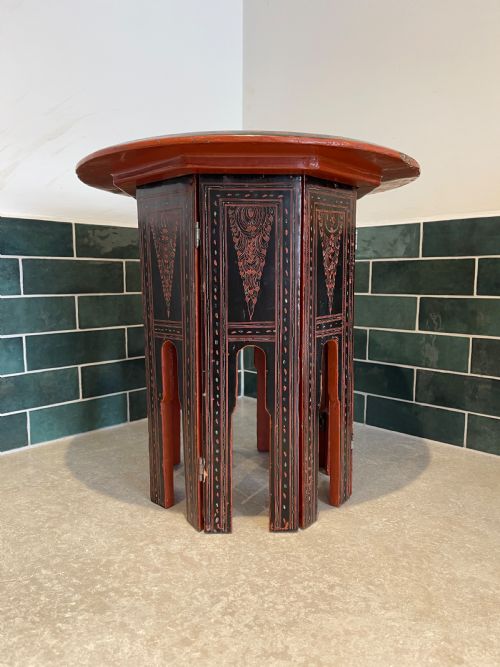


Black Carved Coffee Table
A black carved coffee table brings rich texture and dark tones to a room, spanning styles from Victorian Black Forest to Chinoiserie.
Black Carved Coffee Table
When you search for a black carved coffee table, you encounter low tables, side tables, occasional tables, and nests of tables drawn from diverse global traditions. The examples listed here embrace distinct stylistic lineages including Anglo-Indian, Anglo-Burmese, Chinese Traditional, Japonisme, and Victorian Black Forest.
The forms range from low Chinese ebonised coffee tables and Burmese lacquer pieces to intricate Victorian marble pietra dura tables and French etageres. You are most likely to meet low-slung Asian lacquer designs alongside nineteenth-century European interpretations featuring ebonised wood or dark walnut.
Origins stretch across the nineteenth and twentieth centuries, capturing periods from eighteen-fifty through nineteen-thirty. These tables function equally well as central coffee tables or low occasional surfaces, bringing deep dark finishes and carved relief into contemporary interiors.
How they were made
Maker's workshops utilised solid hardwoods, walnut, and oak, frequently applying ebonised finishes or black lacquer to achieve a dense dark surface. Raised relief detail, japanning, and marquetry inlay provide surface texture across these pieces.
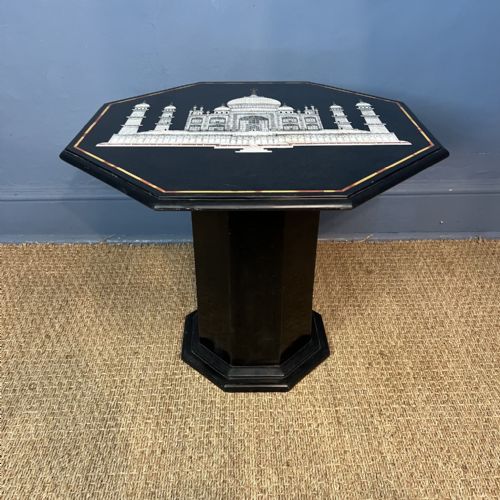
Detailing often incorporates stone inlay, soapstone, and black marble panels, particularly within pieces drawing on Italian Venetian or Indian Taj Mahal traditions. Carving ranges from deep figural work in Black Forest pieces to precise gilt lacquer on Chinese low tables.
The listings on this page span the nineteenth century up to nineteen-thirty, incorporating lacquer, marble, soapstone, and hardwood.
What varies in quality
The distinction between standard execution and finer work rests on the crispness of the carving and the depth of the lacquer or ebonised finish. Pieces displaying detailed raised relief work or integrated stone inlay demonstrate a higher level of workshop skill.
Material selection marks the division across the range, with solid hardwoods, walnut, and genuine marble panels sitting above simpler constructed items. The integrity of the surface decoration, whether marquetry inlay or gilt lacquer, defines the enduring character of the table.
Liberty of London
The Black Carved Coffee Table Glossary
- Ebonised wood
- Timber treated with stain or polish to imitate the deep black appearance of ebony. This finish was widely utilised in nineteenth-century furniture.
- Pietra dura
- An inlay technique using cut and fitted polished coloured stones to create pictorial designs. It appears on nineteenth-century table tops.
- Marquetry
- The art of applying pieces of veneer to a structure to form decorative patterns. Walnut and exotic hardwoods were frequently employed for this work.
- Black Forest
- A nineteenth-century carving style originating in Switzerland, known for naturalistic depictions of animals and foliage in dark wood. These pieces often incorporate deep relief work.
Black Carved Coffee Table: Frequently Asked Questions
Where do these black carved coffee tables originate?
The pieces originate from diverse global traditions, encompassing Anglo-Indian, Burmese, Chinese, French, and Victorian European workshops. Makers drew upon local timber and regional decorative techniques.
Designs reflect the aesthetic movements of their respective periods, ranging from nineteenth-century Black Forest carving to early twentieth-century Chinese lacquer.
How do I care for a lacquered or ebonised surface?
These dark surfaces require gentle dusting with a soft, dry cloth to protect the finish. Avoid harsh chemical cleaners and direct sunlight to preserve the lacquer or ebonised wood.
Keeping the table away from excessive moisture and heat sources will maintain the integrity of the wood and any inlay work.
Can I use a low side table as a coffee table?
Many occasional tables, side tables, and nests of tables function effectively as low coffee tables in contemporary settings. Their dimensions suit placement before a sofa or seating group.
Lower heights, particularly on Chinese ebonised low tables and Burmese pieces, align well with modern lounging proportions.
What is the difference between Chinoiserie and Japonisme?
Chinoiserie reflects European interpretations of Chinese artistic motifs, often utilising lacquer, raised relief, and gilt decoration on dark wood. Japonisme represents the later nineteenth-century fascination with Japanese art and design principles.
Both styles appear on dark wood tables from the period, though their decorative vocabularies draw from distinct cultural traditions.