


Banjo Wheel Barometer
A banjo wheel barometer is a domestic wall instrument combining weather tracking with classic cabinetwork, prized for its decorative presence.
Banjo Wheel Barometer
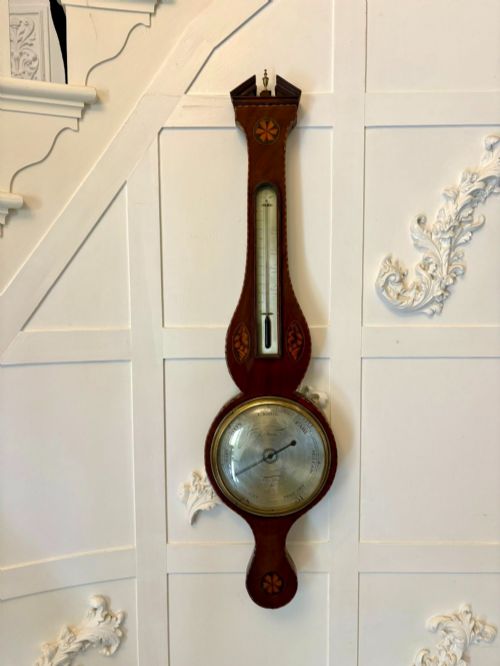
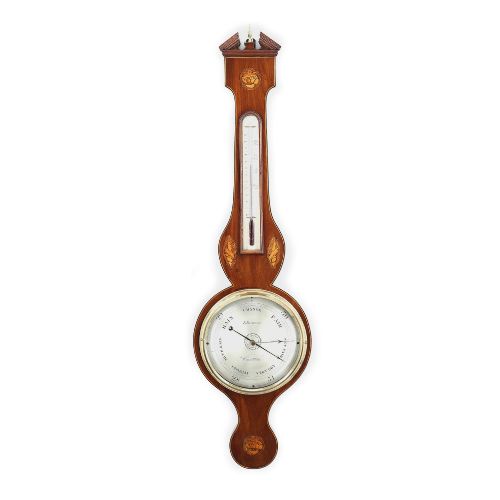
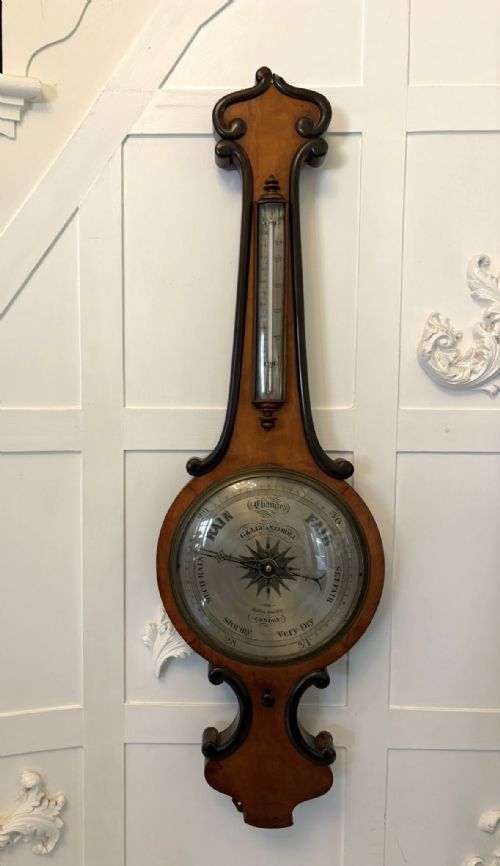
A banjo wheel barometer combines practical weather forecasting with decorative wall furniture, taking its name from the distinctive shape that echoes the musical instrument. These instruments typically feature a circular dial at the top for reading atmospheric pressure, mounted above a tapering trunk that often houses a thermometer or mirror.
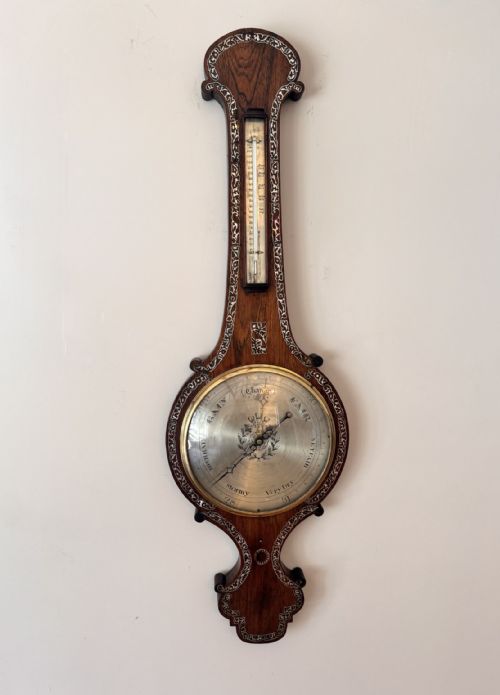
The version most commonly encountered on this page originates from the Georgian, Regency, and Victorian periods, manifesting as a wall barometer housed in richly grained timber. Makers constructed these cases using deep timbers such as mahogany, rosewood, and walnut, frequently embellishing the outlines with delicate stringing and shell or mother-of-pearl inlays.
Examples span the late eighteenth century through to the late nineteenth century, reflecting shifts in taste from austere neoclassical lines to heavily carved Victorian flourishes. Whether signed by provincial makers or prominent London firms, each piece serves as both a functional mercury barometer and a statement of domestic refinement.
Assessing Quality and Execution
The refinement of the cabinetwork and the crispness of the dial engraving dictate the standing of a piece within the range. Superior examples display dense timber selection, intricate shell or mother-of-pearl inlay aligned with precision, and well-proportioned carved pediments.
Signatures inscribed upon the silvered brass dial plate elevate an instrument, particularly when linked to recorded makers working in London or provincial trading centres. The complexity of the face layout, such as the inclusion of auxiliary dials, hygrometers, or spirit levels, indicates the ambition of the original commission.
Listings feature walnut, mahogany, and rosewood cases enhanced with mother-of-pearl and bone inlay across the Georgian and Victorian periods.
B. Besozzi of Weymouth·G & L Guanziroli London·Ganthony of London·Prada of High Wycombe·Molton of Norwich·Luisetti of London·Fagioli of Clerkenwell London·Giana Shrewsbury·Jenkins Of Old Swindon·L Casatelli of Liverpool·James H Kelly of Glasgow·Watkins·Roncoroni·W.E. Pain of Cambridge·H Marks High Street Bloomsbury·Hayward of Ashford·Vecchio & Co of Shaftsbury·A. Rivolta·J Groce York·Leone of Aylesbury·Jasper Salop·Poncia Worcester·C. Bellatti·W. N. Telford Chester·George Bateman London
The Banjo Wheel Barometer Glossary
- Mercurial Barometer
- An instrument measuring atmospheric pressure using a column of liquid mercury sealed in a glass tube. Changes in air pressure cause the mercury to rise or fall, moving a balanced weight connected to the dial pointer.
- Silvered Metal
- A brass or copper dial plate treated to achieve a brushed silver finish, subsequently engraved with weather descriptors, scales, and maker details. The markings are often filled with black wax to ensure legibility.
- Onion Top
- A rounded, bulbous pediment shape crowning the top of the barometer case. This architectural silhouette appears frequently on Victorian mahogany and walnut wall instruments.
- Marquetry
- The art of applying fitted pieces of wood veneer, shell, or bone onto a structural panel to create decorative patterns. Makers utilised this technique to adorn the central trunk and base of wall barometers with floral motifs and shells.
Banjo Wheel Barometer: Frequently Asked Questions
How do I read a banjo wheel barometer?
Read the main dial by observing the position of the pointer against weather inscriptions such as rain, change, and fair. The secondary pointer, adjusted by a central knob on the glass bezel, serves as a marker to track whether pressure is rising or falling since your last check.
Traditional mercury instruments respond to shifts in atmospheric pressure driven by local weather patterns. A rising pointer indicates improving conditions, while a falling pointer warns of incoming moisture or unsettled skies.
Where should I hang a wall barometer?
Hang your instrument on an interior wall that remains free from direct sunlight and dramatic temperature swings. Plaster or masonry walls provide a stable mounting surface that prevents the instrument from vibrating or shifting.
Avoid positioning the barometer near radiators, fireplaces, or exterior doors where rapid heat changes could affect the internal mechanism. A stable environment ensures the timber case remains sound and the mercury column reads accurately.
How do I date an antique barometer?
Examine the timber species, the style of the pediment, and the signature engraved on the dial face. Georgian pieces often feature simpler architectural lines and satinwood inlay, whereas Victorian examples tend towards heavier walnut cases and carved onion tops.
Maker signatures provide a reliable chronological anchor when cross-referenced with recorded working periods. Provincial clockmakers and instrument makers often stamped their towns and operating dates directly onto the brass dial plates.
Can antique barometers still be calibrated?
Most antique wheel barometers can be adjusted by a specialist using a reference instrument to align the internal pulley and counterweight. The linkage between the float and the dial pointer requires delicate handling due to the presence of exposed mercury.
Professional intervention ensures the mechanism operates smoothly without putting undue stress on the silk threads or brass gears. Once set against local barometric readings, the instrument will track weather changes reliably.