







Balkan Kilim Flatweave
These balkan kilim flatweave examples bring warmth and folk tradition to a floor through flatwoven wool and cotton textiles.
Balkan Kilim Flatweave
A balkan kilim flatweave represents a distinct tradition of floor coverings and rugs, emerging across periods spanning from the mid-nineteenth century into the early twentieth century. These textiles encompass specific forms such as area rugs and large room-size carpets, carrying designs rooted in regional folk art and traditional motifs.
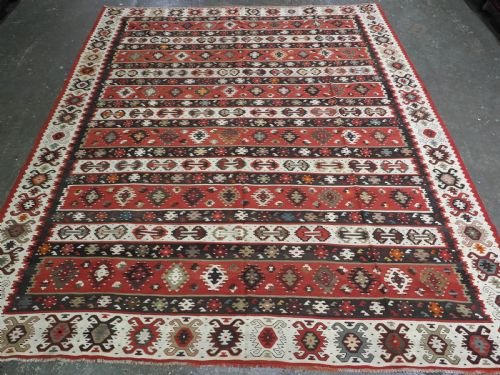
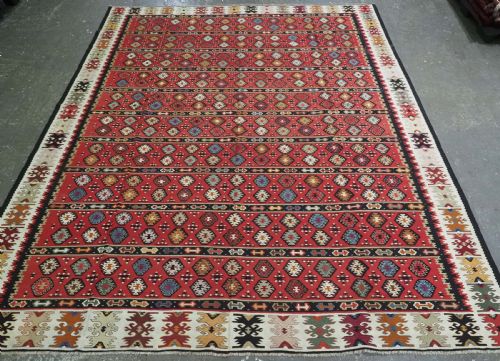
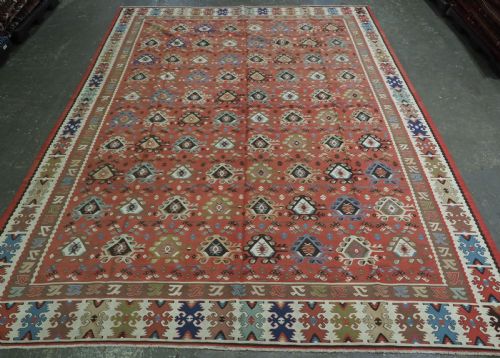
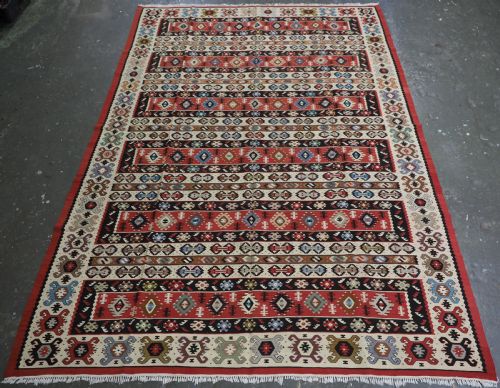
The version most commonly met on this page is the Sarkoy or Pirot kilim, frequently dated around nineteen twenty and documented under styles like Balkan Folk, Ottoman Balkan, and traditional Balkan. These pieces typically display banded, repeat medallion, or flowering tree patterns executed in formats suited for substantial living spaces.
Makers in this category worked within established regional idioms rather than individual signatures, producing pieces that function as both practical floor coverings and historical artefacts. The geographical attribution ranges across Ottoman Balkan, Thracian, and Turkish origins, uniting them under a shared flatweave construction.
Materials and construction methods
The construction of a balkan kilim flatweave relies primarily on wool and cotton fibres, utilised to build both the structural foundation and the patterned surface. Weavers interlocked the weft threads tightly across the warp to create a smooth, pileless textile without knots.
Natural dye traditions supplied the soft reds, pastels, and warm colour palettes recorded in the pieces, yielding gentle variations across large banded and repeat designs. The absence of pile allows the geometric and floral motifs to remain sharp and structurally integrated into the fabric.
Listings span production dates from eighteen sixty to nineteen thirty, constructed entirely from wool and cotton materials.
Judging quality in flatweave textiles
Quality in a balkan kilim flatweave rests on the precision of the flatweave technique and the integrity of the wool and cotton materials. Tighter tension in the weft interlacing produces a durable textile that maintains its structural form over decades of use.
Visual balance also defines the upper tier of these pieces, where repeat medallion, lattice, or flowering tree layouts demonstrate careful proportion and harmonious colour relationships. The preservation of original dimensions and the crispness of traditional motifs separate standard examples from superior survivals.
The Balkan Kilim Flatweave Glossary
- Flatweave
- A textile produced without knotted pile by interweaving warp and weft threads directly on a loom. This method creates a thin, reversible rug.
- Kilim
- A pileless rug or carpet originating from regions including the Balkans, Anatolia, and the Ottoman Empire. They are known for geometric and traditional folk designs.
- Sarkoy
- A specific regional designation for flatweave rugs produced in the Balkan region. These textiles often feature banded, medallion, or flowering tree motifs.
- Pirot
- A recognised centre of flatweave production located in the Balkans. Pirot kilims are celebrated for intricate geometric patterns and balanced layouts.
- Warp
- The vertical threads held under tension on a loom that form the structural foundation of the textile. Weft threads are woven horizontally through them.
- Weft
- The horizontal threads passed through the warp to build the pattern and colour of a flatweave. Tightly beaten wefts conceal the vertical warp entirely.
Balkan Kilim Flatweave: Frequently Asked Questions
What is a balkan kilim flatweave?
A balkan kilim flatweave is a pileless textile produced in the Balkan region, utilising wool and cotton materials woven into rugs and carpets. These pieces date from periods such as the mid-nineteenth and early twentieth centuries.
They display regional design traditions including banded patterns, repeat medallions, and flowering tree motifs associated with Balkan folk art.
How were these flatweaves used historically?
Historically, these textiles served primarily as functional floor coverings, area rugs, and large room-size carpets within homes. Their flat structure made them practical for walking upon while providing warmth.
Over time, they also functioned as decorative wall hangings and important household goods representing regional weaving traditions.
How do I care for an antique kilim?
Living with these textiles requires gentle maintenance, such as regular light vacuuming without a rotating brush bar to protect the flatwoven wool and cotton fibres. Professional cleaning suited for antique rugs preserves the natural dyes.
Keeping the piece out of direct sunlight prevents the soft reds and pastel tones from fading over the years.
How are Sarkoy and Pirot kilims distinguished?
Sarkoy and Pirot flatweaves share stylistic traits within the broader Ottoman Balkan tradition, often featuring banded layouts and repeat medallion designs. Attribution generally follows documented regional characteristics and historical weaving centres.
Both types employ similar wool and cotton construction methods while expressing local variations in folk art motifs.