





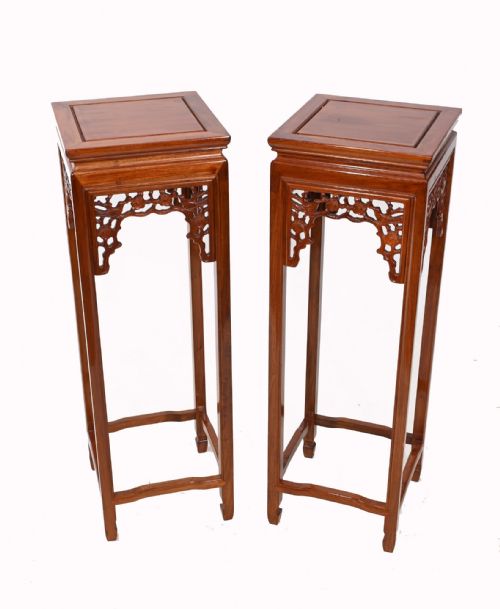

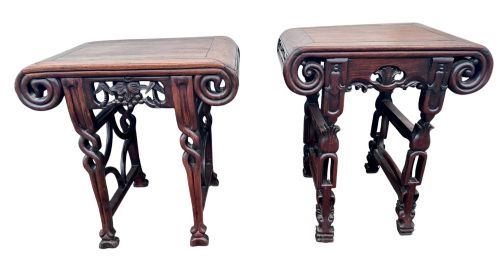


Asian Display Pedestal
An asian display pedestal elevates ceramics and plants with dense timber and inset stone, bringing tactile structure to a room.
Asian Display Pedestal
An asian display pedestal serves as a stable stage for heavy vessels, jardiniere bowls and imported plants. These pieces arrive from the nineteenth century, stretching across the Victorian era, the Meiji period and the Qing Dynasty.
The commonest forms on this page include plant stands, vase tables, occasional tables and tiered pedestals. Makers built them in singleton versions and matched pairs to suit formal interiors.
Materials and construction
Carpenters constructed these supports from dense timbers such as hardwood, rosewood, hongmu, padouk, ebonised elm and general lacquered wood. Many examples incorporate cool marble inserts to provide a contrasting, moisture-resistant surface for ceramic pots.
Detailing relies on hand carving, painted lacquer finishes and occasional mother of pearl inlay. Joinery methods prioritise rigid strength to support heavy stone and ceramic weights without shifting.
Asian Display Pedestal Retail Price Guide 2026
Typical asking prices for asian display pedestal among the pieces listed under this phrase on Sellingantiques today, from the lower quarter to the upper quarter. They describe what is for sale here now, not the wider market.
Some nineteenth-century makers designed these sturdy stands so well they outlasted the heavy plants that originally leaked water onto their marble tops.
Distinctions in craftsmanship
Quality rests in the crispness of the timber carving and the density of the chosen wood. Heavier rosewood and hongmu variants hold finer, deeper relief work than simpler softwood frames.
The fit of the inset marble top and the alignment of tiered joints determine the structural integrity. Superior examples display seamless joins and harmonious proportions between the top surface and the supporting legs.
The Asian Display Pedestal Glossary
- Hongmu
- A dense, dark tropical hardwood favoured in traditional Chinese furniture making. It accepts intricate carving without splintering.
- Jardiniere stand
- A tall, sturdy table designed specifically to hold large ornamental plant pots. These usually feature water-resistant stone or lacquered surfaces.
- Marble top
- A polished slab of stone fitted flush into the wooden frame of a table. It offers a cool, flat resting place for heavy vases.
- Meiji period
- The era of Japanese history lasting from eighteen sixty-eight to nineteen twelve. Pieces from this time often combine traditional joinery with distinct regional carving.
- Mother of pearl
- An iridescent inner shell layer used for delicate inlay work. Craftsmen embed small pieces into dark wood to create shimmering floral or geometric patterns.
Asian Display Pedestal: Frequently Asked Questions
What is an asian display pedestal used for?
These pieces function primarily to elevate heavy ceramic vases, bronze urns and potted plants. Raising the object improves its visibility and protects floors or lower furniture from damp soil.
Beyond utilitarian plant holding, they act as compact side tables or display surfaces in reception rooms. Their vertical emphasis draws the eye upward in a tight interior space.
How do I identify a Qing Dynasty stand?
Qing Dynasty pieces typically employ dense hardwoods like hongmu and feature deep, traditional hand carving. Look for distinct stylistic motifs and robust joinery that predates twentieth-century industrial methods.
Sellers often date these through wood oxidation and construction wear rather than maker marks. The presence of heavy marble inserts further points toward traditional nineteenth-century workshops.
Are these stands strong enough for heavy pots?
Most examples are engineered from heavy tropical hardwoods specifically to bear substantial weight. The inclusion of stone inserts adds considerable downforce stability to the frame.
Even so, checking the structural integrity of the lower stretchers is sensible before placing exceptionally heavy stone or ceramic vessels on top.
How do I style a pedestal in a modern room?
Pair a carved wooden stand with a simple, contemporary ceramic bowl to create a sharp textural contrast. The dense timber grain grounds minimalist interior schemes.
Position them in corners or beside seating where vertical height breaks up low furniture layouts. Singletons work well as lamp tables, while pairs frame doorways or fireplaces.