

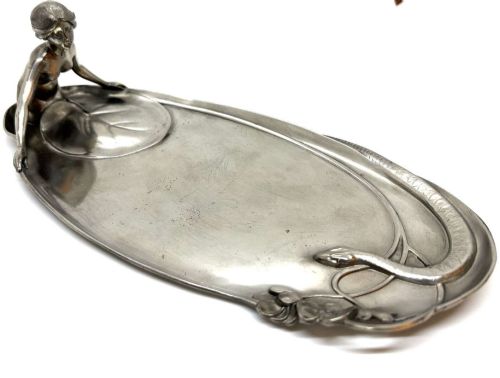


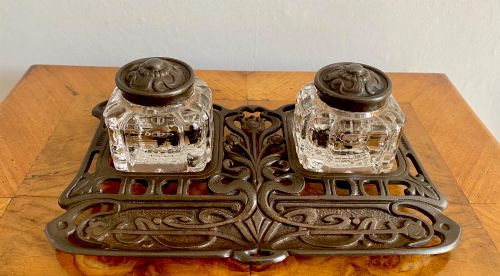


Art Nouveau Desk Tidy
These art nouveau desk tidy pieces bring flowing organic lines and naturalistic forms to your workspace, making everyday correspondence a pleasure.
Art Nouveau Desk Tidy
An art nouveau desk tidy brings organic forms and botanical motifs to the workspace through inkstands, card trays, and pen rests. These desk accessories organise writing equipment while introducing characteristic sinuous curves into the room.
The pieces on this page span the late Victorian and Edwardian eras, predominantly dating from around nineteen hundred. You will most commonly encounter cast metal inkwells and trays featuring stylized floral and maiden designs.
Makers such as Zimmermann and WMF produced varied forms ranging from simple pen trays to elaborate double inkstands with original glass bottles. French examples in copper sit alongside German pewter and British brass wares.
How they were made
Foundries shaped these items using metalcasting techniques, pouring brass, bronze, Britannia metal, and pewter into detailed moulds. Artisans then finished the surfaces with silver plating or silvering to enhance the reflective quality of the fluid designs.
Glass inserts, such as ink bottles and dishes, were mouth-blown and shaped to fit snugly into metal stands and waterfall frames. Metal components frequently received hand-chased detailing to sharpen the undulating plant stems and tendrils.
Art Nouveau Desk Tidy Retail Price Guide 2026
Typical asking prices for art nouveau desk tidy among the pieces listed under this phrase on Sellingantiques today, from the lower quarter to the upper quarter. They describe what is for sale here now, not the wider market.
Listings feature works in brass, bronze, copper, pewter, and silver plate dating from eighteen eighty to nineteen ten.
What varies in quality
The artistic ambition of the casting dictates the quality, separating mass-produced items from sculptural masterworks. Crisp, deep relief work on botanical elements shows careful tooling after the cast cools.
Completeness of the set alters the desirability, particularly the presence of original glass ink bottles and matching dishes. Silvered surfaces that retain their plating without excessive wear command greater interest.
WMF·Zimmermann·Maurice Dufrene
The Art Nouveau Desk Tidy Glossary
- Art Nouveau
- A style of art and design characterised by fluid, sinuous lines and motifs derived from plants and flowers. This aesthetic dominated European design around nineteen hundred.
- Britannia Metal
- A tin-based alloy used as a base for silver plating or left with its own bright finish. It was frequently cast into decorative domestic objects.
- Inkstand
- A desk accessory holding one or more inkwells along with compartments for pens, stamps, and wafers. These acted as the centrepiece of a nineteenth-century writing table.
- Geschutz
- A German term often stamped on metalware meaning protected or patented. It indicates the design was registered by the manufacturer.
- Silvered Pewter
- Pewter treated with a thin coating of silver to give it a brighter, more reflective appearance. This finish was favoured by continental European metalworkers.
Art Nouveau Desk Tidy: Frequently Asked Questions
What is an art nouveau desk tidy?
An art nouveau desk tidy is a decorative desk accessory designed to hold writing equipment, ink, and correspondence while displaying characteristic floral and organic motifs.
These items combine practicality with the flowing, sinuous aesthetic popular at the turn of the twentieth century.
How were inkwells used?
Inkwells held liquid ink for dip pens before fountain pens became common household items.
They sat upon desks alongside pen trays and blotters, requiring regular refilling and cleaning to keep the writing nibs working smoothly.
Are original glass inserts important?
Original glass ink bottles and dishes complete the historical integrity of an inkstand.
Finding pieces that retain their matching blown glass components adds considerably to the character of the desk tidy.
How do I date these metal items?
Dating relies upon stylistic markers, registration numbers, and known maker marks stamped into the base metal.
The organic abstraction typical of nineteen hundred helps distinguish these wares from earlier Victorian or later art deco designs.