



Art Nouveau Desk Stand
These art nouveau desk stand pieces bring sinuous botanical lines and organic form to a workspace.
Art Nouveau Desk Stand
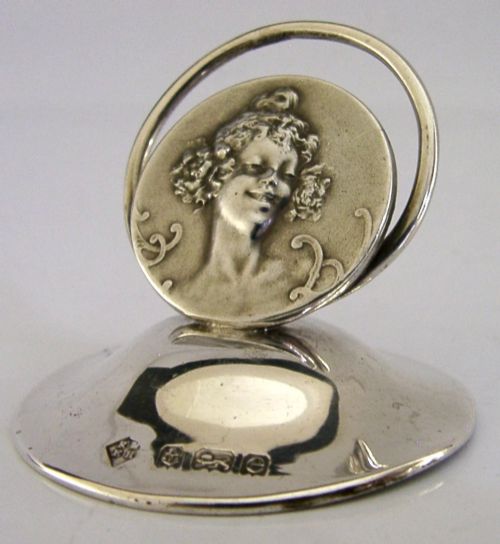
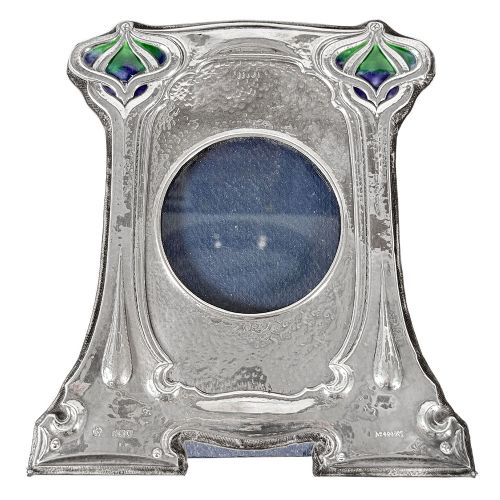
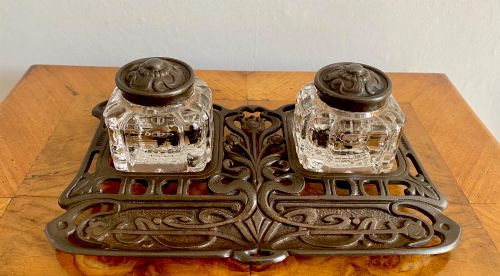
An art nouveau desk stand unites inkwells, pen rests, and glass dishes within a unified desktop design shaped by organic curves and flowing flora. Buyers seeking this phrase encounter varied tabletop accessories that serve as practical inkstands, menu holders, or inkwells from the turn of the twentieth century. The pieces recorded here span the 1890 period through the Edwardian era, carrying the characteristic aesthetic of the style into functional desktop furnishings. Alongside dedicated inkstands, related desk accessories such as revolving bookcases and photo frames appear in the selection.
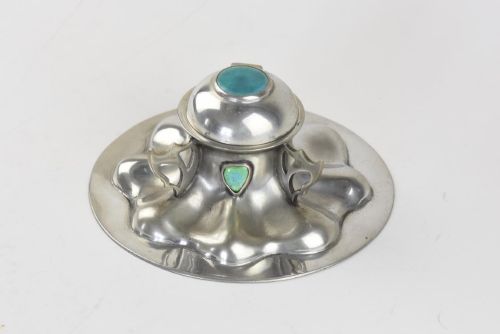
Most examples originate from the 1900 period, displaying the characteristic whiplash lines and vegetal motifs of the movement. Brass, pewter, bronze, and sterling silver form the primary metal bodies, often incorporating glass bottles, ceramic cabochons, or marble bases. While some items are complete desk sets with original ink bottles, others take the form of single inkwells or copper stands produced by continental and British makers.
Materials and construction
Metals such as brass, copper, pewter, and bronze are cast and chased to create the flowing, asymmetric contours typical of the movement. Silversmiths combine sterling silver with enamel or glass elements, while pewter items frequently incorporate ceramic cabochons or polished finishes. Gilding and silver plating are applied to bronze foundations to alter surface reflection and colour.
Glass is utilised for removable ink bottles and dishes, fitted directly into metal or marble receptacles. Wooden pieces employ mahogany with inlaid veneers or pine construction for larger desktop items like writing bureaux.
Art Nouveau Desk Stand Retail Price Guide 2026
Typical asking prices for art nouveau desk stand among the pieces listed under this phrase on Sellingantiques today, from the lower quarter to the upper quarter. They describe what is for sale here now, not the wider market.
Periods represented span from the Victorian era and 1880s through the Edwardian period and 1907.
Judging quality in desk accessories
Quality rests upon the crispness of the cast metalwork and the integration of decorative elements such as enamel panels or Ruskin cabochons. Finer examples display meticulous chasing and finishing by hand, whereas simpler production pieces rely purely on the initial cast without secondary detail work. The survival of original glass ink bottles, stoppers, and fitted components elevates an item significantly.
The choice of materials also dictates the standing of a piece, with gilded bronze, sterling silver, and signed metalwork representing the upper tier. Maker attribution, seen in works by designated silversmiths and bronze artists, separates standard commercial production from distinguished studio output.
William Hutton and sons·W M F·Albert Marionnet·Zimmermann·Maurice Dufrene
The Art Nouveau Desk Stand Glossary
- Cabochon
- A polished, convex gem or ceramic piece without facets, frequently set into metalwork as a decorative focal point.
- Chasing
- The manual technique of indenting and texturing metal surfaces with hammers and punches after casting.
- Inkstand
- A complete desk accessory comprising one or more inkwells, pen trays, and sometimes stamp boxes mounted on a shared base.
- Whiplash line
- The characteristic S-curve and undulating vegetal line that defines the visual rhythm of the style.
- Patina
- The surface sheen and colour acquired by metals through age, handling, and oxidation over decades.
Art Nouveau Desk Stand: Frequently Asked Questions
What is an art nouveau desk stand?
An art nouveau desk stand is a desktop accessory designed to hold writing equipment, featuring the flowing organic lines and botanical motifs of the turn of the twentieth century.
These pieces typically incorporate inkwells, pen rests, or glass dishes mounted within brass, bronze, pewter, or silver frames.
How were these stands used daily?
They sat on writing desks and tables to provide a designated, orderly place for wet ink writing, holding the necessary ink bottles and pens close at hand.
Desk stands kept ink from staining paperwork while adding an ornamental focal point to Victorian and Edwardian studies.
How do I distinguish Edwardian from Victorian pieces?
Victorian desk pieces often lean towards heavy, ornate brass or wood construction with formal symmetry and traditional ornamentation.
Edwardian items from around 1900 increasingly adopt the asymmetric, plant-inspired curves and whiplash lines characteristic of the new artistic movement.
How should I care for mixed metal stands?
Bronze, brass, and pewter benefit from gentle dusting with a soft cloth to preserve the accumulated patina and surface character.
Harsh metal polishes should be avoided, particularly on plated or patinated surfaces where aggressive cleaning removes historical depth.