


Art Deco Wooden Headboard
An art deco wooden headboard brings architectural geometry and striking grain figures straight into a modern bedroom.
Art Deco Wooden Headboard
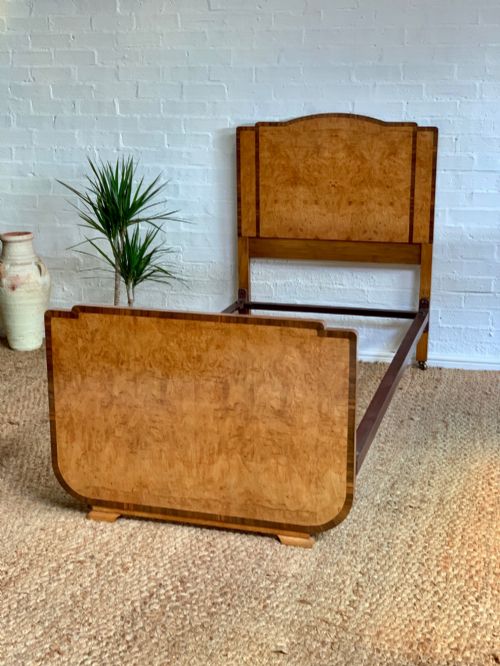
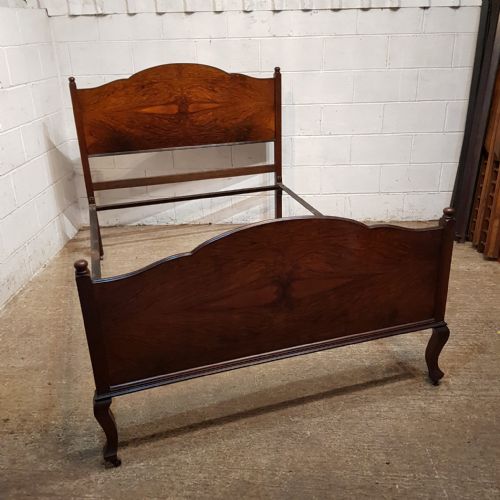
An art deco wooden headboard forms the central anchor of a period sleeping space, defining the architectural character of the room. When you search for an art deco wooden headboard, you encounter substantial bed frames and complete bedsteads rather than standalone panels. These pieces originate predominantly from the 1930s, displaying the characteristic geometric lines and streamlined silhouettes of the era.
How they were made
Cabinet makers utilised choice hardwoods and decorative veneers over solid timber carcasses to achieve striking visual patterns. Walnut and burr walnut dominate the construction, providing rich, swirling grain figures across wide surfaces. Craftsmen also applied blonde birds-eye maple and satinwood to introduce contrasting tones and geometric banding.
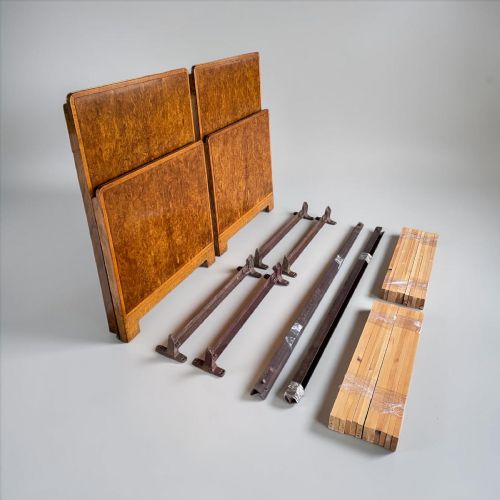
Surfaces received multiple layers of hand-polished lacquer or French polish to protect the delicate wood veneers while accentuating their natural lustre. Structural stability relied on robust internal timber framing, sometimes supplemented by iron fixings to support the heavy headboard and footboard assemblies.
The listings span pieces dated across the 1900s, 1920s, and 1930s, constructed predominantly in walnut, satinwood, and maple.
What varies in quality
The distinction between standard production items and exceptional pieces lies in the choice and matching of timber veneers. Master workshops selected heavily figured burr walnut or exotic satinwood, arranging the grain in symmetrical book-matched patterns across the bedstead. Simpler pieces rely on plain walnut with minimal grain movement and straightforward linear construction.
Integration of auxiliary furniture separates basic frames from high-end designer commissions. Superior examples feature seamlessly attached bedside cabinets, curved architectural pediments, and complex tiered styling that requires advanced woodworking joinery. The precision of the curved veneering and the crispness of the stepped mouldings dictate the overall grade.
Waring & Gillow England·Betty Joel
The Art Deco Wooden Headboard Glossary
- Veneer
- A thin slice of decorative hardwood applied over a stable secondary timber core. This technique allows makers to display striking grain patterns without risking the warping associated with solid exotic boards.
- Burr walnut
- A growth deformity on a walnut tree that produces swirling, highly decorative grain patterns when sliced. Cabinet makers prized these sections for central focal panels.
- Bedstead
- A complete framework for a bed, including headboard, footboard, and side rails. Unlike a simple panel fixed to a wall, these stand as unified architectural furniture pieces.
- Odeon style
- An architectural design influence characterised by stepped curves and monumental rounded forms reminiscent of cinema design from the period. This shape gives large headboards their distinctive silhouette.
Art Deco Wooden Headboard: Frequently Asked Questions
How do I fit an old bedstead?
Traditional wooden bedsteads use integrated timber side rails that slot directly into the headboard and footboard posts.
Modern mattress bases often require discreet wooden slats or adaptor brackets to sit securely within the historic frame dimensions.
Are these beds standard sizes?
Period dimensions often differ slightly from modern metric mattress standards, particularly in length and width.
Many double and king frames accommodate contemporary mattresses comfortably, but checking the internal clearance measurements remains essential before purchase.
How do I care for walnut veneer?
Maintain polished wood surfaces by dusting regularly with a soft, dry cloth and avoiding placement near direct heat sources.
Apply a quality beeswax polish occasionally to nourish the grain and protect the historical finish from drying out.
Can I separate attached bedside tables?
Attached cabinets and bedside units form an integral structural component of the overarching headboard design.
Attempting to detach these elements compromises both the architectural integrity and the original aesthetic balance of the bedstead.