
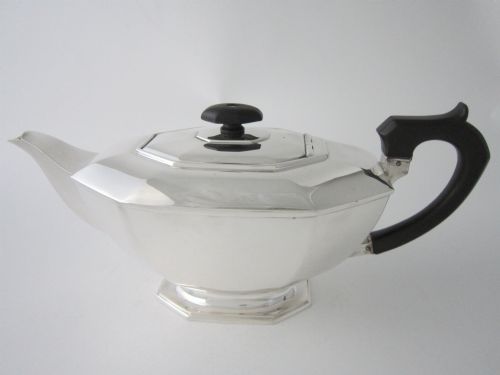
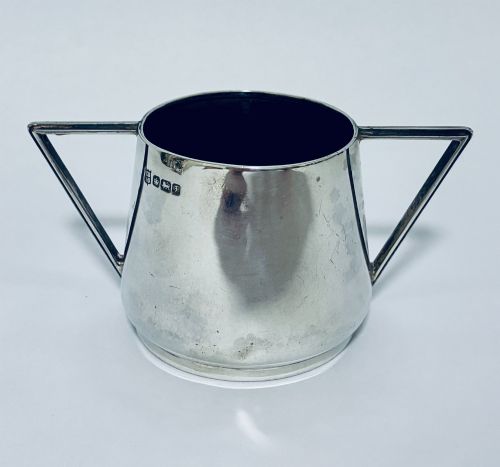


Art Deco Tea Service
An art deco tea service brings geometric symmetry and the sharp lines of the interwar years straight to the table.
Art Deco Tea Service
An art deco tea service combines form and function through the distinct geometric language of the 1920s, 1930s, and 1940s. These sets coordinate teapots, coffee pots, sugar bowls, and cream jugs into unified assemblages designed for modern entertaining.
The most common versions met here range from sturdy silver-plated metalware to fine bone china and earthenware decorated with stylised floral or linear motifs. Many pieces hail from Staffordshire potteries or British silversmiths active during the interwar period.
Complete settings vary from compact tea-for-two arrangements to larger four-piece ensembles that include matching trays and salvers. Buyers encounter both sterling silver creations and ceramic services bearing characteristic geometric patterns.
How they were made
Metalsmiths shaped sterling silver and silver plate through spinning, hammering, and soldering, often incorporating ebonised wood handles or ivory insulators to prevent heat transfer. Pewter sets utilised casting and lathe-turning techniques to achieve clean, angular profiles.
Ceramic services relied on bone china, porcelain, and earthenware bodies formed by slip casting or pressing, then hand-painted or transfer-printed with vibrant glazes. Kiln firing fixed the colours and hardened the surfaces for daily domestic use.
The Cube tea set solved the perpetual rolling problem of round pots by adopting a stable, stackable square geometry.
What varies in quality
Material weight and gauge dictate the substance of metal services, where thicker silver plate or solid sterling construction provides greater durability and presence on the table. The precision of the joints, handles, and spouts reveals the maker's technical capability.
Ceramic quality rests in the crispness of the transfer print or the hand-painted brushwork, alongside the translucency and finish of the bone china or porcelain body. Well-preserved glazes without crazing and undamaged pattern work distinguish superior ceramic sets.
Armada Pewter·Georg Jensen·Clarice Cliff·Shelley·Doric China·Mappin & Webb·Walker & Hall·Gladstone Potteries·Alfred Meakin·Edward Barnard·Henry Clifford Davis·Stower & Wragg·A. Davenport·Noritake
The Art Deco Tea Service Glossary
- Sterling Silver
- An alloy containing 92.5 percent silver by mass, widely used by British silversmiths for high-end tea services.
- Bone China
- A type of porcelain containing animal bone ash, producing a strong, highly translucent ceramic body favoured by Staffordshire potteries.
- Silver Plate
- A base metal, such as nickel silver, coated with a thin layer of pure silver through electroplating.
- Ebonised Wood
- Timber treated to resemble ebony, frequently utilised for insulating handles on metal teapots.
- Salver
- A flat metal tray used for serving tea or drinks, often matching the geometric motifs of the accompanying pot.
Art Deco Tea Service: Frequently Asked Questions
What pieces comprise a standard set?
A standard service typically includes a teapot, a sugar bowl, and a cream jug, while larger configurations add coffee pots and matching trays.
Additional items such as sugar tongs or tea cups frequently accompany specific settings depending on the original manufacturer's design.
How do I care for silver plated sets?
Clean silver plate and sterling silver gently using warm water and a mild detergent, avoiding harsh abrasive cloths that damage the surface.
Dry the metal immediately with a soft cloth to prevent water spots and store pieces in dry conditions.
Can I use these sets daily?
Ceramic and metal sets function adequately for serving hot beverages, though older glazes and delicate handles require careful handling.
Hand washing remains essential to preserve hand-painted ceramic patterns and prevent degradation of ebonised wooden elements.
How do I identify the period?
Makers' marks, pottery stamps, and silver hallmarks stamped onto the base provide definitive clues regarding the manufacturing date and origin.
Stylistic cues such as stepped geometric handles and angular spouts point directly to the interwar decades.