







Art Deco Statement Necklace
An art deco statement necklace brings striking geometry and bold materials together, offering the quintessential look of the interwar years.
Art Deco Statement Necklace
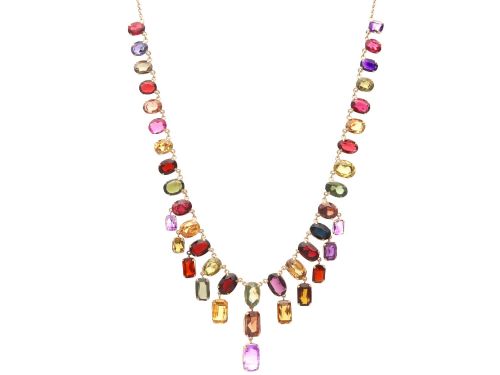
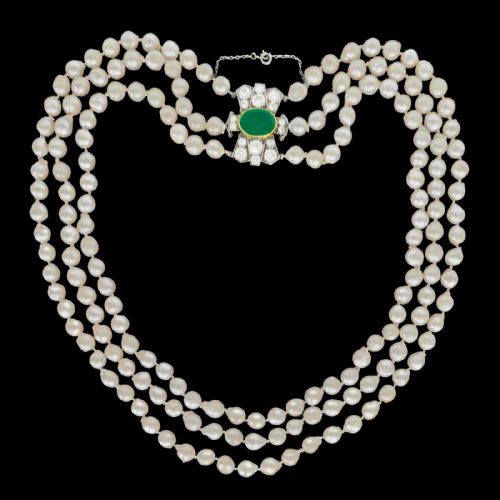
An art deco statement necklace is a substantial piece of neckwear designed to draw the eye with geometric impact and period character. You will most frequently encounter fringe necklaces, layered strands, and modernist designs originating from the nineteen-twenties and nineteen-thirties.
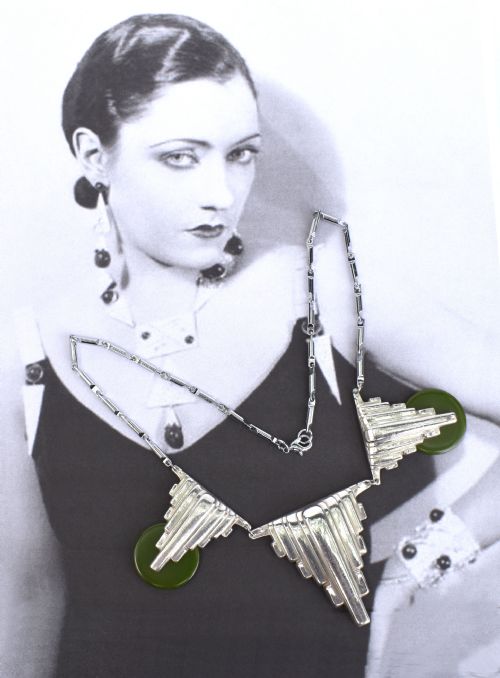
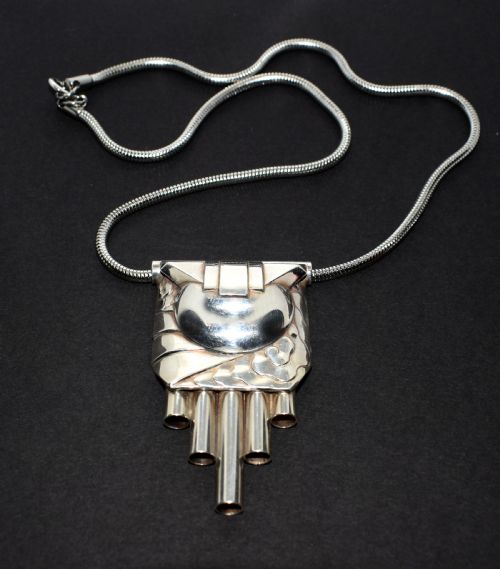
The selection ranges from precious platinum and diamond fringe pieces to industrial chrome and colourful plastics like bakelite or galalith. This variety spans glamorous high-society jewels and bold, avant-garde modernist costume pieces.
How they were made
Precious versions utilise platinum and white gold as a lightweight, strong foundation to set diamonds, sapphires, aquamarines, and jadeite securely. Bench jewellers utilised meticulous hand-piercing and fringe construction to achieve fluid movement across the chest.
Modernist and industrial examples pair chrome and silver with bakelite, galalith, or enamel to create striking blocks of colour and metallic sheen. These materials reflect the machine-age enthusiasm for novel synthetics and industrial metals.
Art Deco Statement Necklace Retail Price Guide 2026
Typical asking prices for art deco statement necklace among the pieces listed under this phrase on Sellingantiques today, from the lower quarter to the upper quarter. They describe what is for sale here now, not the wider market.
Early plastic necklaces sometimes smell faintly of camphor when rubbed, a quirky chemical telltale for the seasoned collector.
What varies in quality
Quality rests in the architectural harmony of the design and the precision with which the stones or synthetic elements are integrated. Superior pieces display seamless articulation and a balanced weight that sits correctly against the collarbone.
In gemstone pieces, the cut and matching of diamonds, sapphires, or jadeite dictate the upper tier, while in plastic and chrome pieces, originality of components and crispness of the geometric moulding separate the ordinary from the exceptional.
Jacob Bengel
The Art Deco Statement Necklace Glossary
- Fringe necklace
- A necklace featuring drops or pendants suspended closely along the front section to create a cascading effect. This style was particularly popular during the nineteen-twenties.
- Bakelite
- An early thermosetting phenol formaldehyde resin used extensively in twentieth-century jewellery for its vibrant colours and durability. It remains highly collectible today.
- Galalith
- A semi-synthetic plastic made from casein and formaldehyde, often utilised in modernist jewellery for its smooth finish and rich colour depth.
- Platinum
- A dense, ductile precious metal prized for its strength and white lustre, allowing delicate stone settings without bulk.
Art Deco Statement Necklace: Frequently Asked Questions
What defines an art deco statement necklace?
These necklaces are defined by their strong geometric motifs, symmetrical or sharply linear patterns, and a commanding presence on the neckline. They break away from organic Victorian curves in favor of industrial-inspired design.
They utilise both precious gemstones and novel twentieth-century materials to achieve a high-impact visual style.
How do I wear a vintage statement necklace?
Because of their visual weight, these necklaces work best when allowed to be the focal point of an outfit. Pair them with simple necklines that do not compete with the geometry of the piece.
Keep other jewellery minimal to let the necklace sit comfortably and draw proper attention.
Are bakelite necklaces considered fine jewellery?
Bakelite pieces fall into the category of costume or modernist designer jewellery rather than fine gemstone jewellery. However, their historical significance and distinct aesthetic command strong collector interest.
They represent an important shift toward accessible, design-led style in the interwar period.
How do I distinguish platinum from silver?
Platinum is noticeably heavier than silver and maintains its bright white finish without tarnishing over time. It is typically marked with specific precious metal stamps and is found alongside diamonds and high-value gemstones.
Silver acquires a natural patina and appears alongside stones like marcasite, onyx, or turquoise.