


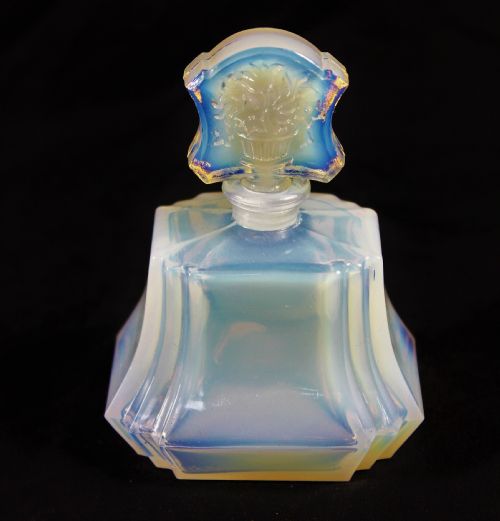
Art Deco Dressing Accessories
Art deco dressing accessories comprise vanity items and personal requisites designed to adorn the dressing table and toilette in striking geometric style.
Art Deco Dressing Accessories
Art deco dressing accessories encompass a varied array of vanity and grooming items produced principally during the nineteen-twenties, nineteen-thirties, and nineteen-forties. The selection focuses heavily on perfume bottles, scent bottles, and atomizers, alongside powder boxes, trinket boxes, and vanity jars.
Buyers also encounter functional grooming pieces such as silver shaving sets, clothes brushes, hand mirrors, and complete dressing table sets. Gentlemen's requirements appear through geometric and modernist enamel cufflinks.
Figural pieces add distinctive character to the category, including ceramic bathing belle powder boxes, flapper powder puff dolls, and porcelain hatpin holders. Most surviving examples date from around nineteen-thirty.
Materials and construction methods
Makers utilised a combination of sterling silver, silver mounts, and chrome to frame glass, crystal, and ceramic bodies. Cut glass and overlay glass vessels often received intricate surface decoration.
Enamel and guilloche enamel work provided vibrant colour contrasts on silver, glass, and metal surfaces, particularly in blue and green tones. Fabric elements supported powder puffs and dressing textiles.
Art Deco Dressing Accessories Retail Price Guide 2026
Typical asking prices for art deco dressing accessories among the pieces listed under this phrase on Sellingantiques today, from the lower quarter to the upper quarter. They describe what is for sale here now, not the wider market.
Materials represented across the inventory include sterling silver, chrome, porcelain, fabric, ceramic, and various cuts of glass.
Judging the range
Quality rests on the crispness of the geometric moulding and the precision applied to guilloche enamel and metal mounts. Pieces attributed to documented makers display superior refinement in glass-cutting and silver-smithing.
The integrity of enamel surfaces and the matching of components within sets dictate the distinction between standard production items and finer studio or factory output.
Karl Palda·Henry Perkins·Asprey & Co·René Lalique·Fasold & Stuach·Sabino
The Art Deco Dressing Accessories Glossary
- Guilloche
- An intricate mechanical engraving technique that produces precise, repetitive patterns beneath translucent enamel. This decorative surface appears frequently on silver lids and compacts.
- Atomizer
- A spray bottle mechanism utilising a bulb and tube assembly to diffuse perfume. These glass vessels frequently feature metal mountings and vibrant enamel decoration.
- Bathing belle
- A ceramic or porcelain figurine modelled in swimwear, commonly seated upon or forming the lid of a powder trinket box. These humorous figures capture period leisure themes.
- Hatpin holder
- A ceramic or porcelain vessel pierced or shaped to store long hatpins on the dressing table. They often take figural forms such as flapper figures.
- Overlay glass
- A glass-making technique involving layers of contrasting colours fused together before cutting. This process exposes lower layers to create graphic patterns.
Art Deco Dressing Accessories: Frequently Asked Questions
What items belong to dressing sets?
Dressing sets incorporate matched pieces for the vanity table, including perfume bottles, clothes brushes, hand mirrors, and powder jars. They coordinate in material and decorative style.
Silver mounts and enamel work frequently tie the individual components together into a cohesive suite.
How do I identify glass atomizer bottles?
Atomizer bottles feature specialised metal spray collars and internal siphon tubes designed for misting perfume. The glass bodies range from simple crystal cylinders to heavy cut glass and opalescent designs.
Many examples incorporate coloured enamel or overlay techniques characteristic of the period.
Were cufflinks part of dressing accessories?
Men's geometric and modernist enamel cufflinks frequently accompany vanity items in period collections. They share the characteristic colour palettes and metallic finishes of the dressing table.
Enamel geometric patterns match the visual vocabulary found on contemporary powder boxes and scent bottles.