
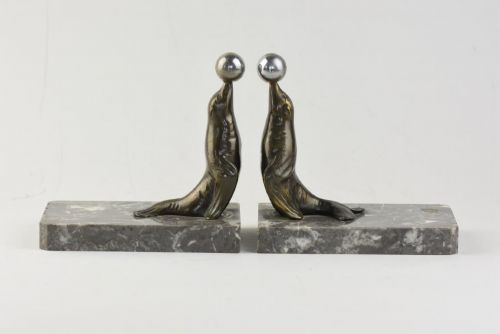


Art Deco Animal Bookends
Art deco animal bookends bring sculptural weight to a shelf, pairing period forms with domestic subjects.
Art Deco Animal Bookends
When you search for art deco animal bookends, you are looking at utilitarian shelf supports cast or carved into the likeness of creatures, mostly originating from the nineteen-twenties and nineteen-thirties alongside a small number from the nineteenth century. These objects combine the functional need to keep volumes upright with the era's taste for stylized fauna, ranging from household pets to marine life.
On this page, you are most likely to meet pairs depicting dogs such as greyhounds, Scottish terriers and spaniels, alongside squirrels, sea lions and bamboo dogs. The forms appear as both matched pairs and individual sculptures adapted for the task, shaped by the decorative idioms of interwar design.
How they were made
The construction relies heavily on metal casting, utilising bronze, silvered bronze, brass, and spelter to capture crisp contours and detailed fur or fins. These metal figures are frequently mounted onto heavy bases of marble or hardwood to provide the necessary weight for holding books in place.
Alternative materials include bamboo and carved stone, showing how makers combined organic textures with metallic elements. Technique focused on achieving clean silhouettes and characteristic postures typical of the period, whether through foundry casting or skilled carving.
Canines dominate the menagerie, letting Scottish terriers and greyhounds guard your shelf alongside unexpected sea lions.
What varies in quality
Quality in these pieces is dictated by the fidelity of the casting and the quality of the finish, such as the depth of the silvering on bronze or the smoothness of the marble bases. Finer examples display sharper anatomical details and cleaner lines in the animal subjects, while simpler pieces rely on basic casting with minimal hand-finishing.
The choice of materials also separates the range, with solid bronze and heavy marble sitting at a different level of craftsmanship compared to lighter spelter or brass castings. The integration between the animal figure and its supporting base reveals the care taken by the maker during assembly.
Franz Gruber·C Omin·Karl Hagenaur
The Art Deco Animal Bookends Glossary
- Spelter
- A zinc alloy commonly used as a less expensive alternative to bronze during the early twentieth century. It accepts patination well but is softer and lighter than copper-based metals.
- Silvered bronze
- Bronze that has been treated with a silver coating to give a bright, reflective surface. This finish was favoured for its modern appearance in interwar interiors.
- Patina
- The surface sheen and coloration developed through age and handling on metals like bronze and brass. It indicates natural ageing rather than applied modern finishes.
- Interwar
- The period between the First and Second World Wars encompassing the nineteen-twenties and nineteen-thirties. Much of the design vocabulary seen in these objects originates from this span.
Art Deco Animal Bookends: Frequently Asked Questions
Are these bookends heavy enough for large books?
Many examples combine dense materials like marble and solid bronze to provide substantial weight for holding heavy volumes upright.
Lighter metal castings on stone bases still offer adequate resistance for standard shelf use.
How do I identify the period of these pieces?
Stylistic cues such as streamlined animal forms and geometric bases point directly to the interwar decades.
Materials like spelter and silvered bronze further confirm manufacture during the early twentieth century.
Where should I place them in a room?
They work best on sturdy bookshelves or heavy wooden mantelpieces where their sculptural qualities can be appreciated.
Keep them away from damp areas to protect vulnerable finishes on the metal and stone.
Why are some pairs made of different metals?
Makers selected materials based on cost and the desired aesthetic effect, ranging from precious bronze to economical spelter.
Combinations of metal figures on marble bases were standard practice for stability and decorative contrast.