

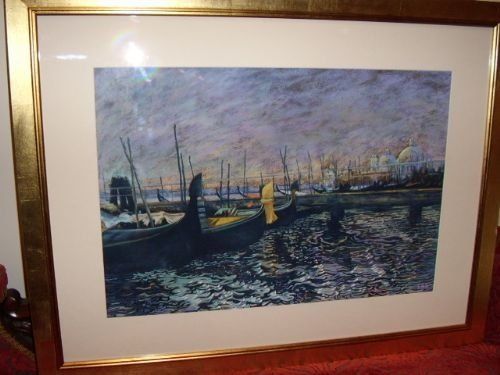
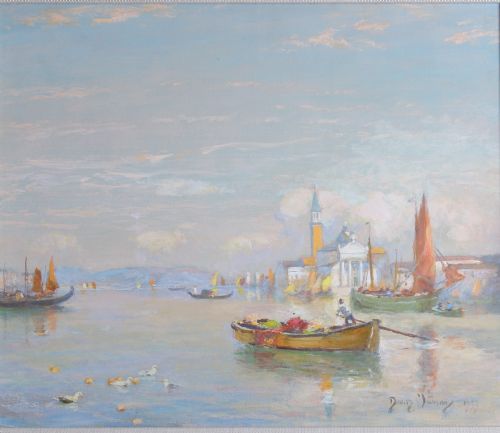
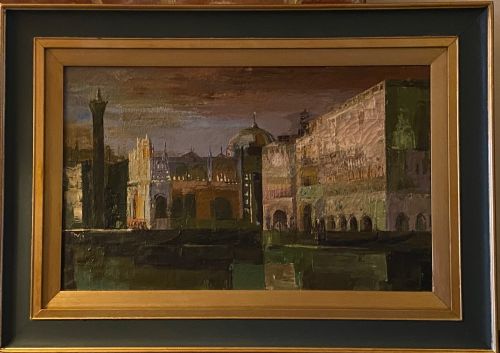
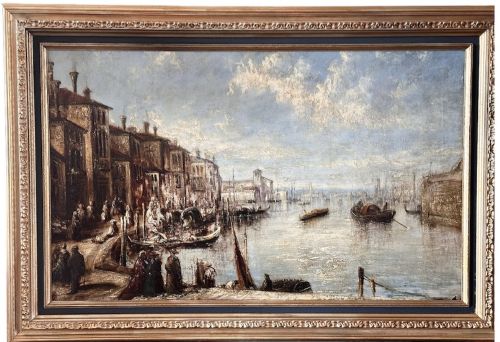
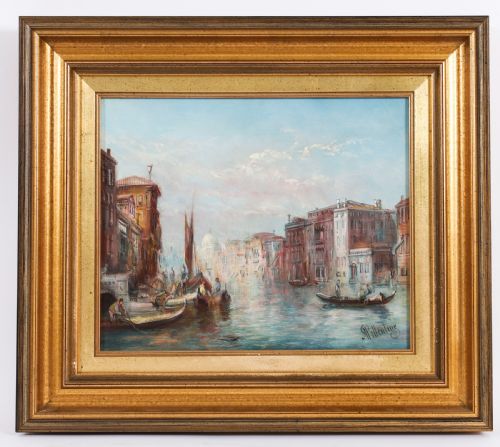


Antique Venice Canal Scene
These antique Venice canal scene artworks capture the timeless romance of the floating city through oil and watercolour.
Antique Venice Canal Scene
An antique Venice canal scene depicts the historic waterways, palazzos, and bridges of Italy, frequently featuring gondolas on the Grand Canal or the Lagoon. These works span from the Victorian era through the mid-twentieth century, capturing the changing light on Venetian architecture.
You will encounter various interpretations, ranging from traditional nineteenth-century oil paintings to early twentieth-century watercolours and pastel works. Many pieces focus on iconic landmarks such as the Bridge of Sighs and Santa Maria della Salute.
The materials used reflect traditional fine art practices, with artists employing oil paint on canvas or watercolour on paper. Framed presentations in wood and gilded wood frequently accompany these historic depictions.
How they were made
Artists utilised oil paint on canvas to build rich textures and deep tones, allowing for the depiction of shimmering water and atmospheric light. Watercolour on paper offered a more fluid, immediate medium well suited to capturing transient reflections on the canals.
Support materials typically included stretched canvas, wood panels, and heavy paper, often housed within bespoke wood and gilded wood frames. Pigments were applied using fine brushes and palette knives to delineate intricate architectural details of Venetian mansions.
Antique Venice Canal Scene Retail Price Guide 2026
Typical asking prices for venice canal scene among the pieces listed under this phrase on Sellingantiques today, from the lower quarter to the upper quarter. They describe what is for sale here now, not the wider market.
Listings feature works from the Victorian era up through the 1960s, executed in oil on canvas, watercolour, and pastel.
What varies in quality
Quality in these artworks rests upon the artist's ability to render light, water, and perspective convincingly rather than the mere age of the canvas. Masterful handling of atmospheric haze and architectural precision distinguishes accomplished academic and impressionist works from standard decorative pieces.
The depth of the palette and the preservation of the paint surface also determine value, as well-maintained oil on canvas or vibrant watercolour paintings retain their original visual impact much better than compromised examples.
Sir David Murray RA·Alfred Pollentine·Francis Moltino·Claude Jousset·Antoine Bouvard Senior·Jane Vivian·William Raymond Dommersen·Vittore Zanetti Zilla·Frank Wasley·William Knox·Helen Donald-Smith
The Antique Venice Canal Scene Glossary
- Gouache
- An opaque watercolour paint that dries to a matte finish, allowing artists to add solid highlights to works on paper.
- Lagoon
- The shallow body of water in which Venice is situated, frequently depicted in nineteenth-century and early twentieth-century coastal views.
- Palazzo
- A grand residential building or palace in Italy, commonly featured lining the canals in these paintings.
- Pastel
- A dry medium made of powdered pigment and a binder, used to create soft-edged compositions with gentle colour transitions.
Antique Venice Canal Scene: Frequently Asked Questions
What periods do these paintings come from?
The available artworks largely date from the nineteenth century through the mid-twentieth century, encompassing Victorian creations as well as impressionist pieces.
Earlier nineteenth-century works often showcase detailed architectural renderings, while later twentieth-century examples lean towards looser impressionistic interpretations of the city.
Are these works painted on canvas or paper?
Both mediums appear frequently across the selection, depending on the artist's preferred technique and the era of production.
Oils are typically executed on canvas or wood panels, whereas watercolours, pastels, and ink drawings utilise paper supports.
How should I frame and display them?
Many pieces come preserved in their original wood or gilded wood frames, which complement the traditional aesthetic of the artwork.
Protect watercolour and pastel pieces on paper from direct sunlight by using UV-filtering glass during framing to prevent fading.
How do I identify different Venetian landmarks?
Artists frequently painted specific architectural icons such as the Bridge of Sighs, the Doge's Palace, and Santa Maria della Salute.
Familiarising yourself with these prominent structures helps determine the exact viewpoint captured along the Grand Canal or the Giudecca.