


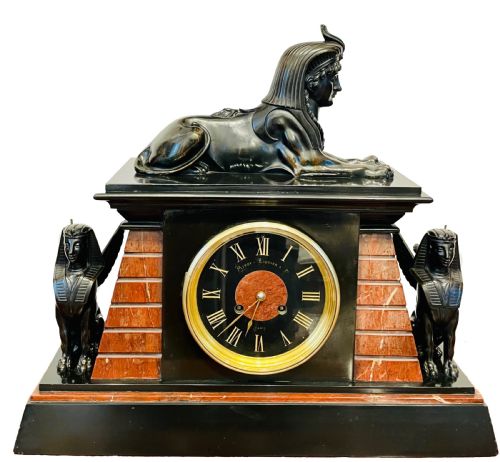


Antique Stone Shelf Clock
An antique stone shelf clock brings architectural weight and steady mechanics into a room, forged in marble, slate and onyx.

Antique Stone Shelf Clock
An antique stone shelf clock is a heavy timekeeper designed to sit on a mantelpiece, shelf or cabinet, driven by mechanical movements. The pieces on this page span the Victorian era, the nineteenth century and the Art Deco period, showing how domestic timekeeping shifted from classical revivalism to geometric modernism.
You will most frequently meet Victorian marble and slate mantel clocks alongside later Art Deco examples in marble and green onyx. Architectural forms dominate, echoing ancient temples and classical buildings through pediments, columns and stepped profiles.
The materials are substantial, relying on natural stone rather than wood or porcelain to create presence. Makers utilised black slate, Sienna marble and contrasting brass accents to build structures that weighed heavily on a surface.
How they were made
The construction of an antique stone shelf clock relies on heavy slabs of marble, slate or onyx cut, shaped and polished to form architectural cases. Masons built these housings to enclose mechanical movements driven by eight day springs or pendulums, often incorporating glass bezels to protect the enamel dials.
Designers applied decorative vocabulary through incised engraving, gilt highlights and contrasting stone inlays rather than surface paint. Egyptian influence and neoclassical motifs appeared as applied bronze ornaments or carved pediments fixed directly to the stone body.
Some Victorian householders relied on heavy slate clock cases so dense they doubled as domestic security measures.
What varies in quality
Quality in an antique stone shelf clock rests in the ambition of the architectural design and the purity of the stone selection. Pieces with intricate Sienna marble veining or complex architectural massing stand apart from plain, uniform boxes.
The integration of secondary materials defines the upper tier of manufacture. Well-wrought brass bezels, crisp enamel dials and finely cast bronze details separate ambitious workshop production from simpler domestic timepieces.
Philippes Paris·Elliott
The Antique Stone Shelf Clock Glossary
- Slate
- A fine-grained metamorphic rock used extensively for Victorian clock cases, often painted black or polished to resemble more expensive marbles.
- Sienna marble
- A yellow-gold Italian marble featuring dark grey and brown veining, prized for its warm decorative impact on nineteenth-century clock cases.
- Drumhead clock
- A timepiece featuring a circular clock face housing mounted centrally within a larger architectural stone or slate plinth.
- Enamel dial
- A fused glass-on-metal clock face carrying painted numerals, providing a durable and crisp surface for telling time.
- Egyptian Revival
- A nineteenth-century design style incorporating pharaonic motifs, scarabs and temple pylons into architectural objects.
Antique Stone Shelf Clock: Frequently Asked Questions
Where should I place a stone clock?
These heavy timekeepers need a sturdy surface like a mantelpiece, sideboard or heavy shelf capable of supporting significant weight.
Keep them away from damp walls and direct sunlight to protect the stone polish and the mechanical movement inside.
How do eight day movements work?
An eight day movement requires winding once a week using a key inserted into holes on the enamel dial.
Spring-driven or weight-driven mechanisms then regulate the escapement to turn the hands steadily across the face.
How do I date a marble clock?
Victorian examples often feature classical architectural styling, columns and Sienna marble or black slate.
Art Deco pieces from the nineteen-twenties and thirties abandon these classical tropes for geometric lines and materials like green onyx.
Are these clocks very heavy?
Solid blocks of marble, slate and onyx create substantial weight, making these clocks far heavier than wooden counterparts.
Lifting them safely requires two hands beneath the base rather than gripping upper architectural elements like pediments.