




Antique Spyglass Telescope
An antique spyglass telescope is a portable optical instrument designed for distance viewing, combining historical brass, leather, and wood into functional scientific craft.
Antique Spyglass Telescope
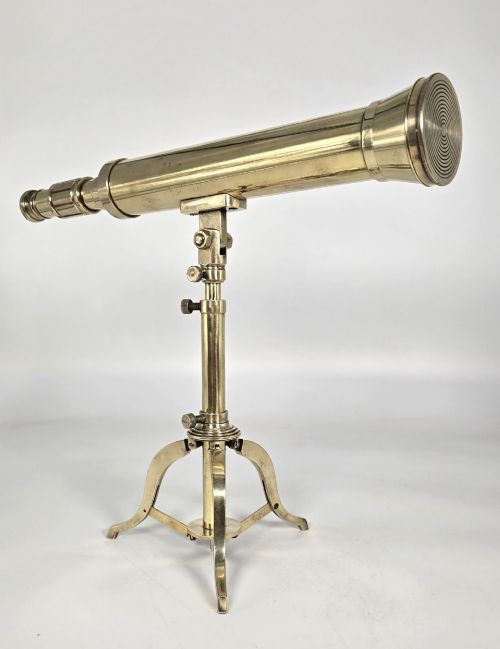
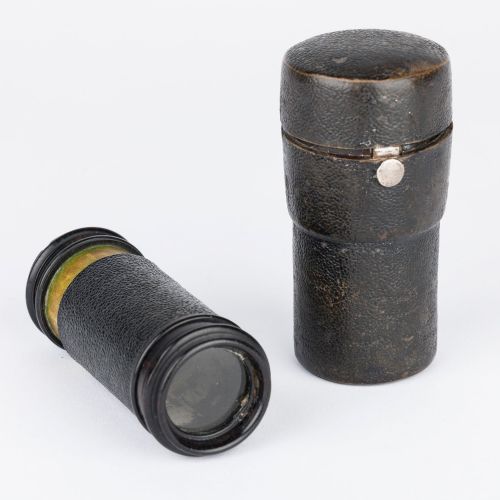
An antique spyglass telescope takes many forms across the selection, ranging from pocket-sized brass tubes to substantial library telescopes mounted on folding stands. Buyers encounter compact pocket spyglasses alongside multi-draw marine and naval instruments utilised for navigation and observation.
The objects stem from periods including the eighteenth century, the Georgian and Regency eras, through to Victorian, Edwardian, and early twentieth-century maritime contexts. Formats span simple single-draw tubes up to six-draw extending telescopes, cased instruments, and specialised walking cane combinations.
Most pieces derive from English workshops and makers, though German naval and optical instruments also appear. The selection balances handheld terrestrial monoculars with table-top scientific and navigational apparatus.
What varies in quality
The standard of an antique spyglass telescope rests upon the precision of its optical lenses and the mechanical integrity of its draw-tubes. Superior examples maintain smooth tension across multiple draws without looseness, preserving sharp focus over terrestrial distances.
Execution and finishing dictate higher tiers, visible in engraved maker signatures, precise decimal calibration, and clean joinery on leather or wood jackets. The inclusion of original fitted boxes, protective caps, or dedicated brass support stands elevates the completeness of the piece.
Antique Spyglass Telescope Retail Price Guide 2026
Typical asking prices for spyglass telescope among the pieces listed under this phrase on Sellingantiques today, from the lower quarter to the upper quarter. They describe what is for sale here now, not the wider market.
Some Victorians concealed their optics entirely inside hollow walking stick canes topped with bone handles for covert strolls.
Nairne & Blunt of London·Ross of London·Voigtländer & Sohn AG·W. & T. Gilbert·Clarkson London·Steward of London·Richardson·Newton & Co·Broadhurst Clarkson & Co·Cary London·L. Casella London·Chadburn Brothers of Sheffield·S & B Solomons·Matthew Berge London·G.adams of London·Dollond·Davis of London·John Gilbert
The Antique Spyglass Telescope Glossary
- Draw
- A sliding tubular section of a telescope that extends outward from the main barrel to adjust focal length. Multiple draws allow a long instrument to collapse into a compact size.
- Terrestrial telescope
- An optical instrument designed for viewing land objects rather than astronomical bodies, containing erecting lenses to render the image upright. These pieces form a large part of the maritime and library selection.
- Library telescope
- A larger optical instrument intended for stationary use on a table or desk, frequently supported by a folding brass tripod or wooden stand. They offer greater magnification than portable pocket spyglasses.
- Officer of the watch telescope
- A marine instrument deployed by naval personnel for signalling, spotting, and watchkeeping duties at sea. They usually feature durable brass and leather construction suited to harsh weather.
- Non achromatic
- An early optical configuration that produces chromatic aberration or colour fringing around high-contrast image edges. These represent earlier technological phases before corrected doublet lenses became standard.
Antique Spyglass Telescope: Frequently Asked Questions
How do I use an antique telescope?
Extend all the sliding brass draws fully until the instrument reaches its maximum length. Adjust the smallest eyepiece tube inward or outward gently until the distant view sharpens into focus.
Keep the optical lenses clean using soft materials to avoid scratching the historical glass. Store the instrument in a collapsed position inside a suitable dry environment when not in active use.
Were these used at sea?
Many of these instruments served as marine, naval, or officer of the watch telescopes on ships. Their robust brass and leather construction protected the internal optics from salt spray and rough handling.
Shorter pocket spyglasses and multi-draw day or night models allowed captains and crew to scan the horizon quickly. Other heavier forms remained ashore in libraries or country houses for land observation.
How do I date an antique spyglass telescope?
Examine any engraved signatures or maker names on the brass draw tubes, as historical trade directories record active operational dates. The number of draws, the materials used like mahogany or walnut, and the typography on the barrel provide further chronological clues.
Georgian and Regency pieces tend to exhibit simpler forms and specific barrel shaping compared to later Victorian multi-draw designs. Cased sets and accompanying brass tripod stands also reflect the prevailing manufacturing standards of their respective decades.
Can I mount a table top telescope?
Certain library and table-top models arrive with original folding brass tripod stands or fitted tabletop mounts designed to support their weight. These stands screw directly into collar mounts attached to the main brass barrel.
Using the designated stand prevents hand fatigue during extended viewing sessions and stabilizes the magnified image. Ensure the mounting screw is tightened securely before adjusting the focus.