
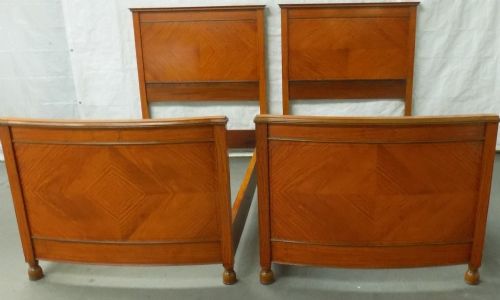


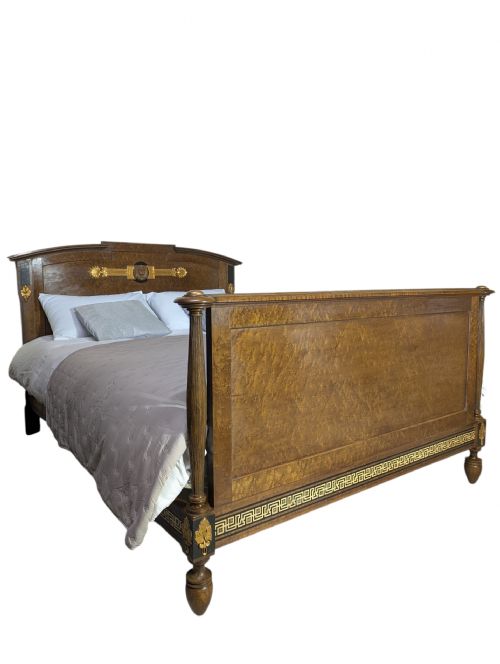


Antique Satinwood Bedstead
An antique satinwood bedstead brings luminous, golden grain into a bedroom, drawing the eye with its pale sheen and refined Edwardian or Art Deco lines.
Antique Satinwood Bedstead
An antique satinwood bedstead forms a striking centrepiece for the bedroom, fashioned primarily from exotic timber with a naturally bright, reflective quality. When searching for an antique satinwood bedstead, buyers encounter forms ranging from single sizes and pairs to double frames, often produced during the Edwardian era, the Victorian period, and the nineteen-thirties.
The pieces appearing on this page showcase distinct stylistic chapters, moving from inlaid Edwardian framing to geometric Art Deco designs and French Empire influences. Single beds and double bed frames dominate the available selections, frequently incorporating contrasting woods alongside the principal satinwood surface.
Craftsmanship spans both late nineteenth-century workshops and twentieth-century studios, reflecting changing domestic tastes across several decades. Buyers are most likely to meet Edwardian inlaid examples or nineteen-thirties blonde wood frames when browsing these listings.
How they were made
Cabinetmakers utilised dense timber foundations, applying fine satinwood veneers to create smooth, light surfaces with characteristic chatoyancy. Structural elements often integrated contrasting materials such as mahogany, walnut, and macassar ebony to frame the golden panels.
Metal components played a crucial role in construction, with iron and brass frequently utilised for internal frame brackets, rails, and decorative mounts. Painted decoration also appears on specific nineteenth-century pieces, adding floral or classical motifs directly onto the timber.
Some nineteenth-century makers concealed their iron assembly bolts behind tidy wooden buttons that lovers of antique joinery still delight in finding.
What varies in quality
The standard of an antique satinwood bedstead depends heavily on the selection of the timber veneer and the precision of its grain alignment. Superior examples display a uniform, luminous figure across large flat panels without heavy patching or mismatched sections.
Maker attribution and decorative detail elevate specific pieces, particularly where delicate stringing, marquetry inlay, or painted artistry remain crisp and intact. The integration of structural hardwoods like mahogany beneath the show-wood also distinguishes more robust constructions from lighter alternatives.
Shapland and Petter·Maple and Co·Betty Joel
The Antique Satinwood Bedstead Glossary
- Satinwood
- A hard, durable tropical timber known for its yellowish colour and high natural lustre. It takes a fine polish and was heavily favoured for high-end cabinetmaking.
- Veneer
- A thin layer of superior wood applied over a secondary timber base to create decorative surfaces. This technique allowed makers to display dramatic grain patterns economically.
- Inlay
- A decorative technique where pieces of contrasting wood, shell, or metal are inserted into recesses flush with the surface. Edwardian makers often used this to frame panels.
- Bedstead
- A framework of a bed supporting the mattress and springs, distinct from modern integrated divans. Antique versions usually feature distinct headboards, footboards, and side rails.
Antique Satinwood Bedstead: Frequently Asked Questions
Will an antique satinwood bedstead fit modern mattresses?
Many older bed frames were built to historical dimensions that differ slightly from modern standard mattress sizes. Adjustments to slats or custom-made mattresses are sometimes necessary for a proper fit.
Buyers should measure the interior width and length of the side rails carefully before purchasing bedding or mattresses for these frames.
How do I care for satinwood surfaces?
Satinwood benefits from gentle dusting with a soft, dry cloth and should be kept away from direct sunlight to preserve its pale golden colour. Excessive moisture and modern aerosol polishes can damage the delicate historic finish.
Application of traditional microcrystalline wax once or twice a year helps nourish the timber and protect the polished surface against drying out.
Are these beds easy to dismantle and assemble?
Most period wooden beds utilise traditional iron bolts or slot-in joints connecting the headboard, footboard, and side rails. These systems allow the furniture to be taken apart for transport and reassembled securely in the room.
Care is required during assembly to ensure all metal fixtures are tightened evenly without straining the surrounding antique wood.