

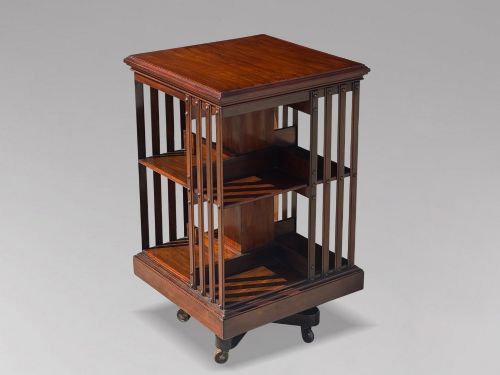


Antique Rotating Shelf
An antique rotating shelf brings accessible order to a room, offering smooth turning movement and clever storage for daily reading.
Antique Rotating Shelf
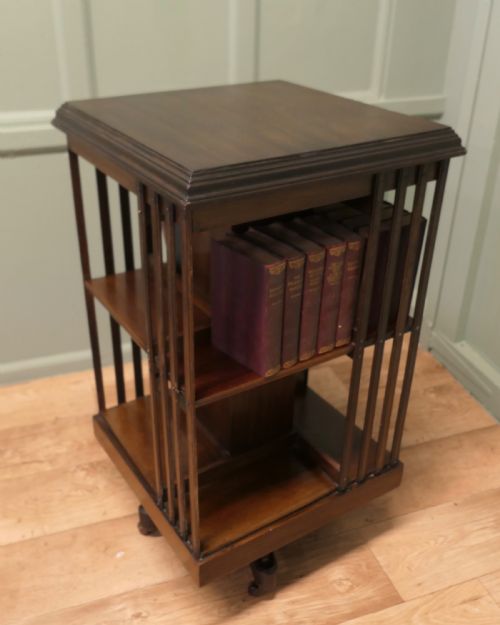
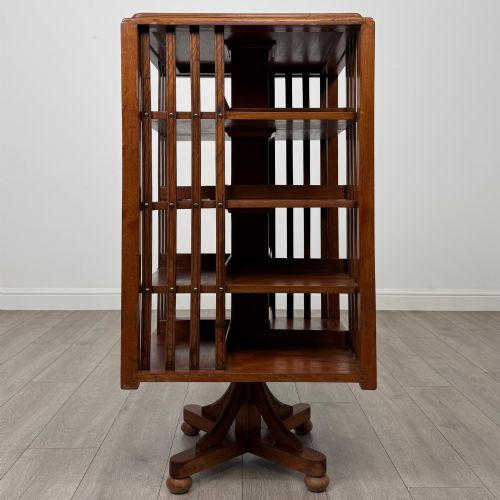
An antique rotating shelf primarily takes the form of a revolving bookcase, designed to sit neatly beside a desk or chair for easy access to volumes. These pieces emerge predominantly from the Edwardian and Victorian eras, spanning the late nineteenth century through to the early decades of the twentieth.
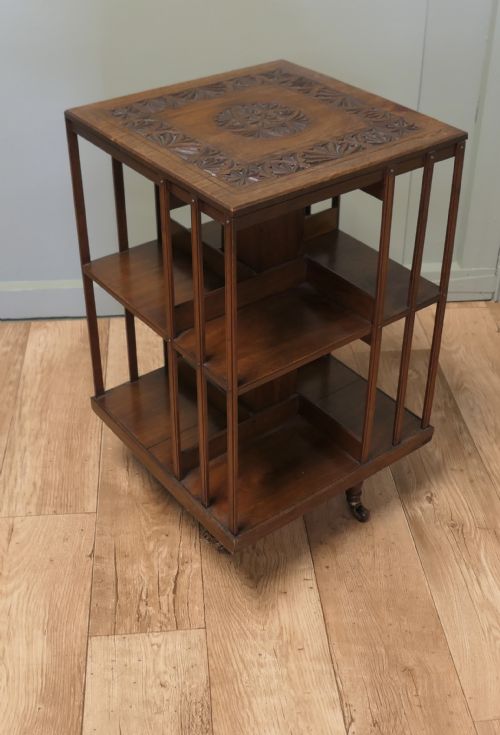
The most common formats on this page are two-tier and four-tier wooden bookcases that spin on a concealed mechanism. Alongside standard Edwardian and Victorian iterations, rarer stylistic variations such as Anglo-Indian designs appear in mahogany and oak.
How these pieces were made
Cabinet makers constructed these revolving shelves using rich timbers like mahogany and oak, often selecting satinwood for contrasting details and inlay. Brass and cast iron components formed the internal bearing mechanisms that allowed the upper tiers to turn smoothly without friction.
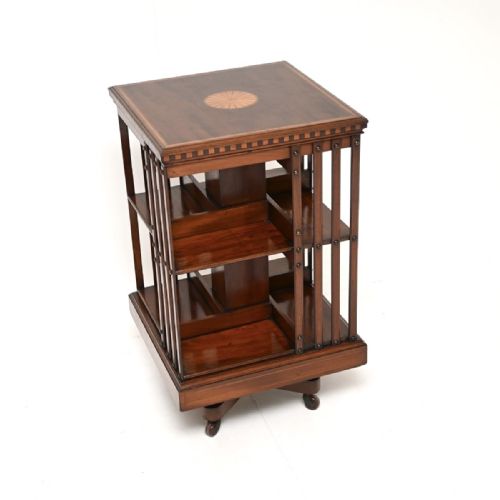
Woodworking techniques combined traditional joinery with turned spindles and carved details to decorate the uprights and tiers. Artisans incorporated satinwood inlay into mahogany surfaces to add visual depth to Edwardian examples.
Antique Rotating Shelf Retail Price Guide 2026
Typical asking prices for rotating shelf among the pieces listed under this phrase on Sellingantiques today, from the lower quarter to the upper quarter. They describe what is for sale here now, not the wider market.
Listings feature items primarily from the Edwardian period, accompanied by nineteenth-century Victorian pieces and later 1930s examples.
What varies in quality
The distinction between standard and superior pieces rests on the choice of timber and the precision of the turning mechanism. Heavier proportions, such as those found on very large oak or mahogany tiers, require robust internal engineering to maintain an effortless spin over decades.
Decorative embellishments also separate the ordinary from the exceptional, particularly the fineness of satinwood inlay and the crispness of carved woodwork. Pieces exhibiting thoughtful secondary woods and sophisticated Anglo-Indian carving demonstrate a higher level of workshop output.
The Antique Rotating Shelf Glossary
- Revolving bookcase
- A freestanding set of shelves designed to rotate on a central pivot base. This mechanism allows a reader to access multiple sides of books from a single seated position.
- Tier
- An individual level of shelving stacked vertically within the bookcase structure. Most examples feature two or four tiers.
- Satinwood inlay
- A decorative technique where contrasting light satinwood is fitted into recesses within a darker primary wood like mahogany. It creates geometric or floral patterns across the surface.
Antique Rotating Shelf: Frequently Asked Questions
How do I care for a revolving mechanism?
Keep the internal pivot clean and free from dust accumulation over the years. Avoid using heavy oils unless the turning action specifically requires lubrication.
Check that the weight of books remains evenly distributed across the shelves to prevent uneven strain on the central spindle during rotation.
Where should I place a revolving bookcase?
Position the piece beside a desk, armchair, or reading nook where its 360-degree rotation is fully accessible. Ensure there is enough clearance around all sides for the books to spin freely.
Keep the timber away from direct heat sources and strong sunlight to protect polished mahogany and oak surfaces from drying out.
How do I distinguish Edwardian from Victorian pieces?
Victorian examples from the nineteenth century tend to display heavier proportions and deeper, darker mahogany tones. They often reflect robust construction suited to dense collections of heavy volumes.
Edwardian pieces from the early twentieth century frequently incorporate lighter satinwood inlay and sleeker frames. These designs lean towards decorative refinement while maintaining practical capacity.
Can these shelves hold heavy books?
Most standard revolving shelves easily accommodate ordinary octavo volumes and novels. The internal wooden and iron mechanisms are built to bear standard reading loads.
Very large reference volumes place more stress on the central pivot and tiers, so distribute heavier tomes evenly across the lower levels.