


Antique Religious Medal
An antique religious medal serves as both wearable devotion and miniature art, carrying centuries of French craftsmanship inside yellow gold and enamel.
Antique Religious Medal
An antique religious medal takes the form of small pendants, charms, and medallions designed for personal devotion and worn close to the heart. When searching for an antique religious medal, buyers typically encounter French works produced across the late nineteenth and early twentieth centuries.
The objects commonly depict the Virgin Mary, the Madonna and Child, or patron saints alongside motifs like the Sacred Heart. These pieces frequently double as jewellery pendants or charm necklaces, combining spiritual significance with the delicate aesthetics of Art Nouveau and traditional ecclesiastical design.
Examples originate predominantly from French workshops active between eighteen ninety and nineteen fifty. The standard format involves a small stamped or carved gold disc fitted with a suspension loop for daily wear.
How they were made
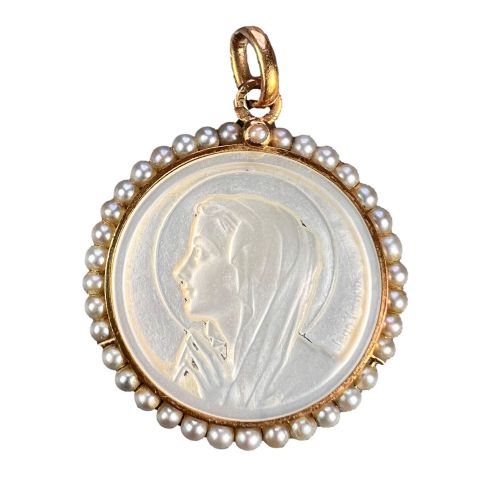
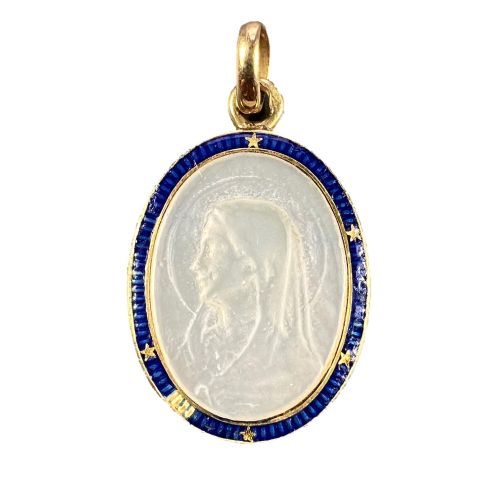
Goldsmiths worked primarily in eighteen-carat yellow and rose gold, shaping the metal through stamping and delicate hand-engraving. Many examples incorporate mother of pearl as a luminous background for sacred figures carved in low relief.
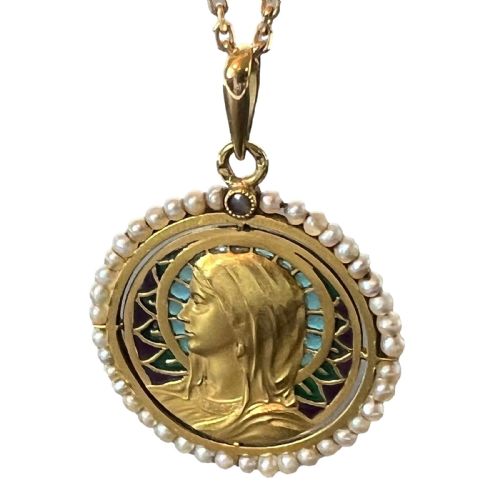
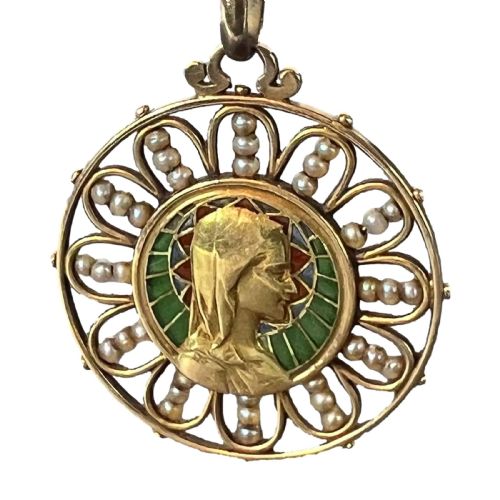
Enamel work appears frequently, ranging from opaque red applications on crosses to translucent plique-à-jour techniques that let light pass through the coloured glass cells like stained glass. Artisans also set seed pearls around the borders to frame the central devotional imagery.
The inventory spans the period from eighteen ninety to nineteen fifty, dominated by French devotional output.
What varies in quality
The distinction between standard production and exceptional work rests upon the precision of the miniature sculpture and the skill involved in surface decoration. Medals bearing the signatures of known French medallists display superior facial expressions, sharper drapery folds in garments, and more deliberate compositional balance.
The complexity of the enamelling technique separates ordinary pieces from masterworks. Intricate plique-à-jour panels require immense technical control to avoid fracturing the glass, whilst simpler solid enamel applications rely entirely on smooth, even colour distribution.
Emile Monier·Paul Brandt·Mazzoni·Pageli Perriat·Emile Dropsy·Guilbert·Vernon·Sellier·Rasumny·Ovide Yencesse·Tairac·Becker·Karo
The Antique Religious Medal Glossary
- Plique-à-jour
- An enamelling technique where the enamel is fired in open-backed cells, creating a stained-glass effect that transmits light directly through the design.
- Seed pearl
- A very small, naturally formed or cultured pearl utilised in clusters or borders to accent the primary subject.
- Medallion
- A large metal disc struck or cast with commemorative, decorative, or religious imagery intended for suspension.
- Mother of pearl
- The iridescent internal layer of mollusc shells, carved and polished to provide a shimmering backdrop for engraved figures.
- Sacred Heart
- A traditional Christian devotional symbol representing the physical heart of Jesus Christ as a focal point for divine love.
Antique Religious Medal: Frequently Asked Questions
What do these medals depict?
These pieces predominantly portray the Virgin Mary, the Madonna and Child, and various revered saints such as Saint Christopher and Saint John the Baptist. Iconography also includes the Sacred Heart and traditional ecclesiastical crosses.
Specific scenes often commemorate milestones like first communions or serve as travel protections, reflecting the personal spiritual life of the original owner.
How are they usually worn?
The pieces function as pendants, charms, or medallions suspended from thin gold chains around the neck. Their small scale allows them to sit comfortably alongside other personal talismans or as a single focal piece.
Many retain their original suspension loops, designed to integrate easily into both historical and modern necklace settings.
How do I identify the period?
Dating relies heavily on stylistic markers such as flowing Art Nouveau botanical lines or the cleaner geometric shifts of the nineteen-twenties. Maker marks and French gold assay stamps stamped onto the suspension rings or edges also provide reliable chronological anchors.
Examining the complexity of the enamelling and the relief depth helps narrow down the era of production between eighteen ninety and nineteen fifty.
Are these items purely decorative?
While highly valued today for their miniature goldsmithing and delicate materials, these objects originated as items of active religious devotion. They were often commissioned for sacred rites, personal prayer, or protection during travel.
Today, wearers appreciate this dual heritage, valuing the items as both portable works of fine art and meaningful spiritual symbols.