

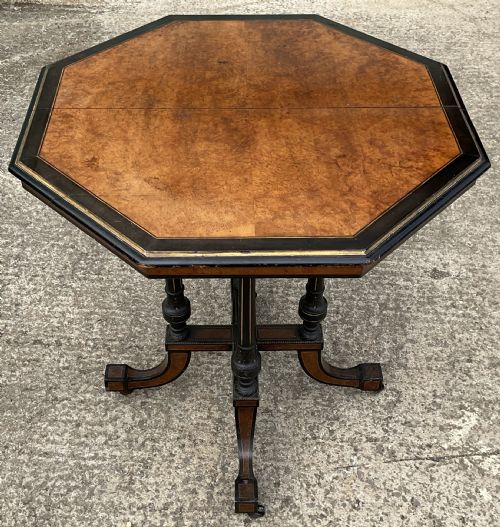

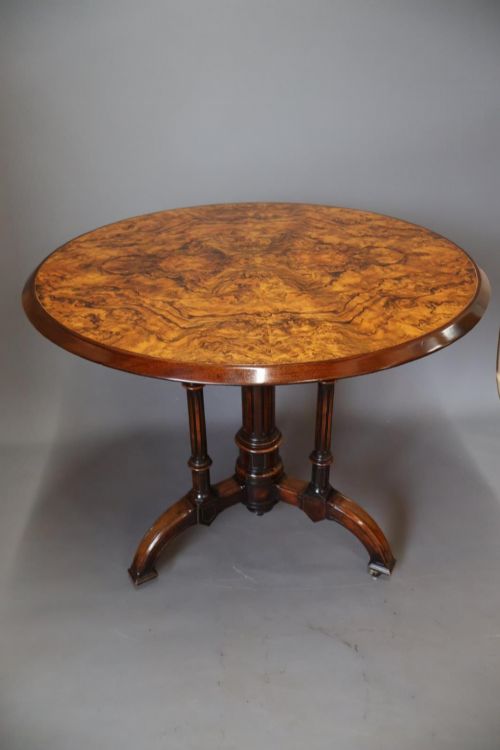


Antique Quadruped Centre Table
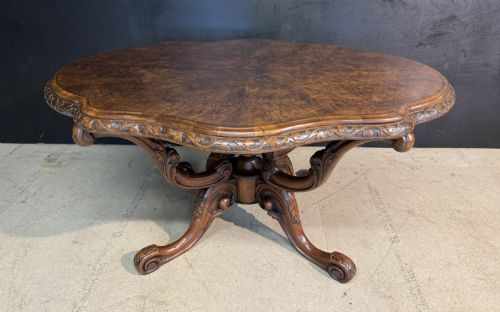
An antique quadruped centre table anchors a room with its four-legged pedestal base, offering a generous surface meant to stand free in the middle of a space.
Antique Quadruped Centre Table
When you search for an antique quadruped centre table, you look at pieces designed to stand centrally within a room rather than against a wall. The form typically rests upon a heavy pedestal supported by four distinct feet or legs, often taking the shape of breakfast tables, loo tables, or specific centre tables.
The versions you meet most frequently on this page date from the nineteenth century, spanning the Regency, William IV, and Victorian periods. Mahogany and walnut dominate these listings, appearing alongside rosewood and occasional satin birch.
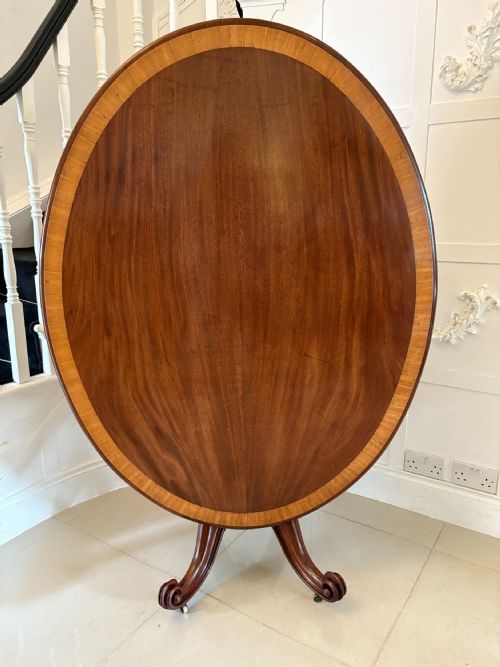
Makers and designers of these periods utilised circular, oval, and octagonal top shapes. Many incorporate tilt mechanisms or fixed pedestals, intended originally for dining, breakfast, or ornamental display.
Materials and Construction
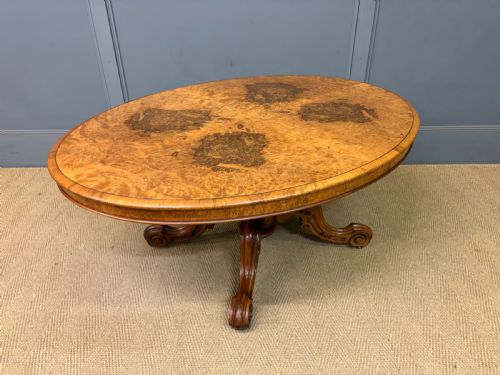
Cabinet makers constructed these tables using dense hardwoods such as mahogany and rosewood for structural strength, often applying figured walnut or burr walnut veneers to the visible top surfaces. Boxwood inlay, marquetry, and satinwood or amboyna banding provide decorative contrast on Victorian and Regency examples.
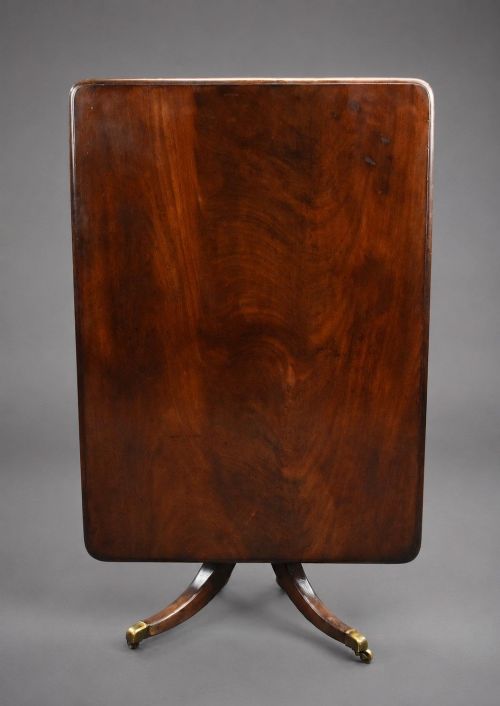
The distinctive four-legged base relies on robust joinery where the central pillar meets splayed legs, frequently fitted with brass castors to allow movement. Tilt-top variants employ a clever catch mechanism to pivot the heavy wooden top upright when not in use.
Tilt-top mechanisms allowed nineteenth-century homeowners to reclaim their floor space instantly by tipping the table flat against the parlour wall.
Distinctions in Quality
Quality rests primarily in the selection of timber and the execution of decorative details like hand-carved bases or precise marquetry inlay. Figured mahogany and burr walnut with rich grain patterns elevate a piece above plain timber constructions.
Structural stability at the central junction defines the better examples. A well-made quadruped base distributes weight evenly across all four feet without wobble, maintaining rigid alignment in the pillar and top.
Gillows·William Trotter
The Antique Quadruped Centre Table Glossary
- Quadruped
- A table base featuring four feet or legs branching from a central pedestal. This configuration provides greater stability for large circular or oval tops than a tripod design.
- Tilt top
- A hinged tabletop mechanism that pivots from horizontal to vertical. This allows the table to be stored flat against a wall when not in use.
- Loo table
- A large round or oval Victorian table designed for the card game loo. These typically feature heavy pedestal bases and tilt-top mechanisms.
- Marquetry
- Decorative patterns formed by fitting together thin slices of various woods and other materials onto a surface. It appears frequently on Victorian walnut tops.
- Crossbanding
- A border of veneer laid around the edge of a tabletop with the grain running perpendicular to the centre. This frames the primary timber.
Antique Quadruped Centre Table: Frequently Asked Questions
Where should I place a centre table?
These tables belong in the middle of a room where people can walk around all four sides. They function well in large hallways, libraries, or spacious sitting rooms as a focal point.
Because the base extends outward in four directions, ensure you leave adequate floor clearance around the perimeter. This prevents tripping and allows proper access to seating arranged nearby.
Can I use an antique breakfast table for dining?
Many nineteenth-century examples were built specifically for morning meals or light dining. Their sturdy pedestals and generous surfaces make them practical for everyday use.
Protect the polished wood surface using placemats and coasters to prevent heat rings and moisture damage. Lift objects rather than dragging them across the veneer.
How do I care for burr walnut veneer?
Dust the surface regularly with a soft, dry cloth to prevent grit accumulation. Avoid placing the table in direct sunlight or near heat sources to keep the wood from drying out.
Apply a quality beeswax polish occasionally to nourish the grain and maintain the natural lustre. Buff gently with a clean cloth after application.
What is the difference between a loo table and a breakfast table?
Loo tables typically date from the Victorian era and feature heavy, elaborately carved pedestal bases with tilt tops. They were made for social card games.
Breakfast tables often date slightly earlier to the Regency or Georgian periods and served similar domestic functions. Both share the stable four-legged base configuration.