






Antique Pharmacy Set
An antique pharmacy set holds the utilitarian history of medicine, bringing glass, wood, and brass into domestic rooms.
Antique Pharmacy Set
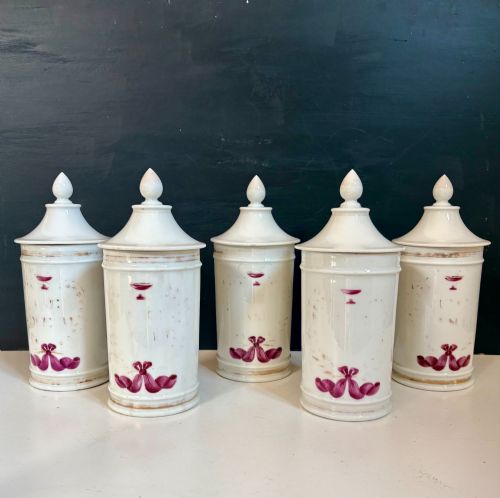
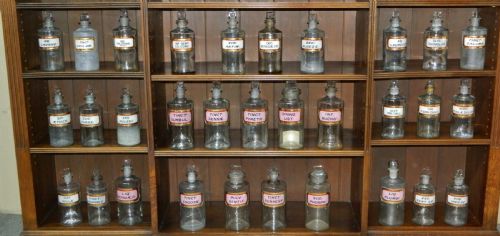
An antique pharmacy set comprises collections of apothecary jars, apothecary bottles, apothecary tools, scientific instruments, and scale weights. These groupings survive from periods spanning the Georgian era, the nineteenth century, nineteen hundred, nineteen twenty, and nineteen thirty.
The most common versions met on this page are matched sets of chemist jars and apothecary bottles formed in glass or box wood. These pieces reflect the functional storage and measurement tasks of historic dispensaries and laboratories.
Collectors encounter diverse scales of production, ranging from small groupings of three pill rounders to extensive collections of nearly thirty chemist jars. Scandinavian painted chemist jars and British precision beam scales demonstrate the geographical breadth of these survivals.
Materials and construction
Makers utilised moulded and blown glass for apothecary bottles and drug jars, often incorporating green glass formulations and paper labels with gold leaf accents. These transparent and coloured vessels protected medicinal contents from light while displaying them clearly.
Woodworking techniques shaped box wood into turned chemist jars and pill rounders, alongside fitted block stands designed to hold apothecary weights securely. Brass formed the material basis for scientific instruments and precision beam scales.
Antique Pharmacy Set Retail Price Guide 2026
Typical asking prices for pharmacy set among the pieces listed under this phrase on Sellingantiques today, from the lower quarter to the upper quarter. They describe what is for sale here now, not the wider market.
Judging the range
The distinction between standard utility items and finer pieces rests on the preservation of original elements such as paper labels, gold leaf detailing, and matched block stands. Complete sets that retain their intended groupings demonstrate higher integrity than pieced-together collections.
The refinement of the materials, from simple turned box wood to sophisticated precision brass mechanisms by notable makers like Oertling, defines the upper tier of these scientific and medical survivals.
Oertling
The Antique Pharmacy Set Glossary
- Apothecary jar
- A vessel designed to hold medicinal herbs, drugs, or preparations in a dispensary. These containers frequently feature glass or wood construction with identifying labels.
- Pill rounder
- A wooden tool used to shape medicinal compounds into uniform pills by hand. Box wood examples survive from the Georgian period.
- Precision beam scales
- A scientific instrument used for exact weight measurement in chemical and pharmaceutical work. These devices utilise a balanced beam and delicate brass weights.
- Block stand
- A fitted wooden base drilled to hold a graded set of apothecary weights in order. This keeps the components organised and protected during use.
Antique Pharmacy Set: Frequently Asked Questions
What is an antique pharmacy set?
An antique pharmacy set is a collected grouping of historic medical and laboratory equipment, such as glass apothecary bottles, chemist jars, and scientific scales.
These sets originate from dispensaries, chemists, and apothecaries, preserving the functional tools used to compound and store medicines in past centuries.
How were apothecary jars used?
Apothecary jars stored dry drugs, herbs, chemicals, and liquid medicines on dispensary shelves. Their tight closures protected contents from moisture and air.
Larger sets allowed chemists to maintain an organised inventory of standard remedies required for daily prescriptions.
How do I date these sets?
Dating relies on material characteristics, manufacturing techniques, and stylistic markers associated with periods like the Georgian era or Victorian nineteenth century. Box wood items and specific glass coloration provide key indicators.
Makers' names stamped on scientific scales or block stands also offer precise chronological reference points.
How should I display them?
These sets display well on wooden shelving, in glass-fronted cabinets, or on dedicated tabletops where light can catch green glass bottles and brass instruments. Grouping them by material highlights their uniform tones.
Keeping matched sets together preserves their historic context and visual impact in a modern room.