



Antique Pewter Set
An antique pewter set brings tactile domestic history to a room, offering grouped vessels and tableware shaped by centuries of metalworking tradition.
Antique Pewter Set
When you search for an antique pewter set, you are looking at matched or contemporaneous collections of metalware, ranging from Georgian plates and Victorian drinking measures to Art Nouveau tea services and desk accessories. These groupings often survive as sets of four or six pieces, having been preserved together in domestic or institutional settings since their manufacture.
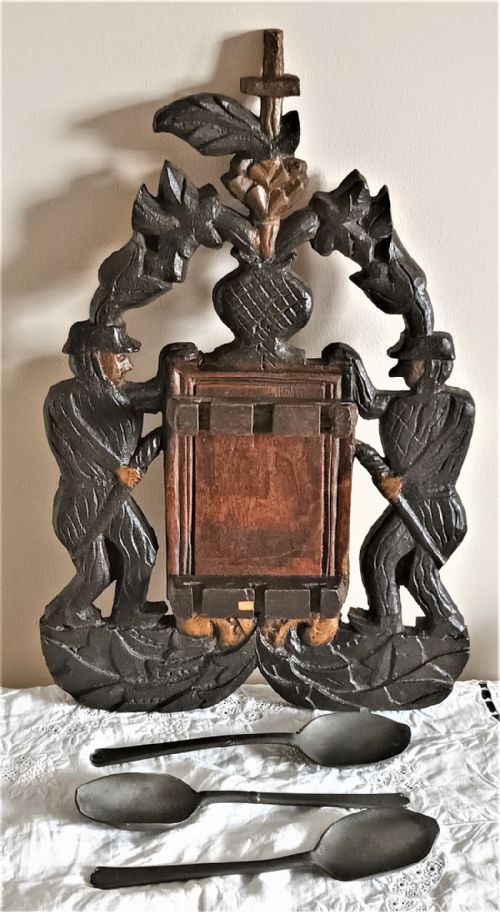
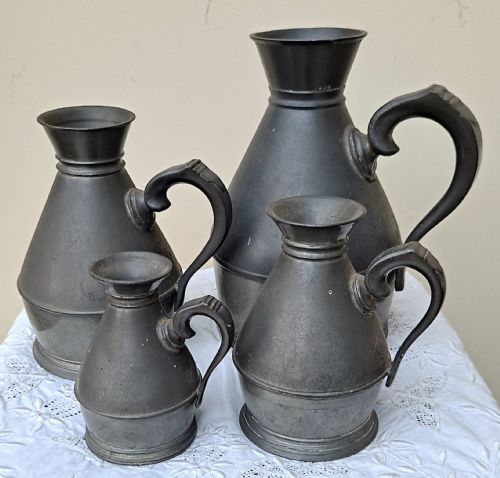
The versions most commonly met on this page include sets of dining plates by makers such as William Wright or T & H Compton, Irish Victorian haystack measures, and bell-shaped tankards. You will also encounter specialised groupings like spoon racks complete with trefid spoons, wall sconce candle holders, and stylised liquid containers from Continental foundries.
Originating across England, Ireland, the Netherlands, and Germany, these sets span the eighteenth, nineteenth, and early twentieth centuries. The materials shift from traditional lead-alloy pewter in earlier Georgian kitchenware to specialised silvered alloys and Britannia metal in later Arts and Crafts and Jugendstil productions.
Materials and construction
The primary material across these listings is pewter, a malleable metal alloy composed principally of tin combined with copper, antimony, or lead depending on the period. Earlier pieces rely on traditional casting and hammering techniques, which impart a dense weight and a soft, undulating surface texture to plates and measures.
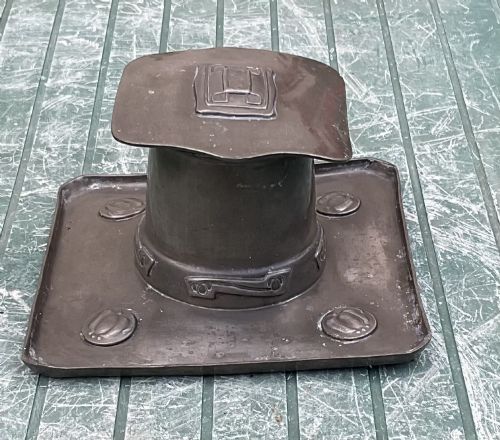
Later nineteenth and twentieth-century pieces incorporate Britannia metal or silvered pewter finishes, often produced by German and English firms utilising advanced stamping and electroplating methods. These techniques allowed makers like W.M.F. and Archibald Knox to achieve crisp, organic contours characteristic of the Art Nouveau movement while maintaining a metallic sheen.
Complementary materials appear in specific sets, such as oak spoon racks holding pewter spoons, brass accents, cut glass inserts, and woven cane details. Japanned surfaces also occur on neoclassical Dutch chestnut urns, combining painted lacquer finishes with the underlying metal body.
Antique Pewter Set Retail Price Guide 2026
Typical asking prices for pewter set among the pieces listed under this phrase on Sellingantiques today, from the lower quarter to the upper quarter. They describe what is for sale here now, not the wider market.
The material selection across these items includes traditional pewter, Britannia metal, and silvered alloys paired with ceramic or glass elements.
Evaluating quality and craftsmanship
The distinction between standard domestic items and finer examples rests upon the crispness of the casting and the integrity of the maker's marks. Clear touchmarks, town marks, and royal verification stamps like the VR cipher provide historical validation and indicate adherence to strict guild or manufacturing standards.
Proportional harmony and surface preservation dictate the visual standing of a set. Pieces that retain their original soft grey patina without excessive polishing or deep pitting demonstrate superior care and material stability over generations of use.
Design ambition separates utilitarian workshop output from creator-led commissions. Sets designed by known artists like Archibald Knox for Liberty show meticulous attention to line and form, whereas standard tavern measures prioritise utilitarian durability over artistic flourish.
Archibald Knox for Liberty·William Wright·T & H Compton·Zimmermann
The Antique Pewter Set Glossary
- Pewter
- A malleable metal alloy primarily composed of tin, historically mixed with lead or copper to create domestic vessels and tableware. It is known for its low melting point and dull silvery-grey appearance.
- Britannia metal
- A specific type of tin-based alloy introduced in the late eighteenth century, harder and brighter than traditional pewter. It was widely utilised for spinning into hollowware and tea sets.
- Haystack measure
- A distinctively shaped Irish drinking vessel featuring a bulbous body and a flared neck resembling a stacked mound of hay. These measures typically carry verification stamps from the nineteenth century.
- Trefid spoon
- An early form of spoon featuring a flat, three-lobed terminal handle popular during the late seventeenth and eighteenth centuries. They are frequently found paired with contemporary wall racks.
- Touchmark
- An identifying stamp or hallmark impressed into metalware by a pewterer or guild to certify the maker and the quality of the alloy. Finding a legible touchmark greatly assists in dating a piece.
- Japanned
- A European imitation of East Asian lacquerwork achieved by applying successive layers of dark varnish and curing them under heat. This technique appears on neoclassical Dutch urns in the listings.
Antique Pewter Set: Frequently Asked Questions
How were pewter measures used?
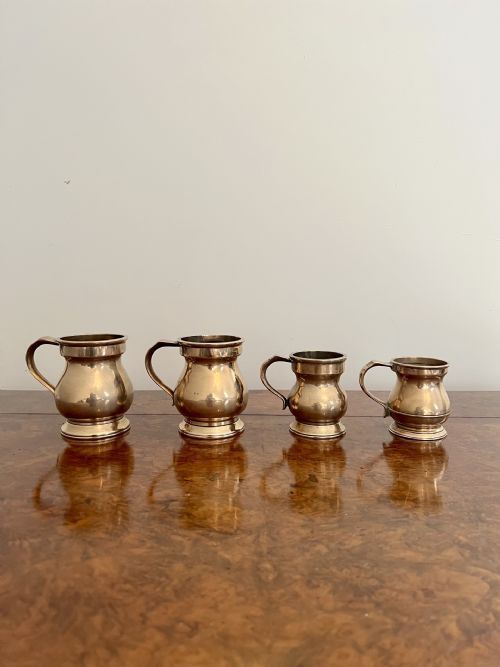
Pewter measures served as standard volumetric containers for serving ale, wine, and spirits in domestic households, inns, and taverns. Their precise capacities were often verified by royal or local inspection marks stamped directly into the metal.
Over time, these measures transitioned from daily tavern tools into decorative collectibles. Their robust construction allowed them to withstand heavy commercial use before entering private collections.
How do I care for antique pewter?
Antique pewter requires minimal intervention and should be cleaned gently using warm water and mild soap when necessary. Avoid aggressive metal polishes that strip away the historical patina and thin the soft alloy over time.
Store the pieces in a stable environment away from extreme humidity and direct heat sources. Handling them with clean hands prevents acidic skin oils from tarnishing the surface.
How can I date antique pewter?
Dating pewter relies on examining the object's form, manufacturing technique, and any maker's marks or royal ciphers present on the surface. Earlier pieces often display hammer marks and heavier lead-alloy compositions, while twentieth-century examples show machine stamping and distinct stylistic movements.
Reference marks against historical touchmark registries to narrow down the decade of production. Comparing the set's overall design characteristics to known periods like Georgian or Art Nouveau provides further chronological context.