


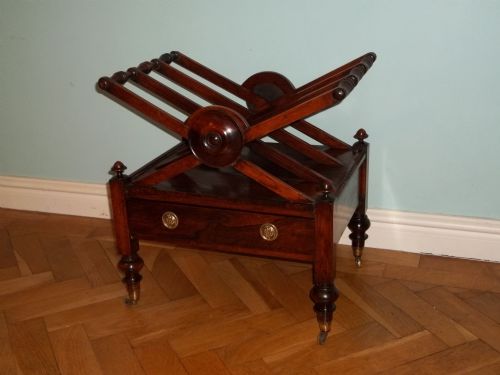


Antique Periodical Rack
These antique periodical racks and canterburys keep daily journals and weekly newspapers orderly.
Antique Periodical Rack
An antique periodical rack serves to hold newspapers, magazines, and journals within easy reach in a sitting room or study. These pieces appear in forms ranging from traditional canterburys with partitioned sections to revolving stands and simple wooden stands.
The versions most commonly met on this page span the Victorian and Edwardian eras, alongside pieces reflecting Regency and Arts and Crafts styles. Makers designed them for standing beside armchairs or desks to manage the growing volume of printed matter.
How they were made
Cabinet makers utilised dense hardwoods such as mahogany, oak, rosewood, and walnut for the frames, often incorporating satinwood and boxwood stringing for visual contrast. Woodworkers shaped partitions and uprights to support heavy bundles of paper without sagging.
Metal components played a structural and decorative role, featuring heavily in revolving stands and tubular brass frames. Workshops also applied brass fittings, wire mesh, and carved details like the Prince of Wales feathers to elevate the design.
Materials across these listings span mahogany, oak, rosewood, walnut, satinwood, and boxwood, alongside brass and wire mesh.
What varies in quality
Quality rests upon the selection of timber and the crispness of any carved or inlaid decoration. Superior examples display figured grain mahogany or rosewood, precise boxwood stringing, and solid brass mounts that hold their alignment.
Construction methods also separate standard items from finer pieces, particularly in the stability of revolving mechanisms and the joinery of individual partitions. Pieces following specific designs, such as those after Loudon or by established firms, command attention for their adherence to proportions.
Howard and Sons of London
The Antique Periodical Rack Glossary
- Canterbury
- A low stand with partitions, originally designed for holding sheet music or periodicals, often fitted with low legs and castors. This form remains one of the defining shapes for holding papers in nineteenth-century interiors.
- Stringing
- A narrow strip of contrasting wood inlaid into the surface of a piece to form decorative borders. Cabinet makers used boxwood and other light timbers against dark mahogany or walnut.
- Revolving
- A design incorporating a rotating mechanism that allows access to books or magazines from multiple angles. These stands typically combine a wooden structure with brass uprights or a central column.
- Turned
- Wood shaped on a lathe to create rounded spindles, legs, or columns. This technique appears frequently on the vertical supports of stands and canterburys.
Antique Periodical Rack: Frequently Asked Questions
What is a canterbury?
A canterbury is a low stand featuring divided sections intended for holding sheet music, books, or newspapers. They typically include a carrying handle and small castors for moving across the floor.
Cabinet makers produced them from woods such as mahogany, rosewood, and walnut throughout the nineteenth century.
How do I place a revolving stand?
A revolving magazine stand functions best beside an armchair or near a reading table where books and periodicals remain frequently accessed. The rotating action allows users to reach different compartments without moving the base.
These brass and mahogany stands suit studies and sitting rooms alike.
Are these racks sturdy enough for modern magazines?
These pieces were built to support heavy nineteenth-century newspapers and bound volumes, making them robust for contemporary publications. Solid hardwoods and fixed partitions handle daily use without issue.
Care should be taken to distribute weight evenly in revolving models.
How do I distinguish Victorian from Edwardian pieces?
Victorian examples often feature heavier timbers, deep mahogany tones, and substantial brass elements. Edwardian pieces frequently showcase lighter inlaid satinwood and boxwood stringing with more delicate proportions.
Stylistic cues and wood selection offer the clearest guide to the period of manufacture.