

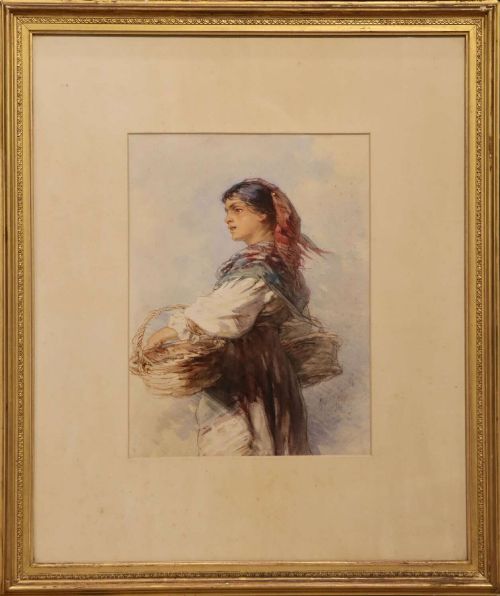


Antique Peasant Portrait Paintings
These antique peasant portrait paintings capture working people and rural life, offering direct and honest character studies for your walls.
Antique Peasant Portrait Paintings
When you search for antique peasant portrait paintings, you encounter works depicting rural workers, farmers, and village figures from past centuries. These pieces record ordinary lives with directness, focusing on individuals rather than idealized nobility.
The selections available here span from the early eighteenth century through to the early twentieth century. You will find watercolours and oil paintings on canvas, board, and paper, created within British, French, Dutch, and Italian traditions.
How they were made
Artists painted these subjects using oil paint and watercolour applied to prepared canvas, wooden panels, or heavy paper. Brushwork ranges from the fine detail seen in nineteenth-century watercolours to the looser application of later impressionist styles.
Frames often complement the works, utilising giltwood moulded to period tastes. Supports vary from traditional stretched canvas to sturdy wooden boards and delicate paper sheets.
Antique Peasant Portrait Paintings Retail Price Guide 2026
Typical asking prices for peasant portrait paintings among the pieces listed under this phrase on Sellingantiques today, from the lower quarter to the upper quarter. They describe what is for sale here now, not the wider market.
What varies in quality
Quality rests upon the artist's ability to render expression and convey personality within the subject. Stronger pieces demonstrate confident draughtsmanship and a sure handling of light across skin and clothing.
Condition also influences standing, as works preserved with stable paint layers and minimal restoration retain their original character more fully. The prominence of the artist and the depth of the regional setting elevate certain works above standard decorative pieces.
Guido Bach·Filipo Indoni·Ferruccio Vitale·Pierre Louis Joseph De Coninck·Richard Waitt·Jan Steen·William Lee Hankey
The Antique Peasant Portrait Paintings Glossary
- Watercolour
- A paint consisting of pigment suspended in a water-based solution, typically applied to paper. It creates luminous, translucent layers favoured for intimate portraiture and studies.
- Giltwood
- Wood carved and coated with a thin layer of gold leaf or metallic powder. This material frequently frames nineteenth-century paintings to enhance their visual weight.
- Realism
- An artistic movement focused on representing everyday subjects and situations in a contemporary setting accurately. It avoids supernatural or romanticized interpretations in favour of truthful observation.
- Genre portrait
- A painting depicting subjects from everyday life, often engaged in common activities. These works focus on ordinary people rather than historical or mythological figures.
Antique Peasant Portrait Paintings: Frequently Asked Questions
What periods do these paintings come from?
The works span multiple centuries, with particular concentration in the nineteenth century alongside examples from the eighteenth and early twentieth centuries.
Styles shift from early Dutch influences and British baroque through to nineteenth-century realism and impressionism.
How should I hang these portraits?
These works suit domestic spaces where their intimate character can be appreciated up close. Pair them with traditional wooden furniture or place them singly as a focal point.
Ensure placement avoids direct sunlight to protect pigments, particularly on watercolour works on paper.
Are these paintings on canvas or wood?
Support materials vary, including traditional stretched canvas, wooden panels, and heavy paper sheets. Each medium reflects the specific choice of the artist working within their period.
Watercolours typically appear on paper, while oils are found on canvas and board.
How do I identify the artist?
Signatures, inscriptions on the reverse, and stylistic markers often attribute a work to a specific hand or regional circle. Documentation provided with each listing records known attributions.
Comparing brushwork and subject matter to documented works by known painters aids identification.