






Antique Octagonal Loo Table
An antique octagonal loo table is a striking Victorian centrepiece that brings warmth and practical surface area to a grand room.
Antique Octagonal Loo Table
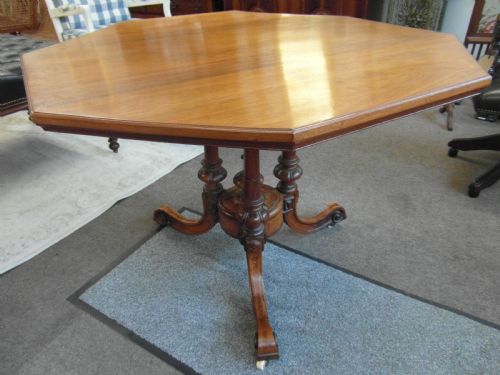
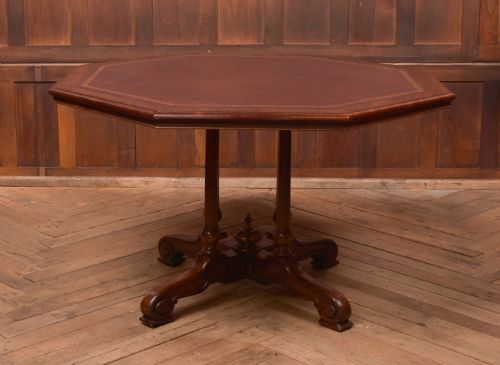
An antique octagonal loo table is typically encountered as a Victorian centre table or side table, often featuring an eight-sided top supported by a central pillar. These pieces belong predominantly to the nineteenth century, spanning William IV, early Victorian, and later Victorian periods.
The form functions primarily as a flexible centre table or occasional dining table within the home. Walnut, burr walnut, rosewood, and mahogany form the main body of these pieces, frequently enhanced by decorative wood inlay or marquetry.
How they were made
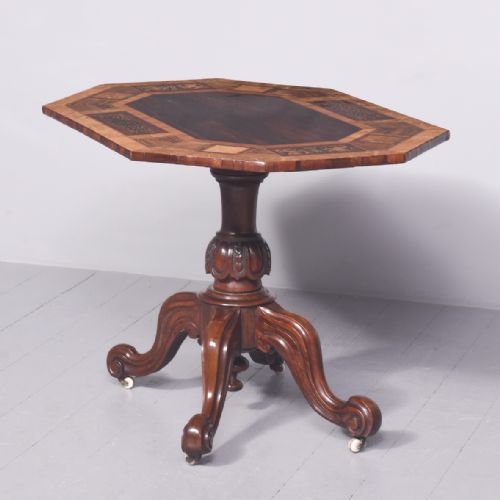
Cabinet makers utilised dense hardwoods such as mahogany and rosewood as foundational structural timber, often veneered with highly figured burr walnut for visual impact. Marquetry and wood inlay in satinwood or ebony were meticulously set into the surfaces to create intricate geometric and floral patterns.
Pillars and columns were turned from solid timber to support the heavy weight of the octagonal tops, sometimes incorporating tilt-top mechanisms for ease of storage. Joinery relied on traditional framing methods to ensure stability across the wide expanse of the table top.
Antique Octagonal Loo Table Retail Price Guide 2026
Typical asking prices for octagonal loo table among the pieces listed under this phrase on Sellingantiques today, from the lower quarter to the upper quarter. They describe what is for sale here now, not the wider market.
Materials recorded on this page include walnut, burr walnut, rosewood, mahogany, oak, ebony, and satinwood.
What varies in quality
The selection of timber grain largely dictates the visual hierarchy, with heavily figured burr walnut and rich rosewood commanding greater visual presence than plain mahogany. Marquetry execution also separates standard production from finer workshop output, depending on the precision of the inlaid contrasting woods.
Carved details upon the central pillar and base demonstrate the hand of a more skilled maker, moving beyond simple turned columns to elaborate ornamentation. The integration of functional elements, such as smooth-operating tilt-top mechanisms, reflects the underlying standard of mechanical construction.
Gillows
The Antique Octagonal Loo Table Glossary
- Burr walnut
- A figured wood veneer taken from the growth excrescences of the walnut tree, prized for its swirling patterns. It appears frequently on Victorian table tops.
- Marquetry
- The art of applying decorative pieces of veneer to a structure to form intricate pictorial or geometric designs. This technique often incorporates lighter woods like satinwood against darker backgrounds.
- Tilt-top
- A hinged mechanism allowing the table top to be pivoted into a vertical position when not in use. This clever design saved valuable floor space in nineteenth-century drawing rooms.
- Centre table
- A freestanding piece designed to be viewed from all sides, placed prominently in the middle of a room. These tables often served multiple social functions in period interiors.
Antique Octagonal Loo Table: Frequently Asked Questions
How do I identify a Victorian loo table?
Victorian loo tables are identified by their nineteenth-century timber choices, substantial central pillars, and characteristic octagonal or circular tops.
Many examples incorporate decorative elements such as burr walnut veneer, marquetry inlay, and tilt-top mechanisms.
What wood was used for these tables?
Cabinet makers predominantly used mahogany, rosewood, and walnut for the primary structure and surfaces of these tables.
Finer versions often feature burr walnut veneers, supplemented by inlay work utilising satinwood and ebony.
How do I live with an antique loo table?
An antique loo table serves well as a prominent centrepiece in a large room, providing a generous surface for lamps, books, or floral arrangements.
Care should be taken to protect the polished wood surfaces from direct sunlight and excessive moisture.