






Antique Ocean Beach Landscape
An antique ocean beach landscape brings the salt air and shifting light of the nineteenth and early twentieth centuries directly into a room.
Antique Ocean Beach Landscape
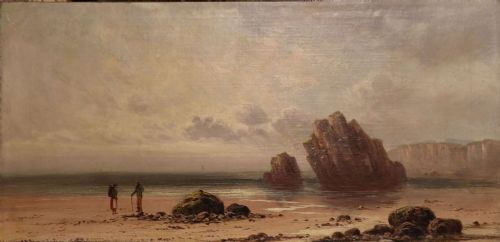
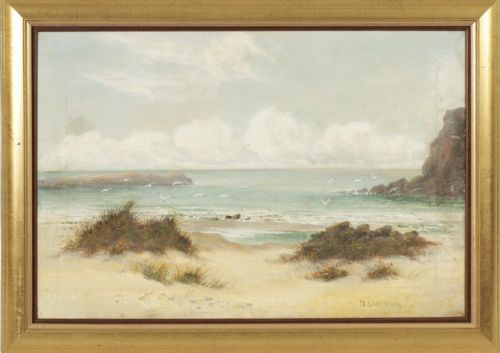
An antique ocean beach landscape captures coastal views, sandy shores, rocky coasts, and bustling harbours through the eyes of earlier artists. These works range from broad marine vistas and dramatic sea stacks to quiet watercolours of fishermen spreading nets on the sand.
Most examples found here date from the Victorian era up through the nineteen-thirties, embracing British Impressionism, nineteenth-century realism, and early twentieth-century interpretations. Painters recorded specific locales from Cornwall and Devon to Scottish borders and French shores.
Buyers encounter both intimate watercolours on paper and larger oil paintings on canvas, often housed within their original gilt wood or ebonised frames. Each piece preserves a distinct atmosphere of the shore, whether bright coastal sunlight or moody weather over the waves.
How they were made
Artists painted these coastal scenes primarily with oil paint on canvas or watercolour applied to paper, capturing the translucent qualities of sea water and the opaque textures of sandy beaches. Brushes worked wet-in-wet for skies and water, while finer lines defined rigging, figures, and rocky outcrops.
Antique Ocean Beach Landscape Retail Price Guide 2026
Typical asking prices for ocean beach landscape among the pieces listed under this phrase on Sellingantiques today, from the lower quarter to the upper quarter. They describe what is for sale here now, not the wider market.
Materials utilised by the artists span traditional paper, canvas, and wood panels, finished with oil paint, watercolour, and protective glass.
What varies in quality
Quality rests upon the artist's ability to handle the difficult interplay of light, atmosphere, and water, moving beyond mere topographical record to capture the true weight of the sea and sky. Stronger compositions command attention through confident brushwork and a convincing sense of space.
The condition of the medium matters greatly, with watercolours vulnerable to fading from sunlight and oils susceptible to craquelure or surface dirt. Original frames that retain their historic gilding or ebonising add substantial character compared to later replacements.
William Banks Fortescue·Kate E Booth·Sir David Murray RA·Owen Bowen·Samuel Edward Kelly·Edmund Gouldsmith·Thomas Bush Hardy
The Antique Ocean Beach Landscape Glossary
- Watercolour
- A painting method where fine pigment is mixed with water-soluble binders and applied to paper. It offers luminous, transparent washes that suit the hazy light of coastal air.
- Oil Paint
- A slow-drying paint made by mixing pigments with a drying oil, usually linseed. It allows for thick, textured applications known as impasto, ideal for rendering churning waves and heavy clouds.
- Gilt Wood
- Timber carved and coated with a thin layer of gold leaf or gold paint. These frames were standard for finer Victorian and Edwardian paintings.
- Ebonised Frame
- Wood treated with a chemical stain or black finish to imitate ebony. This dark framing style gained popularity in the nineteenth century for framing works on paper.
- Marine Painting
- Art that depicts or draws its main inspiration from the sea, ships, and coastal views. It encompasses everything from calm sandy beaches to stormy open waters.
Antique Ocean Beach Landscape: Frequently Asked Questions
How do I care for an antique watercolour beach painting?
Keep watercolours away from direct, strong sunlight to prevent the pigments from fading over time. Ensure they remain behind glass in stable indoor humidity.
Avoid hanging them in damp spaces like kitchens or overly humid rooms, as paper absorbs moisture and attracts mould.
Are these coastal paintings usually signed by the artist?
Many examples bear the artist's signature, often found tucked into a lower corner of the canvas or paper. Signatures help trace the exact period and region where the artist worked.
Unsigned works still appear frequently, attributed instead through stylistic clues, period framing, or contemporary exhibition labels on the reverse.
How do I tell a Victorian beach scene from a nineteen-thirties one?
Victorian marine paintings often feature dramatic skies, narrative elements like figures working the shore, and heavy gilt frames. The clothing of any depicted figures and the detailed realism offer strong chronological clues.
By the nineteen-thirties, brushstrokes loosen toward post-impressionism, focusing more on simplified forms, modernist light, and pared-down compositions of lighthouses and cliffs.
Where were most of these nineteenth-century coastal scenes painted?
Artists frequently travelled to notable fishing ports and dramatic coastlines across Britain, including St Ives in Cornwall, Devon bays, and the Scottish borders. French shores also provided rich subject matter for travelling painters.
These locations offered the changing tides, working boats, and atmospheric weather conditions that fascinated nineteenth-century landscape artists.