
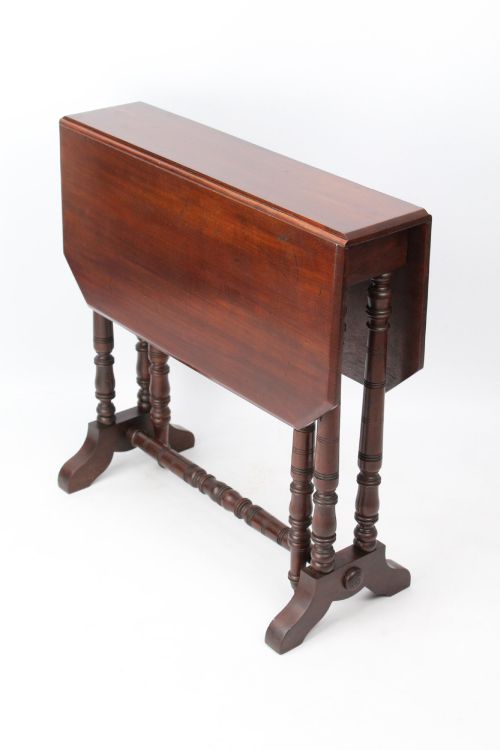


Antique Narrow Drop Leaf
These antique narrow drop leaf tables fold away cleanly against a wall while offering generous surfaces when raised.
Antique Narrow Drop Leaf
An antique narrow drop leaf table typically takes the form of a Sutherland table, a gateleg dining table, or a Pembroke table designed to save space in compact rooms. These pieces appear across the Victorian, Edwardian, and early twentieth-century periods, running from eighteen-sixty up to nineteen-thirty.
The most common version met on this page is the narrow mahogany Sutherland table featuring hinged flaps supported by swinging gate legs. Walnut, burr walnut, oak, and ebonised mahogany also appear frequently, alongside occasional tables and dining tables utilised for tea or smaller meals.
Materials and construction
Cabinet makers built these tables using solid hardwoods such as mahogany and oak, frequently applying finer timbers like satinwood inlay and crossbanding to decorate the top surfaces. Brass fittings often secure the hinges and castor wheels on the legs.
The defining structural mechanism relies on gate legs that swing outward to support the folding flaps when raised. Joinery methods connect slender legs, such as spider-legs, to a narrow central frame designed to fold flat.
Spider-leg tables feature legs so thin they look like they might skitter away across the parlour floor.
Quality variations
The distinction between standard examples and top-tier pieces rests on the choice of timber and decorative detail. Finer tables utilise burr walnut, highly figured mahogany, or precise satinwood inlay, whereas simpler versions rely on plain oak or standard mahogany.
Execution of the folding mechanism and the stability of the gate legs determine the mechanical success of the piece. Superior examples operate smoothly without excessive wobble in the flaps when fully extended.
The Antique Narrow Drop Leaf Glossary
- Sutherland table
- A narrow drop-leaf table with exceptionally slim folding flaps supported by swinging gate legs. It was designed in the Victorian era to occupy minimal floor space when closed.
- Gateleg table
- A table with hinged leaves supported by legs that swing outward like a gate. This construction provides robust support for the drop leaves.
- Crossbanding
- A decorative border of veneer laid so that the grain runs at right angles to the main surface. It frames the top of the table.
- Satinwood inlay
- Small pieces of contrasting yellowish satinwood inserted into the primary timber to form decorative patterns. It adds visual refinement to Edwardian pieces.
- Pembroke table
- A small rectangular table with two hinged drop leaves on opposing sides. It often includes one or more small drawers.
Antique Narrow Drop Leaf: Frequently Asked Questions
How do you open a Sutherland table?
Lift one of the folding flaps upward until it reaches a horizontal position. Swing the supporting gate leg outward from beneath the frame until it locks underneath the leaf.
Repeat the process for the opposite side if extra surface area is needed. Lower the leaves by swinging the gate legs back inward and gently dropping each flap.
Where were narrow drop leaf tables placed?
These tables typically stood against parlour or drawing room walls when folded down, acting as occasional or display surfaces. Their narrow profile prevented them from obstructing walkways in smaller Victorian and Edwardian homes.
When fully opened, they served as tea tables or dining tables for a small number of occupants. Owners moved them into the centre of the room only when the leaves were raised.
How can I date an Edwardian drop leaf table?
Edwardian examples usually date between nineteen hundred and nineteen ten, displaying lighter timbers and more restrained decoration than earlier Victorian pieces. Look for slender legs, satinwood crossbanding, and simpler structural lines.
Heavier proportions, darker mahogany finishes, and more elaborate carved details generally point toward the Victorian period of the nineteenth century.
Are oak drop leaf tables sturdy?
Solid oak versions constructed during the late nineteenth or early twentieth century offer robust structural stability. The dense nature of oak provides a strong frame that withstands regular daily use.
Care should be taken not to lean heavy weight onto the outer edges of the unsupported flaps. The hinges and gate legs distribute weight effectively when the leaves are properly positioned.