

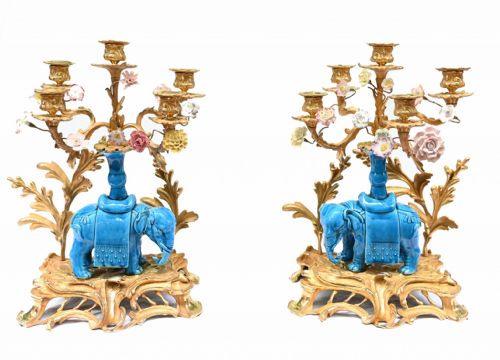


Antique Mantle Garnitures
These antique mantle garnitures bring symmetry to a room, pairing matching side pieces with a central clock or vase.
Antique Mantle Garnitures
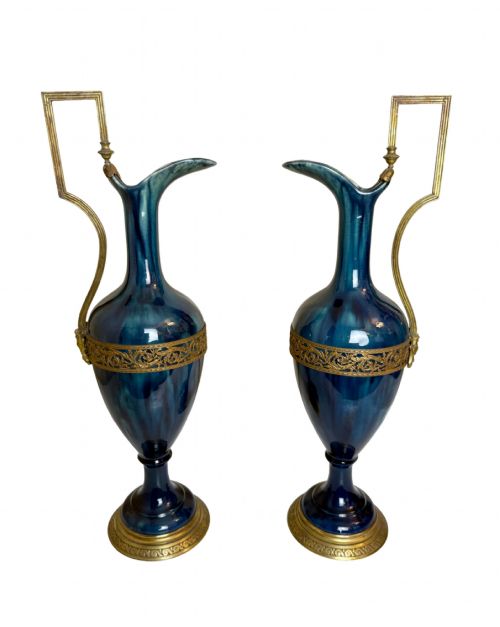
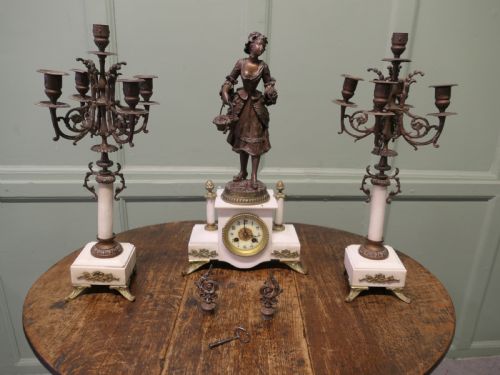
When you search for antique mantle garnitures, you encounter matched groupings designed to sit together on a fireplace shelf or sideboard. The selection spans the nineteenth century and the early twentieth century, showing periods like the Victorian era, the Edwardian period, and the Art Deco years. Most pieces originate from French workshops or English makers, taking the form of clock sets, candelabras, urns, and decorative vases.
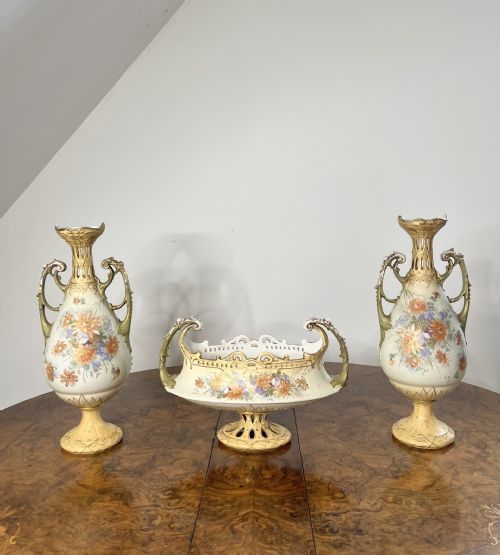
The configurations vary from three-piece sets featuring a central clock flanked by matching candelabras or vases, to larger groupings of four matching vessels. Forms draw on historic design idioms, including Louis XV and Louis XVI revivals, French Empire influences, and Rococo styling. Materials range from block marble and green onyx to porcelain, glass, and toleware.
Materials and construction
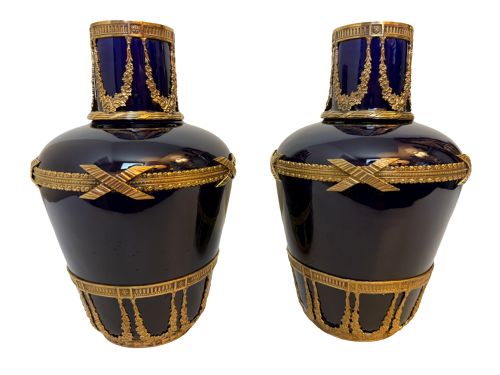
The construction of these sets relies on the combination of cast metals and mineral supports. Makers mounted ormolu, gilt bronze, and gilded brass onto bases of white marble, black marble, alabaster, or green onyx. Clock movements required precision engineering housed within heavy stone or ceramic casings.
Vessels and side pieces utilise ceramic bodies, including Continental porcelain and Paris porcelain, often detailed with hand-painted scenes or enamel work. Glass components, crystal drops, and cloisonne additions complete the decorative surface treatment of the paired items.
Judging the standard of manufacture
The distinction between standard examples and superior pieces rests on the crispness of the metal casting and the depth of the gilding. Higher-tier sets display finely chased details on the ormolu and bronze mounts, with figures and floral motifs rendered in high relief rather than flat moulding.
Material selection and artistic execution dictate the overall standard. Solid marble bases, heavy bronze housings, and finely hand-painted porcelain panels indicate superior workshop production, whereas lighter metals and simpler painted decoration mark more utilitarian production.
Royal Vienna·Finnigan Manchester·Ferdinand Barbedienne·Etienne Maurice Falconet
The Antique Mantle Garnitures Glossary
- Garniture
- A set of matched ornamental objects designed to be displayed together on a mantelpiece or sideboard. These groupings typically consist of a central clock or large vase flanked by two smaller matching vases or candelabras.
- Ormolu
- Gilded bronze produced by applying a mercury and gold amalgam to a cast bronze base and firing it to drive off the mercury. This technique creates a rich, durable golden finish characteristic of French decorative arts.
- Candelabra
- A branched candlestick designed to hold multiple tapers. In matching sets, these pieces mirror the decorative motifs of the central clock.
- Toleware
- Painted or lacquered metalware popular for decorative domestic objects. The technique involves applying enamel paint over tinplate.
- Cloisonne
- Enamelling work where metal strips are soldered to a metal base to form compartments filled with vitreous paste. This method creates intricate patterns of coloured design across the surface of vases and clock casings.
Antique Mantle Garnitures: Frequently Asked Questions
How were garniture sets used?
Garniture sets served as focal points for principal reception rooms, positioned prominently above fireplaces or upon large sideboards. The central clock governed time while the flanking pieces maintained visual balance across the mantel surface.
In some instances, the side pieces functioned practically to hold candles or flowers. More often, they remained purely decorative elements designed to display wealth and taste.
How do I identify French styles?
French styles display distinct decorative characteristics rooted in historic design periods. Louis XV and Rococo revival pieces feature asymmetrical scrollwork, naturalistic foliage, and playful figures such as cherubs.
Neoclassical and Louis XVI examples rely on symmetrical geometry, classical columns, and restrained bronze or ormolu mounts. Empire influenced items incorporate bolder military and classical motifs.
What materials are most common?
Marble and green onyx form the heavy structural bases for many nineteenth-century clock sets. These stone elements provide stability for the internal clock movements and support metal mounts.
Porcelain and glass appear frequently in the accompanying vases and urns. Surface enrichment relies on ormolu, gilt bronze, and hand-painted enamel decoration.
How do I care for these items?
Maintenance requires gentle handling of delicate gilded surfaces and painted porcelain panels. Dusting with a soft, dry cloth prevents the accumulation of grime without risking abrasion to the patination.
Harsh chemical cleaners must be avoided on ormolu and marble, as they strip the historic finish. Clock movements benefit from professional servicing to maintain proper mechanical function.