







Antique Mahogany Spider Table
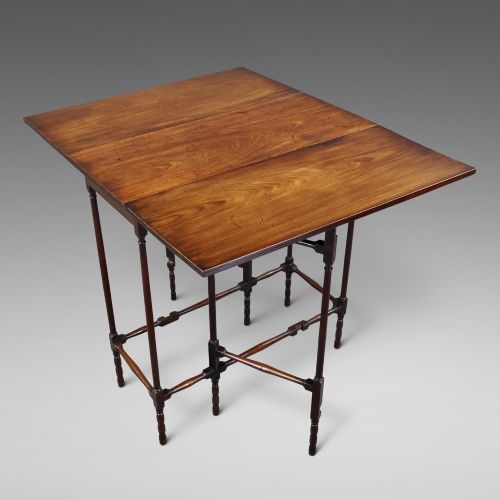
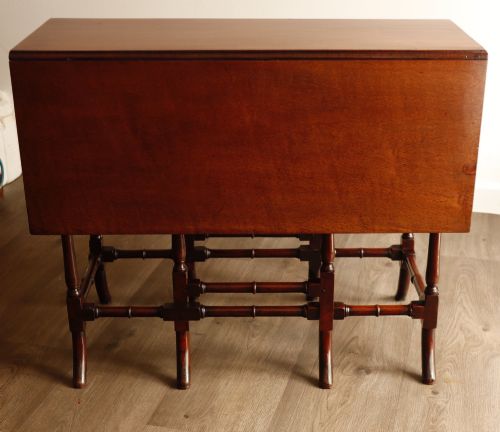
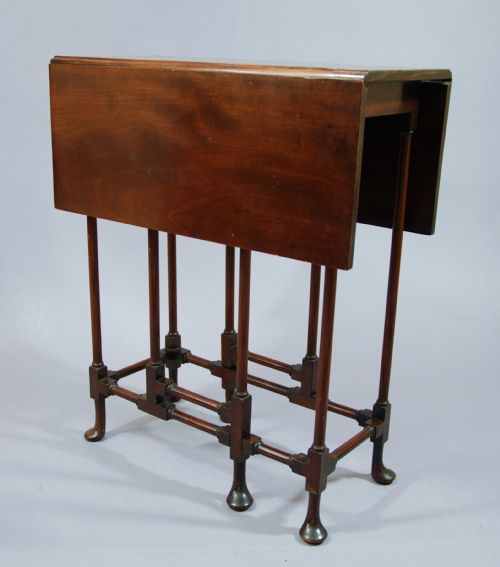
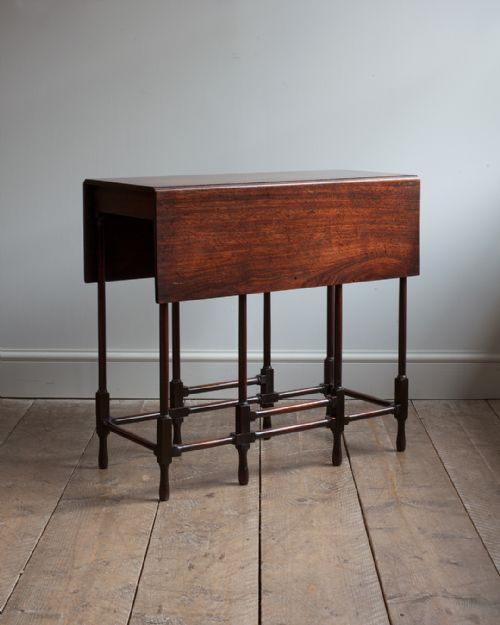
An antique mahogany spider table is a slender, delicate gateleg occasional table built to serve light domestic duties with grace.
Antique Mahogany Spider Table
An antique mahogany spider table is a lightweight occasional table defined by extremely slender turned legs and multiple stretchers, designed primarily for tea, writing, or needlework. Most examples encountered here belong to the Georgian and Edwardian eras, spanning the eighteenth through the early twentieth centuries.
The form frequently incorporates a drop leaf or gateleg mechanism, allowing the table sides to fold down when not in use. These pieces function well as side tables, coffee tables, or small tea tables within contemporary rooms, requiring minimal visual space due to their skeletal framework.
Originating in the eighteenth century, the design evolved through the George III and Chippendale periods before seeing revival forms in the Edwardian era and the early twentieth century. Buyers will encounter both authentic eighteenth-century iterations and later Edwardian interpretations sharing the characteristic slender underframe.
Materials and construction
Makers constructed these tables predominantly using solid mahogany for its tensile strength, which permitted the extraordinary thinness of the characteristic spider legs. Brass hinges, screws, and occasional iron fittings support the folding drop leaves and gateleg pivoting actions.
The underframe relies on complex turning on a lathe to produce the signature fine spindles, tied together by multiple delicate stretchers for structural rigidity. Joinery is typically traditional peg and mortise work, executed with high precision to prevent wobble in such slender frames.
Antique Mahogany Spider Table Retail Price Guide 2026
Typical asking prices for mahogany spider table among the pieces listed under this phrase on Sellingantiques today, from the lower quarter to the upper quarter. They describe what is for sale here now, not the wider market.
Named for limbs resembling arachnid legs, these tables owe their survival to being too delicate for heavy domestic punishment.
Judging quality and proportion
Quality in an antique mahogany spider table rests entirely on the fineness of the turning and the rigidity of the assembled frame. Superior examples maintain absolute stability despite the extreme thinness of the legs, whilst lesser pieces suffer from excessive play in the gateleg joints.
The choice of mahogany grain and the crispness of the moulded edges on the drop leaves distinguish workshop tiers. Finer pieces display carefully selected timber with deep natural warmth, whereas utilitarian versions utilise plain boards and simpler edge profiles.
The Antique Mahogany Spider Table Glossary
- Spider leg
- A term describing the exceptionally slender, ring-turned legs connected by delicate stretchers characteristic of these tables. This thinness requires dense timber such as mahogany to maintain structural integrity.
- Gateleg table
- A table featuring hinged flaps supported by legs that swing outward like a gate. This mechanism allows the surface area to double when required.
- Drop leaf
- A hinged table leaf that folds down when not in use to save space. It is supported by a pivoting leg or bracket.
- George III
- The period of British history spanning from 1760 to 1820, noted for refined furniture design and cabinetmaking excellence. Pieces from this era often display classic proportions and restrained ornamentation.
- Edwardian
- The period covering the reign of Edward VII from 1901 to 1910, though the style extends slightly either side. Furniture from this era often revived earlier eighteenth-century forms with skilled manufacturing.
Antique Mahogany Spider Table: Frequently Asked Questions
What were spider tables used for?
These tables served primarily for serving tea, holding books, or supporting light needlework tasks in drawing rooms. Their portability allowed servants to move them easily about the house as needed.
Today, they function perfectly as bedside surfaces, lamp stands, or compact side tables in smaller rooms where heavy furniture would overwhelm the space.
How do I spot an 18th-century table?
Eighteenth-century examples display hand-turned timber with subtle irregularities in the spindle profiles, alongside patinated mahogany surfaces developed through centuries of polishing.
Examine the underside for hand-cut joints and period fixings that indicate age rather than twentieth-century machine production.
Are spider tables strong enough to use?
Despite their delicate appearance, well-built mahogany examples offer surprising stability due to the interlocking stretcher system. They easily support lamps, books, and cups.
Avoid placing heavy objects or sitting on them, as the slender legs are engineered specifically for light domestic items.
How do I care for mahogany timber?
Keep the wood away from direct sunlight and strong heat sources to prevent the mahogany from drying out or splitting. Dust regularly with a dry cloth.
Apply a traditional beeswax polish occasionally to nourish the grain and maintain the natural lustre of the surface.