





Antique Lockable Decanter Set
An antique lockable decanter set keeps fine spirits safe under lock and key, combining secure housing with handsome entertaining display.
Antique Lockable Decanter Set
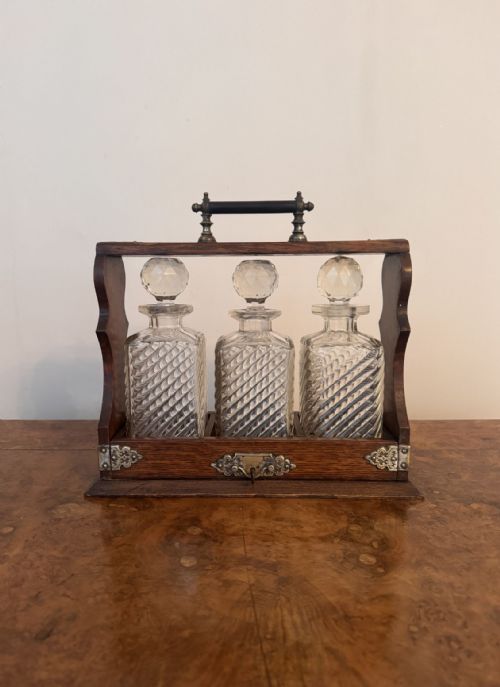
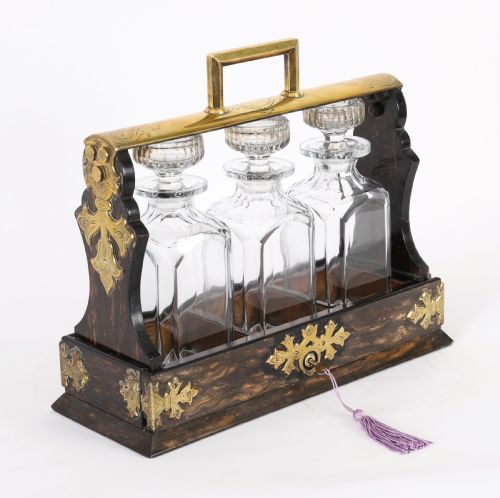
An antique lockable decanter set, most commonly found here in the form of a tantalus or games compendium, is a fitted wooden frame designed to secure liquor bottles against unauthorised access. These pieces primarily emerge from the Victorian and Edwardian eras, spanning from the 1870s through to the 1920s.
Beyond standard bottle storage, some advanced forms double as dry bars or integrate games boxes with compartments for cards and counters. These multifunctional pieces reflect the social habits of late nineteenth and early twentieth century home entertaining.
Materials and construction
Cabinetmakers utilised dense hardwoods such as oak, mahogany, satinwood, and walnut to build the robust carcasses required to support heavy glass decanters. Timber surfaces were often polished to highlight natural grain patterns, whilst some models received delicate inlay work.
Security mechanisms relied on heavy-duty brass mounts and internal locking arms that trapped the stoppers until a key released the folding top bar. This metalwork was frequently reinforced with silver plating to add a bright finish against the dark wood.
Antique Lockable Decanter Set Retail Price Guide 2026
Typical asking prices for lockable decanter set among the pieces listed under this phrase on Sellingantiques today, from the lower quarter to the upper quarter. They describe what is for sale here now, not the wider market.
Servants of the Victorian era quickly learned that a locked tantalus was the ultimate test of patience during long evening duties.
Factors of quality
The distinction between standard utility items and the top of the range lies in the complexity of the cabinetwork and the inclusion of dual functions like integrated games compendiums. Elaborate marquetry stringing, satin wood inlay, and heavier gauge silver plating elevate the status of a piece considerably.
The quality of the glassware is equally decisive, with deep hand-cut crystal decanters carrying significantly more weight and visual brilliance than plain glass alternatives. Complete sets retaining their original matching stoppers and fully functional locking mechanisms represent the pinnacle of survival.
Philip Ashberry
The Antique Lockable Decanter Set Glossary
- Games compendium
- A fitted box containing equipment for various indoor pastimes such as cards, chess, or board games. These are frequently integrated into the base or sides of late nineteenth century decanter sets.
- Marquetry stringing
- A decorative technique involving thin lines of contrasting wood inlaid into the primary timber surface. It creates geometric borders and highlights the cabinet outlines on better quality Victorian boxes.
- Silver plate
- A thin layer of silver applied over a base metal foundation, commonly used for the locking bars, carrying handles, and corner mounts of Edwardian and Victorian barware.
- Cut crystal
- Glassware featuring deep facets and patterns cut into the surface by hand. The heavy lead content in crystal gives these decanters greater clarity and a resonant ring when struck.
Antique Lockable Decanter Set: Frequently Asked Questions
How does a tantalus lock work?
The locking mechanism typically involves a hinged metal bar that folds down over the necks of the glass decanters, blocking the stoppers from being lifted out. When a key is turned in the integrated lock, the retaining bar releases and pivots upward to free the bottles.
This clever design allowed hosts to secure expensive spirits from domestic staff while keeping the bottles proudly on display in the dining room or drawing room.
What is the difference between a tantalus and a decanter set?
While all pieces on this page serve a similar purpose, a standard decanter set sits openly in a tray or box without physical security restrictions. A tantalus specifically incorporates a locking metal framework that physically restrains the decanters.
Many examples listed here blur the lines by combining the locking tantalus frame with pull-out drawers for games, making them comprehensive entertaining cabinets rather than mere holders.
How do I date an antique tantalus?
Dating relies heavily on timber selection, hardware styles, and overall manufacturing characteristics. Earlier pieces from the eighteen seventies frequently feature heavy brass mounts and solid coromandel or walnut, whilst Edwardian versions often employ plainer oak and simpler silver plated fittings.
The presence of integrated games compendiums and specific maker marks, where present, also helps narrow the production window to a particular decade.
Can I use the decanters for modern storage?
Original cut crystal decanters are safe for holding spirits, provided the interior is thoroughly cleaned and inspected for any historical clouding. Care should be taken with antique stoppers to ensure they fit snugly and do not get mixed up between bottles.
Examine the condition of the inner cork or ground glass seals before filling them with valuable whisky or port for everyday use.