
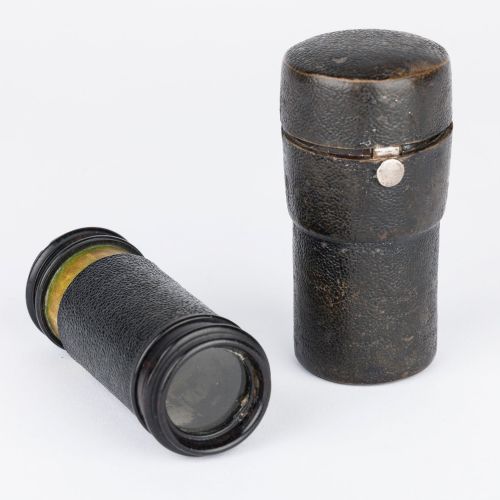


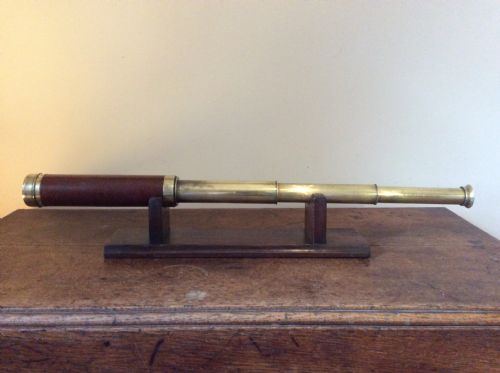
Antique Leather Spyglass
An antique leather spyglass brings portable magnification to your hand, combining brass mechanics with tactile hide casings for field or maritime use.
Antique Leather Spyglass
When you search for an antique leather spyglass, you encounter optical instruments designed for portability and distant viewing across land and sea. These pieces range from pocket-sized pocket spyglasses to larger marine and officer of the watch telescopes utilised by naval personnel and explorers.
The most common examples on this page date from the Victorian and Edwardian periods, typically featuring multi-draw brass tubes encased in stitched leather. You also find earlier Georgian and Regency iterations, alongside military campaign models built for rugged field deployment.
Forms vary from single-draw pocket tubes to complex six-draw terrestrial telescopes and cased scientific instruments. Makers frequently outfitted these pieces with protective leather grips to secure a firm hold in adverse weather.
How They Were Made
Manufacturers built these optical instruments using solid brass for the extending tubes and internal lens mounts, ensuring durable mechanical alignment. Skilled artisans then dressed the exterior barrel sections in hand-stitched leather, often incorporating card linings or wood cores to maintain structural rigidity.
Listings feature Victorian, Edwardian, and Georgian periods, utilising brass, leather, wood, and nickel.
What Varies in Quality
Quality in these optical instruments depends upon the precision of the brass draw-tubes and the clarity of the internal glass lenses. Finer examples exhibit smooth telescoping action without wobble between the draws, paired with sharp, clear image transmission.
The grade of the exterior leather dressing and the quality of the stitching also distinguish standard field pieces from high-end workshop productions. Maker signatures engraved onto the brass draw-tubes elevate the standing of an instrument significantly.
Ross of London·Voigtländer & Sohn AG·Newton & Co·Broadhurst Clarkson & Co·Cary London·L. Casella·Chadburn Brothers·Davis of London
The Antique Leather Spyglass Glossary
- Draw
- A sliding telescoping section of a spyglass tube. Multiple draws allow a long telescope to collapse into a compact pocket size.
- Terrestrial telescope
- An optical instrument configured to erect the image so it appears right side up for land viewing. These typically use an internal erecting lens system.
- Officer of the watch telescope
- A marine telescope utilised by naval officers for signaling and horizon scanning. These models prioritise rapid focus and weather resistance.
- Single draw
- A spyglass design utilising just two main tubes, where one section slides out from the main barrel. This configuration offers straightforward mechanics and sturdy alignment.
Antique Leather Spyglass: Frequently Asked Questions
How do I use a multi-draw spyglass?
Extend all the brass draws fully until the internal stops engage securely. Hold the instrument steady and rotate the eyepiece end slightly until the distant image comes into sharp focus.
Support the main barrel with your hand to prevent wobble while sighting objects. Collapse the draws gently in reverse order when you finish viewing.
What is the difference between a spyglass and a telescope?
The terms are often used interchangeably, though spyglass traditionally denotes a handheld, portable extending tube used for terrestrial viewing. Telescopes can include larger mounted observatory or library instruments on stands.
Portable spyglasses were standard equipment for sailors, officers, and travellers who required immediate magnification in the field.
How do I clean the leather on my spyglass?
Dust the leather gently with a soft, dry cloth to remove surface particles. Avoid applying modern chemical cleaners or excessive moisture to historic hides.
If the leather appears exceptionally dry, consult a specialist conservator regarding appropriate nourishment methods that preserve the original surface texture.