

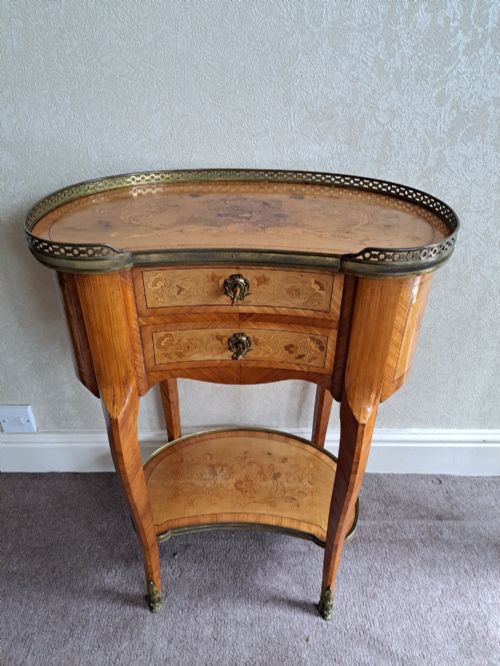


Antique Kidney Console Table
An antique kidney console table brings a graceful curved silhouette to a hallway or drawing room, offering practical surface space without bulk.
Antique Kidney Console Table
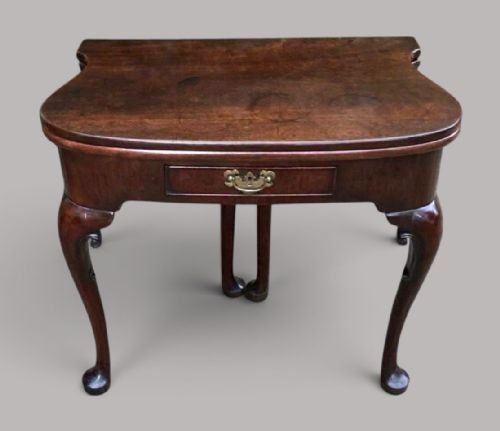
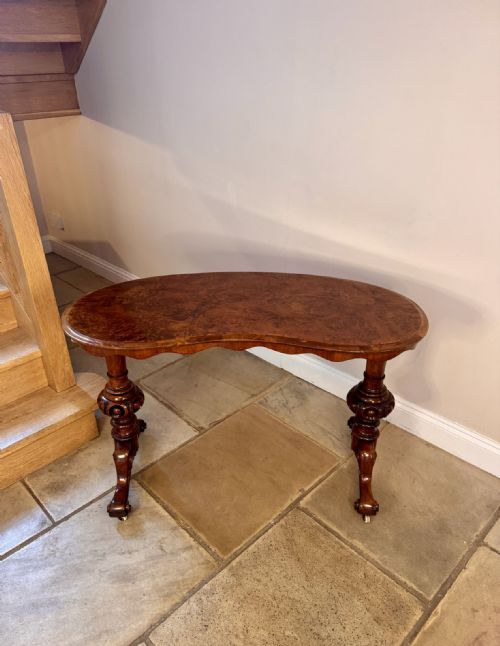
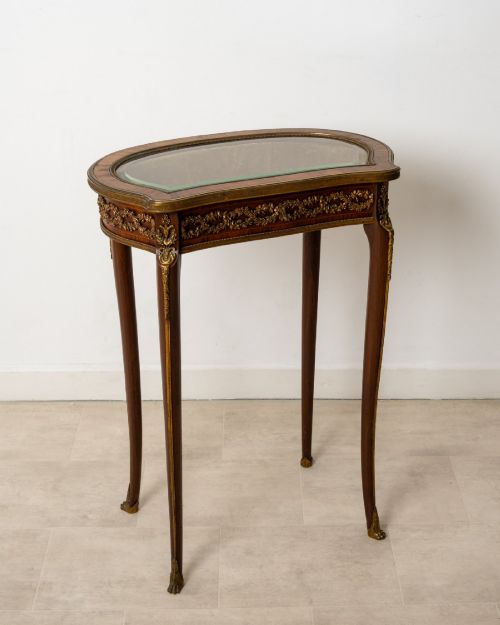
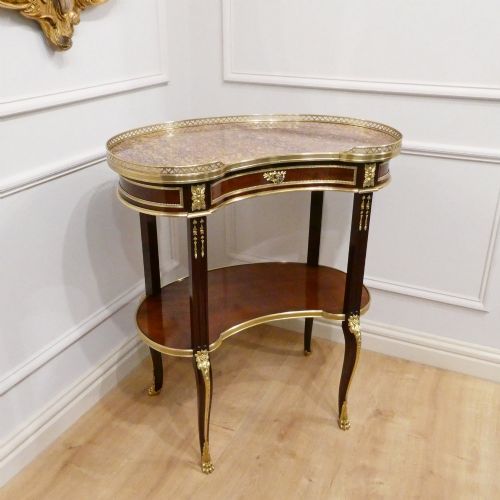
An antique kidney console table is defined by its characteristic curved top, designed to sit neatly against a wall or float as an occasional piece. The pieces seen on this page span the Victorian era and the nineteenth century, alongside French Louis XVI styles.
Makers utilised rich timbers such as mahogany, burr walnut, rosewood and pollard oak to construct these serpentine shapes. Many examples function as writing tables, side tables or occasional tables with inset leather or marble tops.
The form bridges decorative appeal and domestic utility, often embellished with brass mounts, gilt bronze or inlaid decoration. Buyers encounter both British Victorian interpretations and French revival models with distinct neoclassical influences.
How they were made
Cabinetmakers shaped dense hardwoods like mahogany and walnut to form the tight curves of the tabletop, frequently employing fine veneers such as burr walnut and rosewood. These timbers were selected for their striking grain patterns and finished with polished surfaces.
Decorative elements included inlaid marquetry, brass or gilt bronze mounts, and inset panels of leather or marble. Workshops utilised traditional joinery techniques to secure the curved rails to slender legs without compromising structural stability.
Antique Kidney Console Table Retail Price Guide 2026
Typical asking prices for kidney console table among the pieces listed under this phrase on Sellingantiques today, from the lower quarter to the upper quarter. They describe what is for sale here now, not the wider market.
Listings feature nineteenth-century pieces in mahogany, burr walnut and rosewood, alongside marble and leather top variants.
What varies in quality
The distinction between ordinary and superior pieces rests on the choice of timber and the precision of the curved joinery. Finer examples display carefully matched burr veneers and crisp inlay work that follows the demanding kidney contour smoothly.
Secondary materials also dictate quality, such as heavy marble slabs, finely chased gilt bronze mounts or original tooled leather writing surfaces. The integration of decorative plaques or painted decoration elevates the refinement of the piece.
Maison Millet·Williams and Gibton of Dublin
The Antique Kidney Console Table Glossary
- Kidney-shaped
- A tabletop with an indented front edge and a convex back, creating a serpentine profile. This distinctive silhouette allows a person to stand closer to the centre of the table.
- Console table
- A table designed to stand against a wall, traditionally supported by brackets or legs. In earlier periods, these pieces served primarily decorative functions in grand interiors.
- Burr walnut
- Timber taken from the abnormal growth of a walnut tree, producing swirling, knotty grain patterns. Cabinetmakers sliced this wood into thin veneers for decorative table surfaces.
- Marquetry
- The art of applying pieces of veneer to a structure to form decorative patterns and pictures. Craftsmen used contrasting woods to create intricate surface designs.
- Ormolu
- Gilt bronze mounts applied to furniture for decorative effect. This French technique involves coating bronze in gold amalgam to achieve a rich metallic finish.
Antique Kidney Console Table: Frequently Asked Questions
Where do you put an antique kidney console table?
These tables suit hallways, drawing rooms or studies where their curved profile softens straight architectural lines. They occupy less visual weight than rectangular furniture while providing a functional surface.
Because the back is often finished, certain models can stand away from the wall as centre or occasional pieces. Their compact footprint makes them adaptable for smaller spaces.
How do you date an antique kidney console table?
Dating relies on timber selection, secondary woods, construction methods and stylistic markers like Victorian revival or Louis XVI details. Nineteenth-century pieces frequently employ solid mahogany, rosewood or burr walnut veneers.
Cabinetry techniques and the presence of maker signatures or trade labels offer further chronological clues. Comparing the hardware and inlay styles to documented periods helps narrow the origin.
What is the difference between a console and a side table?
Console tables traditionally stood against walls, sometimes secured with wall brackets, while side tables functioned as movable pieces of furniture. Over time, the terms have overlapped considerably in antique descriptions.
Both forms appear with the kidney-shaped top across Victorian and French nineteenth-century examples. The distinction often depends on whether the back is finished for display away from a wall.
How do you clean an antique wooden table top?
Maintenance requires soft, dry cloths to remove dust without disturbing the polished finish of mahogany or walnut veneers. Moisture should be avoided to protect antique polishes and delicate inlays.
Periodic application of specialist wax preserves the moisture in the timber and enhances the grain. Harsh modern cleaning products will damage nineteenth-century French polish.